

Pioneer Applauds MassDOT for Allston Project All At-Grade Plan
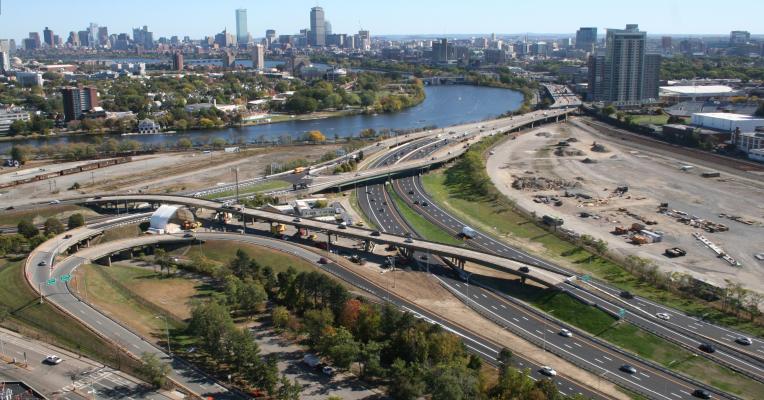
Pioneer Institute applauds the Massachusetts Department of Transportation (Mass DOT) for its decision to move forward with an all at-grade design for the “throat” area as part of the massive $1.7 billion Allston I-90 Interchange project announced yesterday by State Secretary of Transportation Jamey Tesler.
Pioneer had proposed that MassDOT should revise its Scoping Report on the I-90 Allston Multimodal Project and recommend an additional option – a modified at-grade option for the throat area – to the Federal Highway Administration.
The Institute believed then and continues to believe that an all at-grade design will shorten construction time, lower costs, create fewer negative economic and congestion impacts, and improve neighborhood access to park land along the Charles River.
We have reiterated this position numerous time including in an op-ed, a magazine article, public commentary to MassDOT, at project task force and other public meetings, in public testimony at MassDOT board meetings, and open letters to the Governor and The MassDOT Board.
Pioneer recognizes the integral efforts of A Better City, the Conservation Law Foundation, and members of the I-90 Allston Multimodal Project Task Force as well as Senate President Karen Spilka and State Representative Michael Moran in achieving this outcome.
Get Updates on Our Transportation Research
Related Posts
 Metropolitan Transportation Authority of the State of New York from United States of America, CC BY 2.0
  https://pioneerinstitute.org/wp-content/uploads/Screenshot-2024-06-27-135749.png
236
683
Raif Boit
https://pioneerinstitute.org/wp-content/uploads/logo_440x96.png
Raif Boit2024-06-27 14:31:592024-06-27 14:31:59The MBTA’s Aging Infrastructure: Improvements have Failed to Materialize for the T
https://pioneerinstitute.org/wp-content/uploads/Screenshot-2024-06-27-135749.png
236
683
Raif Boit
https://pioneerinstitute.org/wp-content/uploads/logo_440x96.png
Raif Boit2024-06-27 14:31:592024-06-27 14:31:59The MBTA’s Aging Infrastructure: Improvements have Failed to Materialize for the T https://pioneerinstitute.org/wp-content/uploads/PVTA_New_Flyer_bus.jpg
768
1024
Peter Mentekidis
https://pioneerinstitute.org/wp-content/uploads/logo_440x96.png
Peter Mentekidis2023-07-05 16:00:542023-07-05 15:20:50Cheap, Efficient, Effective: The Lessons from the PVTA and WRTA
https://pioneerinstitute.org/wp-content/uploads/PVTA_New_Flyer_bus.jpg
768
1024
Peter Mentekidis
https://pioneerinstitute.org/wp-content/uploads/logo_440x96.png
Peter Mentekidis2023-07-05 16:00:542023-07-05 15:20:50Cheap, Efficient, Effective: The Lessons from the PVTA and WRTA https://pioneerinstitute.org/wp-content/uploads/MBTA-bus-image.jpg
643
1050
Sarah Delano
https://pioneerinstitute.org/wp-content/uploads/logo_440x96.png
Sarah Delano2023-06-29 09:54:062023-06-29 09:54:06Fare-Free Public Transit in Boston: A Holistic View
https://pioneerinstitute.org/wp-content/uploads/MBTA-bus-image.jpg
643
1050
Sarah Delano
https://pioneerinstitute.org/wp-content/uploads/logo_440x96.png
Sarah Delano2023-06-29 09:54:062023-06-29 09:54:06Fare-Free Public Transit in Boston: A Holistic View https://pioneerinstitute.org/wp-content/uploads/MBTA-pension-op-ed.png
1400
1400
Charles Chieppo
https://pioneerinstitute.org/wp-content/uploads/logo_440x96.png
Charles Chieppo2023-06-21 14:02:042023-06-21 14:02:04MBTA retirement fund is headed for a financial reckoning
https://pioneerinstitute.org/wp-content/uploads/MBTA-pension-op-ed.png
1400
1400
Charles Chieppo
https://pioneerinstitute.org/wp-content/uploads/logo_440x96.png
Charles Chieppo2023-06-21 14:02:042023-06-21 14:02:04MBTA retirement fund is headed for a financial reckoning https://pioneerinstitute.org/wp-content/uploads/Bike-lanes-op-ed-image.png
1400
1400
Barbara Anthony
https://pioneerinstitute.org/wp-content/uploads/logo_440x96.png
Barbara Anthony2023-06-12 11:19:362023-07-10 10:40:12Installing bike and bus lanes requires public debate
https://pioneerinstitute.org/wp-content/uploads/Bike-lanes-op-ed-image.png
1400
1400
Barbara Anthony
https://pioneerinstitute.org/wp-content/uploads/logo_440x96.png
Barbara Anthony2023-06-12 11:19:362023-07-10 10:40:12Installing bike and bus lanes requires public debate

