
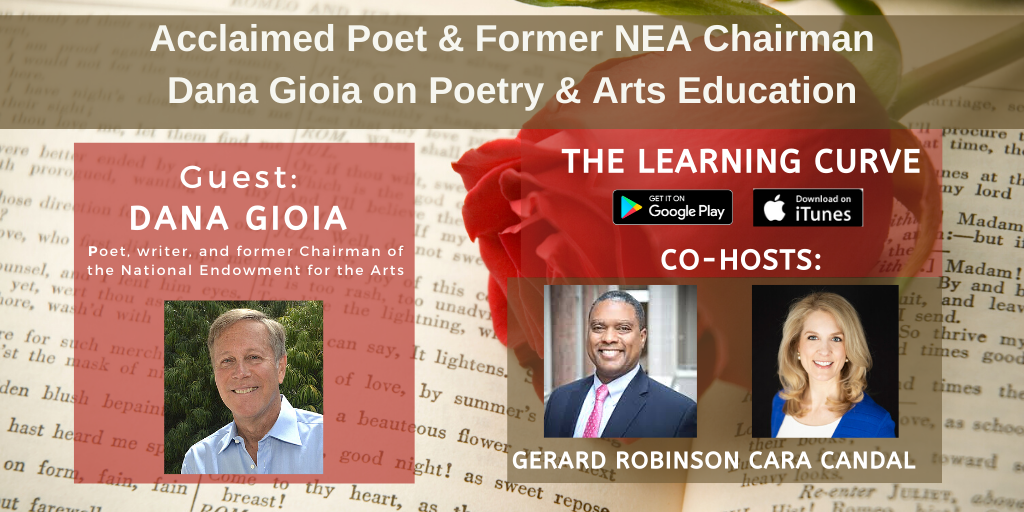

Acclaimed Poet & Former NEA Chairman Dana Gioia on Poetry & Arts Education
This week on “The Learning Curve,” Cara and Gerard are joined by Dana Gioia, a poet, writer, and the former Chairman of the National Endowment for the Arts. Dana discusses why the arts are so pivotal to the intellectual and civic development of America’s K-12 schoolchildren, allowing them to grow spiritually, emotionally, creatively, imaginatively, and even physically. He also explores how some of the specific skills students learn through music, drawing, poetry, and theater go well beyond traditional subjects. Dana explains why he believes the lack of arts education in our schools is a national problem, and addresses some misconceptions about why schools are not offering it. He delves into why poetry has such a profound connection to the human experience, and the many ways in which it builds self-confidence, emotional maturity, and can lead to intellectual transformation. Dana shares stories about learning from his Mexican-American mother to love the arts, teaching students to appreciate poetry at the University of Southern California, and the success of a national contest that he launched at the NEA, Poetry Out Loud. Throughout the interview, he treats listeners to recitations from Shakespeare and Poe, and concludes with a special reading of one of his own sonnets.
Stories of the Week: A new poll finds that 1 in 5 teachers say they are unlikely to return to their classrooms if schools reopen this fall, and in a separate poll of parents, 60 percent will likely pursue homeschooling options. A USA Today series highlights the benefits of high-quality dual-language programs to close achievement gaps among America’s five million English language learners, especially in states with a growing non-native population.
Newsmaker Interview Guest:
 Dana Gioia is an internationally acclaimed poet and writer. Former California Poet Laureate and Chairman of the National Endowment for the Arts (NEA), he was born in Los Angeles of a working-class, Italian- and Mexican-American family. Under Gioia’s direction, NEA’s work included Reading at Risk, To Read or Not To Read: A Question of National Consequence, Poetry Out Loud, The Big Read, and Shakespeare in American Communities, which brought wide public attention to the importance of reading, drama, and the arts. He has published five full-length collections of verse, most recently 99 Poems: New & Selected (2016), winning the Poets’ Prize as the best new book of the year, while his work has also appeared in The New Yorker, The Atlantic, The Nation, Poetry, The New York Times Book Review, and The Hudson Review. Gioia has been awarded 10 honorary doctorates, and in 2010 he received the University of Notre Dame’s Laetare Medal, the oldest and most prestigious honor given to American Catholics. He received a B.A. and M.B.A. from Stanford and an M.A. from Harvard in Comparative Literature.
The next episode will air on June 5th, 2020 with guest Jeff Riley, the Massachusetts Commissioner of the Department of Elementary and Secondary Education.
Newslinks:
Back to school? 1 in 5 teachers are unlikely to return to reopened classrooms this fall, poll says
More US schools teach in English and Spanish, but not enough to help Latino kids
Get Updates on Our Education Research
Recent Episodes
 https://pioneerinstitute.org/wp-content/uploads/TLC-Kotkin-04242024.png
490
490
Editorial Staff
https://pioneerinstitute.org/wp-content/uploads/logo_440x96.png
Editorial Staff2024-04-24 12:33:362024-04-24 12:35:04Hoover at Stanford’s Stephen Kotkin on Stalin’s Tyranny, WWII, & the Cold War
https://pioneerinstitute.org/wp-content/uploads/TLC-Kotkin-04242024.png
490
490
Editorial Staff
https://pioneerinstitute.org/wp-content/uploads/logo_440x96.png
Editorial Staff2024-04-24 12:33:362024-04-24 12:35:04Hoover at Stanford’s Stephen Kotkin on Stalin’s Tyranny, WWII, & the Cold War https://pioneerinstitute.org/wp-content/uploads/TLC-Berner-04172024-3.png
490
490
Editorial Staff
https://pioneerinstitute.org/wp-content/uploads/logo_440x96.png
Editorial Staff2024-04-17 14:53:562024-04-17 14:53:56Johns Hopkins’ Ashley Berner on Educational Pluralism & Democracy
https://pioneerinstitute.org/wp-content/uploads/TLC-Berner-04172024-3.png
490
490
Editorial Staff
https://pioneerinstitute.org/wp-content/uploads/logo_440x96.png
Editorial Staff2024-04-17 14:53:562024-04-17 14:53:56Johns Hopkins’ Ashley Berner on Educational Pluralism & Democracy https://pioneerinstitute.org/wp-content/uploads/TLC-Pinsky-04102024-2.png
490
490
Editorial Staff
https://pioneerinstitute.org/wp-content/uploads/logo_440x96.png
Editorial Staff2024-04-10 12:16:312024-04-10 12:16:3139th U.S. Poet Laureate Robert Pinsky for National Poetry Month
https://pioneerinstitute.org/wp-content/uploads/TLC-Pinsky-04102024-2.png
490
490
Editorial Staff
https://pioneerinstitute.org/wp-content/uploads/logo_440x96.png
Editorial Staff2024-04-10 12:16:312024-04-10 12:16:3139th U.S. Poet Laureate Robert Pinsky for National Poetry Month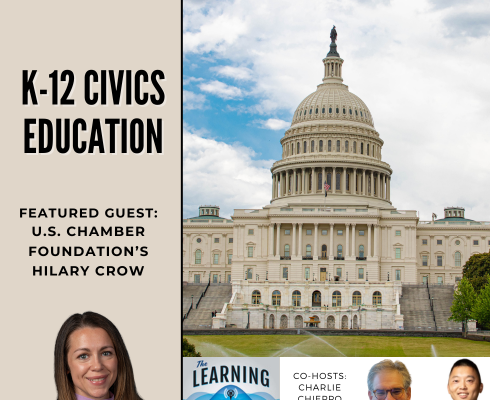 https://pioneerinstitute.org/wp-content/uploads/TLC-Crow-04032024-1.png
490
490
Editorial Staff
https://pioneerinstitute.org/wp-content/uploads/logo_440x96.png
Editorial Staff2024-04-03 12:08:182024-04-03 12:08:18U.S. Chamber Foundation’s Hilary Crow on K-12 Civics Education
https://pioneerinstitute.org/wp-content/uploads/TLC-Crow-04032024-1.png
490
490
Editorial Staff
https://pioneerinstitute.org/wp-content/uploads/logo_440x96.png
Editorial Staff2024-04-03 12:08:182024-04-03 12:08:18U.S. Chamber Foundation’s Hilary Crow on K-12 Civics Education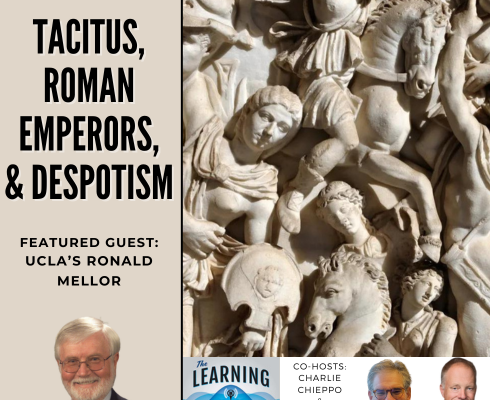 https://pioneerinstitute.org/wp-content/uploads/TLC-Mellor-03272024.png
490
490
Editorial Staff
https://pioneerinstitute.org/wp-content/uploads/logo_440x96.png
Editorial Staff2024-03-27 12:12:142024-03-27 12:12:14UCLA’s Ronald Mellor on Tacitus, Roman Emperors, & Despotism
https://pioneerinstitute.org/wp-content/uploads/TLC-Mellor-03272024.png
490
490
Editorial Staff
https://pioneerinstitute.org/wp-content/uploads/logo_440x96.png
Editorial Staff2024-03-27 12:12:142024-03-27 12:12:14UCLA’s Ronald Mellor on Tacitus, Roman Emperors, & Despotism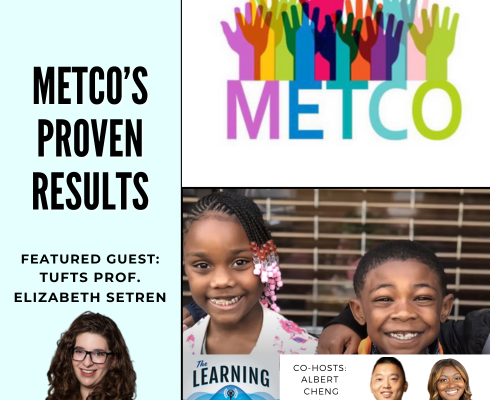 https://pioneerinstitute.org/wp-content/uploads/TLC-Setren03202024.png
490
490
Editorial Staff
https://pioneerinstitute.org/wp-content/uploads/logo_440x96.png
Editorial Staff2024-03-20 12:12:552024-03-20 12:12:55Tufts Prof. Elizabeth Setren on METCO’s Proven Results
https://pioneerinstitute.org/wp-content/uploads/TLC-Setren03202024.png
490
490
Editorial Staff
https://pioneerinstitute.org/wp-content/uploads/logo_440x96.png
Editorial Staff2024-03-20 12:12:552024-03-20 12:12:55Tufts Prof. Elizabeth Setren on METCO’s Proven Results