October 21, 2026
What the Ballot Question Results Tell Us About Taxes, Affordability and Politics

The results are largely in on Tuesday’s ballot questions and, as elections will do, they brought wins, a wince—and important lessons about where Massachusetts politics is heading. Question 1 passed overwhelmingly, Question 5 fell just short, Question 3 went down to defeat despite an $8 million campaign, and Question 7 remains undecided but is trending toward the loss column.
Question 1: An Overwhelming Vote for Transparency
Question 1 passed 86–14, strengthening public records transparency. Pioneer has spent years making the case for greater accountability, particularly in the Legislature and Governor’s Office. Pioneer endorsed the measure and helped advance it. This is a change we have advocated for over a decade and produced a 2018 legal analysis challenging the Legislature’s exemptions, 2024 polling showing overwhelming public support for reform, a recent comparison of public records laws in Massachusetts, Florida and Colorado, among many other pieces.
State Auditor Diana DiZoglio led the campaign with energy and focus, and she deserves the lion’s share of the credit for putting this in the win column.
Now comes the hard part. The Legislature has resisted the legislative audit voters overwhelmingly approved in 2024. Will Beacon Hill respect this latest vote? We’ll be watching—and working to make sure it does.
Question 5: A Narrow Loss and a Striking Political Divide
Question 5, endorsed by Pioneer and inspired and supported by the Mass Opportunity Alliance, fell short, 48–52. It was a big disappointment. Our polling had shown us ahead by anywhere from a few points to eight points. We knew the race was tightening and that a significant share of voters remained undecided, but we believed we had a solid path to victory.
The proposal simply said: Government can grow, but no faster than your earnings. We sought to strengthen the state’s existing tax revenue limit and return excess revenues to taxpayers through refunds. The question did not propose cuts or even a freeze on government services.
As results came in Tuesday night, we tracked the vote town by town, using the 2022 millionaire’s tax vote as a benchmark. An interesting pattern emerged. Question 5 ran ahead of the 2022 anti-tax vote in many lower-income communities but behind it in affluent towns, including some traditionally Republican communities.
We won Worcester and New Bedford. We also carried Springfield, Chicopee and Lawrence. Lawrence is an especially interesting case. In 2022, voters there supported the millionaire’s tax 64–36. Four years later, they voted 56–44 for Question 5, which would, according to one analysis, have returned an average of $700 to taxpayers in years when a refund was triggered. And Lawrence wasn’t alone.
The opposition? It was concentrated in wealthy, hyper-progressive communities like Arlington, Boston, Brookline, Cambridge, and Somerville that voted overwhelmingly against the measure. Those five communities accounted for just 11.8% of the votes in the data we examined. Yet they produced 84,232 more NO votes than YES votes—equivalent to 82% of the statewide margin against Question 5.
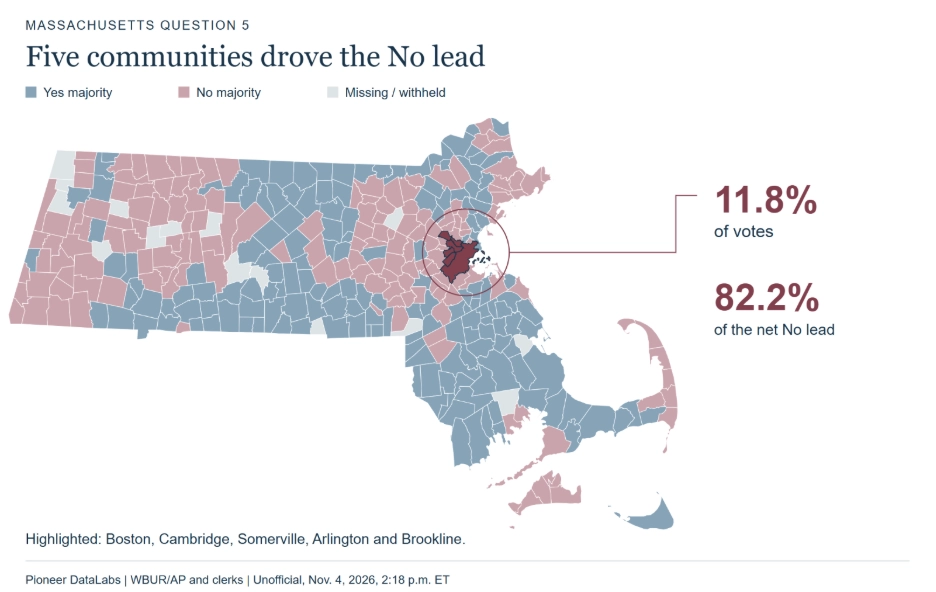
Those five wealthy, liberal bastions accounted for nearly the entire statewide margin of defeat. The divide in attitudes toward affordability between those communities and working-class urban centers around the state, which supported Question 5’s restraint on outsized growth in government revenue, is striking.
We will be examining the results carefully, but our initial cut at the numbers tells us there is a potentially enduring shift here worth paying attention to.
Money Matters. But It’s Not Everything.
Money matters in ballot campaigns. But it can’t sell every proposal. Question 5 came within four points of winning on a shoestring budget. Question 3’s proponents spent $8 million and lost decisively—in fact, it lost in every city and town in the Commonwealth… except for Petersham.
The pro side of Question 5, led by the Taxpayers for an Affordable Massachusetts committee, spent just $551,000 in cash, with the ballot question being aided by another $1.96 million in in-kind support for signature gathering. The doors of hundreds of donors were knocked on and the committee held well-attended fundraisers. But the level of funding required for a substantial statewide effort to educate the public on the issue did not materialize.
Still, we came within four points of winning.
Pioneer opposed Question 3, and not because we don’t see the problem. Too many races go uncontested, and too many incumbents never face a serious challenge. But Question 3 was like using a hammer to set a screw.
California and Washington have tried versions of this system. There’s little evidence it produced more competition or more moderate lawmakers. It can leave voters choosing between two candidates from the same party, make elections more confusing, and weaken political parties without fixing what ails Massachusetts politics.
I laid out the evidence in my Pioneer blog and made the broader case in The Boston Globe.
There are better ways to address the problem. Move the primary earlier so challengers have time to make their case. Enact term limits. Modernize campaign contribution limits.
Question 5’s support appears to have grown through grassroots activity, earned media, social media and the straightforward appeal of returning money to taxpayers. Question 3 had far greater resources but failed to convince voters.
Money matters, especially when trying to reach undecided voters in the final weeks. But the contrast between these two campaigns is hard to miss: A big budget can’t rescue a proposal that doesn’t catch on, and a small one doesn’t necessarily keep a good proposal from coming close to winning.
The Other Ballot Questions
After all the hue and cry about an “unprecedented” year for ballot questions (for some reasons politicians on all sides love the word “unprecedented”), this turned out to be a status quo election. Of the nine ballot questions, five passed. Two preserved the status quo on gun restrictions and marijuana legalization.
Question 7, which sought to “legalize starter homes,” was led by Pioneer’s Chief Housing Economist Andrew Mikula independently of Pioneer. The vote remains extremely close, though the electoral map and trendline suggest it will fall short. We’ll be watching the final count. Whatever the outcome, the obstacles to building homes ordinary families can afford aren’t going away.
What Comes Next
The election offered lessons for Pioneer’s work beyond research and public education. We’ve added litigation, coalition building, and ballot initiatives to our efforts to turn research into policy change. These approaches bring risks, but they also give us new ways to reach people and make a difference.
We need to dig deeper into the results, particularly the divide between affluent communities and working-class Massachusetts. But one thing is clear: The affordability concerns that brought so many voters to Question 5 aren’t going away.
Neither are we.