



November 5, 2026
Q3: Would All-Party Primaries Fix Massachusetts Politics?
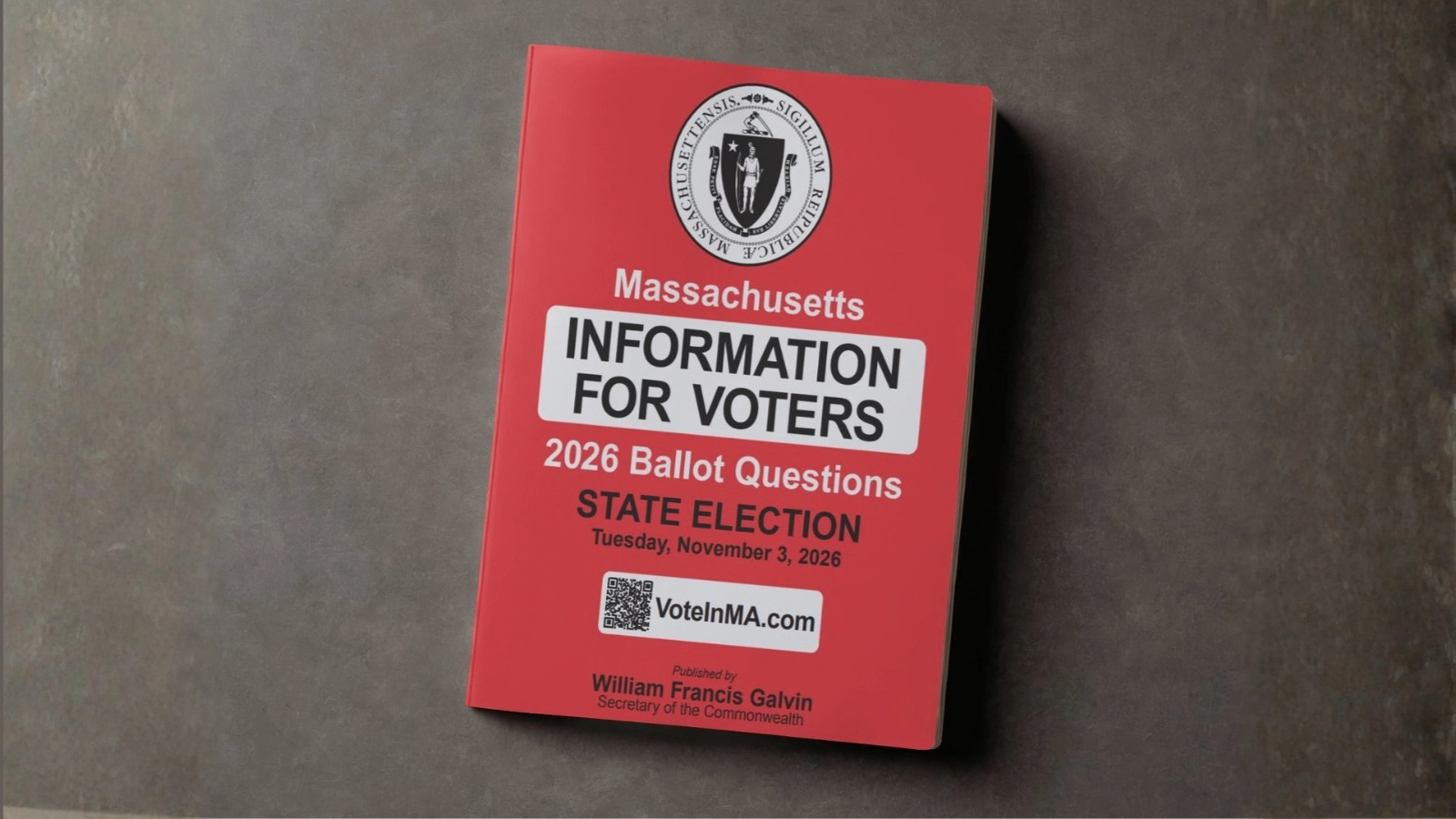
Here’s the official 2026 Massachusetts Voter Guide. You’re welcome! Now let’s dig into Question 3.
Massachusetts currently holds “closed” primaries so Democrats and Republicans can choose their own nominees. Unenrolled voters must choose which party primary to participate in. The winner of each party primary advances to the general election. Q3 would replace that system with a single, “open” primary in which every voter chooses among all candidates; the top two advance to November, even if they belong to the same party. If approved, the change would take effect in 2028.
So, should Massachusetts voters scrap partisan primaries for state elections? Harvard professor Danielle Allen wrote the Voter Guide argument for Q3, centering her case on the need for more political competition. “Today, two-thirds of the legislature is running unopposed,” she writes. All-party primaries, she argues, would make elections “more competitive, forcing politicians to listen.” And: “More competition means more accountability.”
Full agreement here that Massachusetts has a competition problem. Whether partisan primaries are causing it is, well, not so clear.
Are partisan primaries causing a lack of competition in politics?
Allen’s premise: a broader primary electorate gives candidates more reason to appeal beyond their party base—which, in Massachusetts often includes lots of unenrolled voters.
Do top-two primaries lead to more moderate lawmakers?
California and Washington provide more than a decade of evidence. The results are mixed.
In 2017, Eric McGhee and Boris Shor examined state legislators’ voting records before and after California and Washington adopted top-two primaries. They found “virtually no effect” on moderation in Washington or among California Republicans. California Democrats moved toward the center, but redistricting explained part of the change. Term limits and other reforms adopted around the same time made it difficult to isolate the effect of top two.
Later research reached a different conclusion in Washington. A 2024 study (Henrickson, Johnson) found that the adoption of top two in 2008 correlated with more moderate voting.
A 2016 study (Ahler, Citrin and Lenz) looked at voter behavior. Prior to California’s first top-two primary in 2012, the authors gave voters experimental ballots to see whether the new system helped them identify and support candidates closer to their own views. Voters had difficulty identifying moderates—and moderate congressional and state Senate candidates gained no discernible advantage. In fact, the top-two ballot led to voters’ selecting candidates farther from their own ideological positions.
Other research finds a moderating effect. USC’s Christian Grose studied U.S. House voting records from 2003 through 2018. Accounting for the politics of each district, he found that representatives elected under top-two primaries scored 0.07 to 0.10 points closer to the ideological center than those elected through closed primaries. The effect was twice as large as with open primaries, but far smaller than the gap between the parties.
Some studies find modest moderation; others little or none.
More competition—or different competition?
One concern is that primary voters tend to be more politically engaged than November voters. In heavily Democratic districts, two Democrats could advance from the primary, leaving Republican voters without a candidate in November.
California shows that same-party November elections are not rare under top two. Over the past decade, about one-third of its legislative races have featured two candidates from the same party. Most were in districts dominated by that party.
More rarely, vote-splitting can knock a party out of November altogether. In 2012, Democrats held a 40.8-to-35.3 percent registration advantage in California’s 31st Congressional District. But four Democrats split their vote, allowing two Republicans to advance. The reverse happened in California’s Republican-leaning 4th state Senate district in 2022: six Republicans split nearly 60 percent of the vote, allowing two Democrats with just 22.1 and 18.7 percent to advance. The more candidates a party fields, the greater the risk of splitting its vote.
So, would Q3 make Massachusetts elections more competitive? I agree with Tufts’ review, which says the evidence is unclear. Q3 would not redraw safe districts or ensure that challengers run. It would change who votes in the primary—and which two candidates survive into November.
Top two changes where competition occurs and who participates. Does it foster more competition?
What happens to the parties?
Massachusetts currently holds separate Democratic and Republican primaries. Party members vote in their own primary; unenrolled voters can choose either ballot. Q3 would end those party primaries, though parties could still make endorsements. It would also eliminate the requirement that statewide candidates win 15 percent of the vote at their party convention to make the primary ballot.
Adopting Q3 could also have an effect on parties other than the Democrats and Republicans. After California adopted top two, the share of districts without a minor party or independent candidate on the November ballot rose from 53 to 72 percent.
Q3 would preserve a route to achieving official party status in Massachusetts: a candidate would need to win at least 3 percent for any statewide office in the primary. But party status would not guarantee a candidate a place in November; only the top two advance.
That is the tradeoff. Every voter gets a say among every candidate in the primary, but parties no longer choose their nominees, and only two candidates reach November.
Bottom line: Massachusetts has a competition problem. Q3 would change who competes, who votes, and who makes it to the November ballot. Whether it would result in more competition is an unknown.
Related Publications