

Home Policy Priorities Education

Educational Excellence

Advancing academic excellence and rigorous standards for all students.

About Educational Excellence 

Parents need choices, but they especially need good choices grounded in rigorous academic content. On the Nation’s Report Card, only 40% of U.S. public school students are proficient. In Massachusetts—a high-performing state—only 43% are proficient; states like New York and Illinois lag further, in the low 30s. Despite very high levels of spending on U.S. K–12 schools, our students rank 32nd globally, according to the U.S. Department of Education. 

Before the 1993 Education Reform Act, Massachusetts students performed at the national average. By 2006, strong standards and expanded parental choice made the Commonwealth the nation’s top performer—and the only state competitive with leading countries worldwide. Since 2012, all states have lost ground due to Common Core, the pandemic, and accelerating digital distractions. Today, Massachusetts students still lead the nation, but only narrowly. 

Our mission is to raise excellence in every school—public and private—through stronger standards, innovative teaching, effective virtual tools, and improved teacher preparation and recruitment. 

August 21, 2025

School Choice is Expanding like Never Before—Now Comes the Real Test

School choice is sometimes sold as a cure-all for underperforming public schools, other times it is deemed ineffective and a siphon of public resources. Both can be true, but this debate misses the point: school choice is not a guarantor of student success, nor was it ever intended to be. Its purpose is to provide choices, and most agree that choice is good. Not all choices will be good, to be sure. Indeed, there are poor-performing charter and private schools, just as there are ineffective district schools. When systems with school choice features fail, we ought to blame and reform the choices—they are clearly of poor quality—not ban the freedom to choose. It is grossly undemocratic to suggest otherwise.
August 20, 2025

How Massachusetts Let School Accountability Slip—and Student Achievement with It

The Commonwealth’s enormous investments in its schools—over 100 billion dollars since MERA was enacted—have continued to this day, but basic accountability has not. It is time to honor the original bargain. Massachusetts must once again couple its record-high investments with the same uncompromising scrutiny that made our schools the envy of the nation. That means prying accountability out of the foxes’ paws and restoring it to a truly independent watchdog—an EQA reborn.
July 29, 2025

Lessons from Military-Run Schools: America’s Secret Weapon in Education

Military-run schools lead every U.S. state in NAEP scores and even outperform educational juggernauts abroad—despite half of their students living at the poverty line. “Lessons from Military-Run Schools: America’s Secret Weapon in Education” argues that, rather than embracing new fads and experimental programs, American public schools ought to be studying the DoDEA playbook. 
July 16, 2025

On Literacy, Time to Learn From Louisiana & Mississippi

Twenty years ago, saying that Louisiana and Mississippi had something to teach Massachusetts about education would have given rise to laughter. Well, it’s no longer a laughing matter. After years during which Massachusetts was celebrated as a national leader in education, we…

Support Pioneer

Philanthropic support fuels our ability to deliver bold ideas, rigorous research, and real-world impact—advancing solutions that shape policy and strengthen communities.

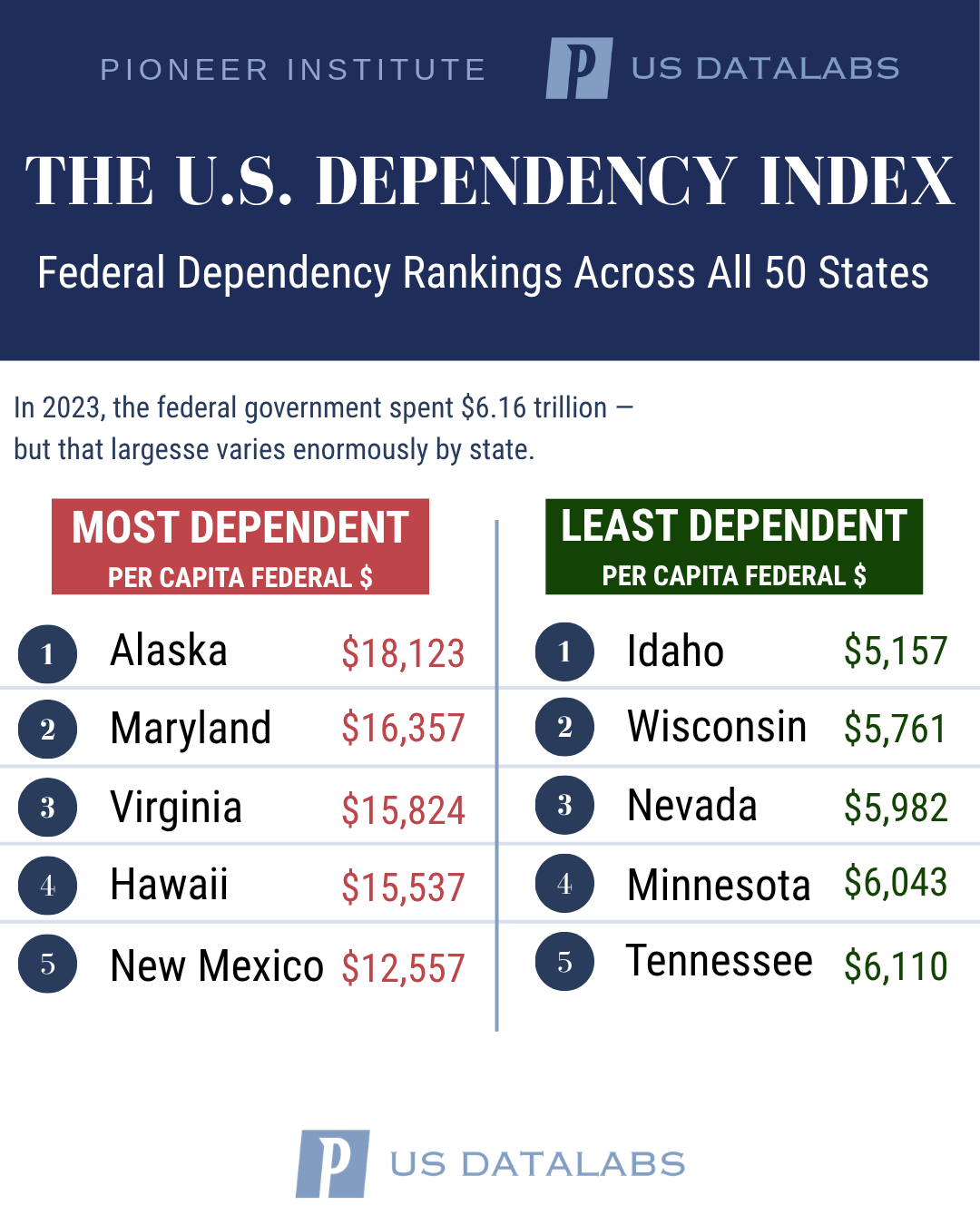
Dependency Index – Federal Money to the States

Think you know which states depend most on Washington? Pioneer’s new Dependency Index may change your mind. Alaska ranks most dependent on federal funds, and Idaho ranks least. Check out where your state ranks here! https://loom.ly/6LMwO0c