Tag Archive for: #EducationInnovation

MBTAAnalysis: A look inside the MBTA

/
The MBTA shuttles over a million passengers a day around Greater…

The Clock is Ticking…….

/
The clock is ticking towards December 30, 2017.  As part of…

U-Ark’s Robert Maranto & BASIS Ed Texas’ Sean Woytek on Academically Intensive Charter Schools

In this week’s episode of The Learning Curve, co-hosts U-Arkansas Prof. Albert Cheng and Walter Blanks of the American Federation for Children interview Prof. Robert Maranto and Sean Woytek co-authors of the Education Next piece, “Why Academically Intensive Charter Schools Deserve Our Attention.” They explore how rigorous charter school networks like BASIS Ed have achieved exceptional outcomes and what their success can teach policymakers and educators nationwide about improving academic performance nationwide.

Florida’s John Kirtley on School Choice

In this week’s episode of The Learning Curve, co-hosts U-Arkansas Prof. Albert Cheng and American Federation for Children Senior Fellow Shaka Mitchell interview John Kirtley, Managing Partner and co-founder of Keswick Partners, and founder and Chairman of Step Up for Students, a nonprofit that manages Florida’s state-funded K-12 scholarship programs serving over half a million students. Kirtley shares his journey from the private sector into education reform in the late 1990s, and why business leaders must actively engage in shaping K-12 policy.

Alisha Searcy on Center for Strong Public Schools

This week on The Learning Curve, co-hosts U-Arkansas Prof. Albert Cheng and Dr. Helen Baxendale of Great Hearts Academies interview longtime public education champion and Learning Curve co-host Alisha Searcy. Alisha joins the show as a guest to share her story and insights into K-12 public education reform. Herself a product of public-school choice, she discusses how those early experiences shaped her belief in accessible, high?quality schooling for all students.

DFI’s Jim Blew on Federal Education Tax Credit Program

In this week’s episode of The Learning Curve, co-hosts Alisha Searcy and Dr. Cara Candal of ExcelinEd interview former assistant secretary at the U.S. Department of Education and co-founder of the Defense of Freedom Institute (DFI), Jim Blew. Mr. Blew reflects on his tenure in federal education leadership and his motivation for establishing DFI. He discusses the decades of rising federal K-12 spending through initiatives like RTTT, ESSA, and ESSER funds, instead calling for devolving federal authority out of the U.S. Department of Education, and more private school choice and charter public school innovation.

Blackstone Valley’s Dr. Michael Fitzpatrick on MA’s Nation-Leading Voc-Techs

In this week’s episode of The Learning Curve, co-hosts U-Arkansas Prof. Albert Cheng and Walter Blanks interview Dr. Michael Fitzpatrick, who has served as superintendent-director of the Blackstone Valley Vocational Regional School District since 1994. A leader in vocational-technical education, Dr. Fitzpatrick reflects on his own educational journey and offers insights into leadership that puts students first. He discusses how Massachusetts’ voc-tech schools used the 1993 Education Reform Act’s accountability tools like MCAS, standards, and school choice, to drive achievement, particularly for students with diverse learning needs.

Study Recommends Easing Barriers to Innovative Learning Models

Despite Massachusetts families’ strong interest in alternative to traditional educational models, entrepreneurs seeking to establish innovative learning environments face significant challenges, according to a new study published by Pioneer Institute.

EdChoice’s Robert Enlow on School Choice

In this episode of The Learning Curve, co-hosts U-Arkansas Prof. Albert Cheng and Alisha Searcy interview Robert Enlow, president and CEO of EdChoice. Mr. Enlow discusses his decades of leadership in school choice advocacy, from his early work with the Milton and Rose Friedman Foundation to spearheading policy reforms nationwide.

Closing the Doors, Leaving a Legacy: Embark Microschool’s Story

Microschools launch and close more easily than traditional schools—is that a feature or a bug? This week on Microschooling Journeys, Brian Hyosaka shares the story of Embark Micro Middle School in Denver, a tuition-free, philanthropy-backed microschool closing after six successful years. Rather than charge tuition or become a charter, they chose to "go out on top." Embark’s legacy includes inspiring hundreds of educators. Folks, this is where we leave our limited podcast series.  Microschooling Journeys has come to an end, if you listened,  thank you, please give me a shout, I’d love your feedback.  This is Curious Mike signing off!

Wildflower’s 70+ Microschools, Eight Years Later: Did Matt’s Vision Become Reality?

This week on Microschool Journeys, Curious Mike sat down with Matt Kramer, founder and CEO of Wildflower Schools, a national network of teacher-led Montessori microschools. How does he take a teacher who dreams “Maybe I should have my own little school”- and make that a reality? And how does he take a noble vision - socio-economic diversity, loosely a third from each wealth class - and make the budget work, using ESAs, vouchers, charters, and other subsidies? Tune in for this fascinating conversation!

Curious Mike’s Visit to Rain Lily Microschool

In this episode of Microschooling Journeys, Curious Mike visits Rain Lily Microschool in Nassau County, Florida.  He visits: Wow.  Then he hears the two founders origin story.  Kati is a veteran Montessori teacher frustrated with culture and teacher respect issues in her former school, dreaming of a place where all parents felt welcome. Tania trains in Cuba, and then with her husband makes the fraught journey to USA, and ends up working her way up the ladder.  Like many, they have a dream of “their own” little school - but how?   Enter Wildflower Network.  It’s a network for teacher-led microschools, and they help people just like Kati and Tania: with septic tanks, with website creation, with touchy legal issues, with building a sliding scale tuition model that can tap Florida’s public dollars.  This episode is a little different stylistically: it’s Mike’s monologue. Tune in next time for an interview with Matt Kramer, CEO of Wildflower’s 70+ campuses, about expanding these innovative schools nationwide.

Amar Kumar, CEO of KaiPod: 70 Microschools and Growing 

In episode four of Microschooling Journeys, Curious Mike interviews Amar Kumar, the founder and CEO of KaiPod, a network of 70 microschools across the country. They explore what makes KaiPod distinct—whether it’s culture, curriculum, or teacher hiring practices. Amar discusses how he measures and ensures the quality of each school. Next week, Mike heads to Florida to visit Rain Lily Microschool, part of the Wildflower network.

All of the Above: Nick’s Year of Homeschool, Virtual High, Online College, and KaiPod Microschool

In this week's episode of Microschooling Journeys, Curious Mike chats with Nick, a 15-year-old homeschooler dual-enrolled at VLACS and Arizona State University online, pursuing a business degree. Nick shares his unconventional education path, why he left traditional school after kindergarten, and how KaiPod Microschool fits into his journey. Will he return next year? What are his future aspirations? Tune in to find out! Plus, stay tuned for next week’s episode with KaiPod CEO Amar Kumar.

Microschool First Impressions: Curious Mike & Spencer Blasdale Visit KaiPod

In the premiere episode of Microschooling Journeys, Curious Mike joins his friend Spencer Blasdale, a former school leader and former CEO of SchoolWorks, on a road trip to KaiPod Microschool in Nashua, New Hampshire. With years of experience evaluating schools—public, private, and charter—Spencer brings a sharp, seasoned perspective to his first encounter with a microschool. At Kaipod, they observe a unique setup: 14 students guided by two dedicated adults in a personalized, community-driven learning environment. Spencer’s impressions spark key questions: How does this innovative model compare to traditional schools? Would he have considered it for his two daughters? Join us for this engaging exploration of microschooling! Stay tuned for future episodes that deepen the journey: Episode 2 features Meghan, a KaiPod guide; Episode 3 spotlights Nick, a 15-year-old student at KaiPod; and Episode 4 concludes with CEO Amar Kumar, sharing his vision for revolutionizing education through microschools.

U-OK’s Dan Hamlin on Emerging School Models & Learning Loss

This week on The Learning Curve, co-hosts Alisha Searcy of DFER and U-Arkansas Prof. Albert Cheng interview Dan Hamlin, an Associate Professor in the Department of Educational Leadership and Policy Studies at the University of Oklahoma. Prof. Hamlin offers his insights on the state of K-12 education policy and reform. He shares how his academic experiences and research shaped his philosophy on education and informed his work with Harvard PEPG’s “Emerging School Models” conference.

Mountain State Modifications: Tiffany Uses ESA Flexibility to Pivot Quickly For Her Son’s Education

This week on Homeschooling Journeys, we meet Tiffany Hoben from West Virginia. Curious Mike chatted with her twice: once in June 2024, and again in October 2024.  This October episode shows the nature of homeschooling: plans change.  That cuts both good and bad.  One cool opportunity disappeared; but at roughly the same time, a new need emerged, as well as the perfect educator to solve that problem.  Tiffany, like other homeschoolers using Education Savings Accounts (ESAs), has a variety of experiences: she gets to personalize her son's education, but in doing so, experiences friction that comes both from DIY and from the red tape of actually making purchases (software challenges and bureaucratic hoops).  Her $4,900 “Hope Scholarship” is used for her son’s biology curriculum, rock climbing, an AI-aided writing class, and above all, a specialized phonics tutor.  She is optimistic about the future of ESAs for homeschoolers in West Virginia.  

Homeschooling with Hope: Katie Switzer’s ESA Experience

In this episode of Homeschooling Journeys with Curious Mike, Katie Switzer from West Virginia shares her compelling story as a homeschooling mom navigating the state's Hope Scholarship program. She recounts her pivotal role as a plaintiff in the legal battle that saw the scholarship declared unconstitutional by a West Virginia Circuit Court, only to be appealed to the state Supreme Court. Katie also sheds light on the frustrations and red tape surrounding the reimbursement process, a challenge many parents face when trying to access funds through the scholarship. Despite the hurdles, Katie successfully uses her Hope Scholarship for her children’s education, covering basic curriculum, speech therapy, piano lessons, and online classes with a beloved teacher, Miss Ashley. This episode provides an eye-opening look at the struggles and successes within the evolving landscape of school choice and education savings accounts.

Lynch Foundation’s Katie Everett on School Finance Model for Catholic Schools & School Choice

This week on The Learning Curve, co-hosts U-Arkansas Prof. Albert Cheng and Mike Goldstein interview Katie Everett, the Executive Director of the Lynch Foundation. Ms. Everett shares her journey into K-12 education reform and discusses the influential vision of Carolyn and Peter Lynch, and their foundation's role in shaping education policy in Massachusetts and beyond.

Surf, Skate, Learn: Hands-On Science for Homeschoolers

In this episode of Homeschooling Journeys, Curious Mike interviews Uli and Toni, the founders of Surf Skate Science, a unique program that combines beach-based science lessons with surfing and skateboarding activities. The program offers kids hands-on experiences in physics and chemistry, both on land and in the water. They explore how Surf Skate Science highlights the advantages of Education Savings Accounts (ESAs), which allow families to fund specialized, engaging educational experiences. This episode also reflects on how traditional schools often lack the resources, freedom, and partnerships, like those between Uli and Toni, that can make learning truly relevant and memorable for kids.

Steven Wilson on Charter Public Schools

Mr. Wilson delves into his extensive background, including his tenure at Pioneer Institute, his work with Governor Bill Weld, and his contributions to the landmark 1993 Massachusetts Education Reform Act. Steven shares insights into the high academic expectations and success of Boston's charter schools, emphasizing the importance of recruiting and retaining quality teachers and principals.

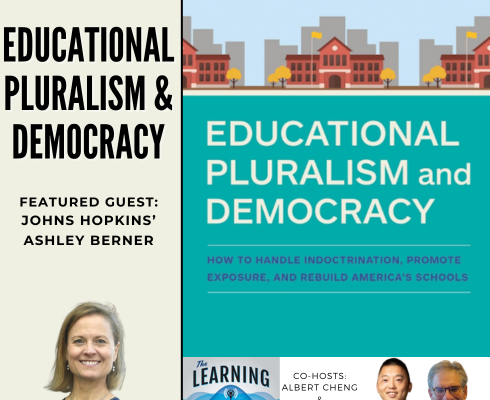
Johns Hopkins’ Ashley Berner on Educational Pluralism & Democracy

Johns Hopkins’ Institute for Education Policy director, Dr. Ashley Berner discusses educational pluralism's role in improving K-12 performance, exploring European models and the impact of U.S. school choice programs. Dr. Berner analyzes universal ESAs and vocational-technical schooling, addressing persistent academic struggles and civic knowledge gaps.