




July 9, 2026
Massachusetts Has a Small-Home Shortage; Zoning Reform Can Help Fix It
New report finds seniors and first-time buyers locked out of a market that stopped building smaller homes
Boston – A new Pioneer Institute report finds that a mismatch between who lives in Massachusetts and the housing being built is squeezing two generations at once: young families who cannot get into a house, and seniors who cannot downsize.
Local land use rules often make it difficult to build small, reasonably priced, and low-maintenance homes, despite a growing need for them as the population ages and average household sizes continue to shrink.
“Eroding affordability has shifted the market in favor of buyers who have purchased homes before,” said Andrew Mikula, Senior Housing Fellow at Pioneer Institute, and the author of the report. “At the same time, high housing costs – including the steep cost of purchasing a new home – also prevent many seniors from downsizing. A key solution is to allow for smaller homes in types and arrangements that tend to be lower-cost and more easily navigable for seniors.”
The report recommends allowing for townhomes and small multifamily buildings in existing neighborhoods without discretionary reviews, reducing minimum lot size requirements and parking mandates, expanding rights to build accessory dwelling units, and strengthening the state’s Starter Homes Zoning District program. Statewide, townhomes and condos generally sell for significantly less than new single-family homes, but many towns restrict or ban them.
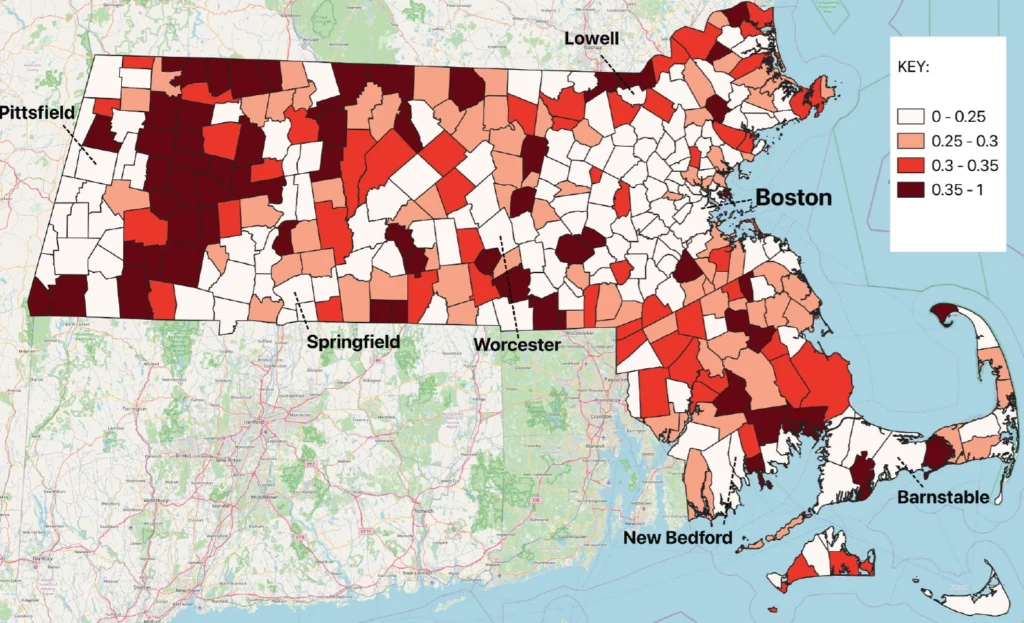
In most Greater Boston communities, the ratio of small owner-occupied homes to small owner-occupied households is less than 0.25. The Berkshires, Cape & Islands, and Pioneer Valley also face significant shortfalls.
Courtesy of Pioneer Institute.
Massachusetts household sizes have been shrinking in recent decades. As of 2024, 63 percent of Massachusetts households have one or two people, but just 44 percent of occupied homes have two or fewer bedrooms. Nationally, the share of new single-family homes with two or fewer bedrooms fell from 24 percent in 1984 to 5 percent in 2024.
The shortage squeezes both ends of the age spectrum. Many seniors who want to downsize can’t find smaller homes to move into. From 2021 to 2024 alone, Massachusetts added 78,000 senior-led households, and surveys show nearly half of older adults expect to relocate at some point.
At the same time, worsening affordability and scarce options have made home buying more difficult for young families. Since 2020, Massachusetts home values have surged 50 percent, and the income needed to afford a median-priced home has jumped 80 percent, to $180,500. In 2025, first-time buyers accounted for a record-low 21 percent of all U.S. home purchases.
“The regulations that make it nearly impossible to build small homes in Massachusetts were written for a different era,” said Jim Stergios, executive director of Pioneer Institute. “Reforming them is the most direct path to giving families and seniors real choices about where to live and helping to resolve our housing crisis.”
About Andrew Mikula: Andrew Mikula is a Senior Fellow in Housing at Pioneer Institute. Beyond housing, Andrew’s research areas of interest include urban planning, economic development, and regulatory reform. He holds a Master’s Degree in Urban Planning from the Harvard Graduate School of Design.
Related Publications