


October 21, 2026
Massachusetts’ Declining Unemployment Rate is the Result of a Shrinking Labor Force
At first glance, the latest unemployment numbers for Massachusetts look like good news. The state’s unemployment rate fell to 4.3 percent in August, its lowest level since March 2025 and down from a recent high of 4.8 percent in February, according to data released September 18 by the U.S. Bureau of Labor Statistics.
But a falling unemployment rate doesn’t always signal a stronger labor market. A closer look shows that Massachusetts employers are still cutting jobs, and that unemployment is falling mainly because fewer residents are working or looking for work at all.
Outside of education and health care, employers continue to cut jobs
Payroll data paint a fuller picture. Even as the unemployment rate fell in August, Massachusetts employers shed 7,300 private-sector jobs, on top of 2,700 lost in July. That included a loss of 6,400 jobs in professional and business services, one of the Commonwealth’s most productive sectors, according to BLS figures.
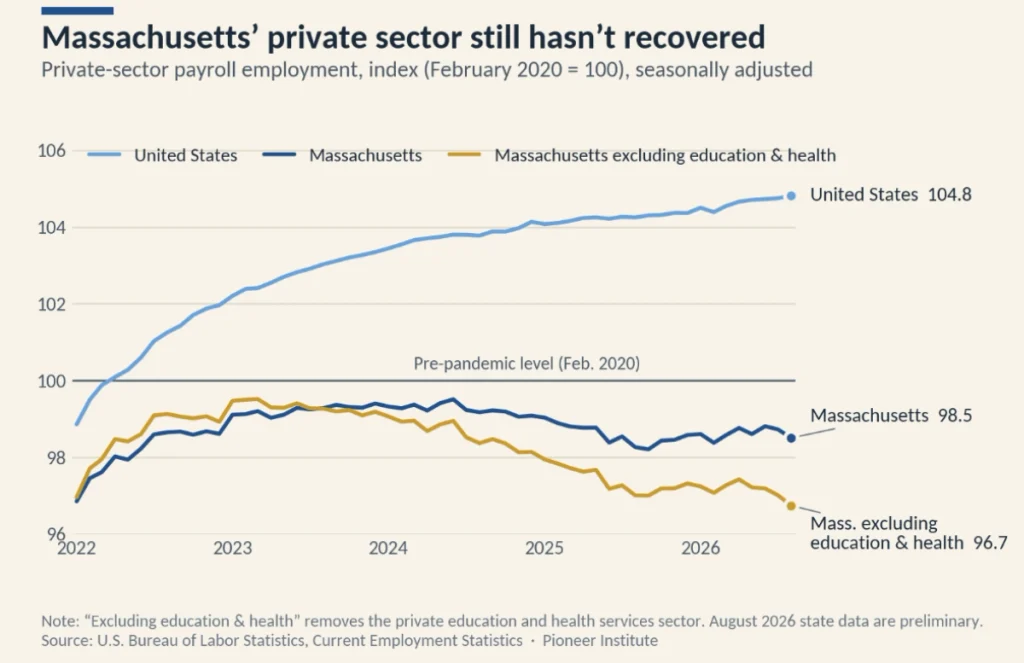
August extends a long stretch of weak growth. Over the past year, the state added just 7,900 private-sector jobs, a gain of about 0.2 percent. Since February 2020, Massachusetts has lost 49,000 private-sector jobs, with nearly every major industry shrinking except private education and health services.
Take those two sectors out, and Massachusetts had 79,700 fewer private-sector jobs in August 2026 than it did in February 2020. The figure above shows how dependent the state has become on education and health care for what little growth it has had.
Massachusetts is one of just six states where private-sector employment has yet to return to its pre-pandemic level. Over the same period, private employment nationwide grew by roughly 6.2 million jobs, or about 5 percent, and by more than 10 percent in competitor states like North Carolina, Florida and Texas.
Why the falling unemployment rate is misleading
If employers are cutting jobs, why is unemployment falling? Fewer residents are counted as unemployed not because they found work, but because they have left the labor force altogether.
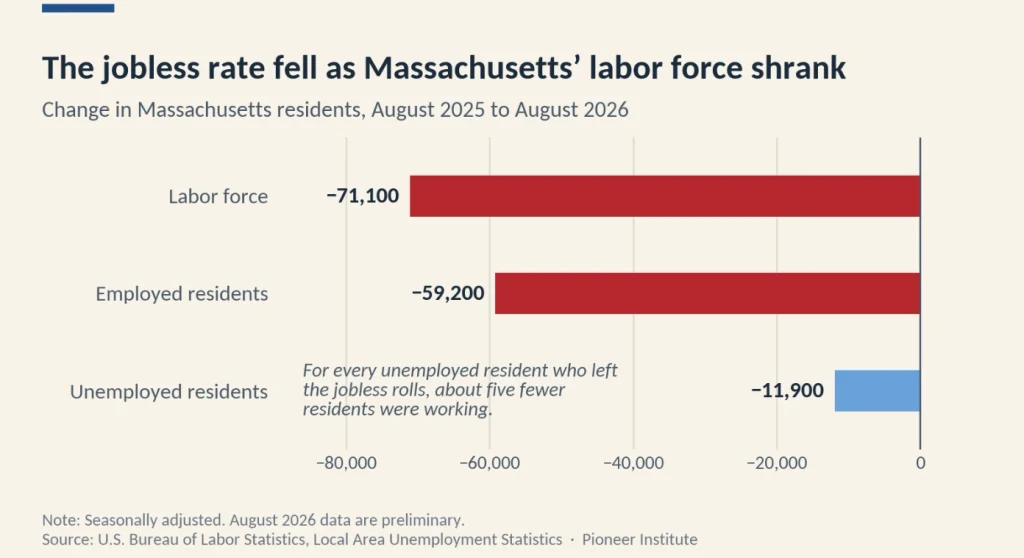
Since peaking in March 2025, the state’s labor force has shrunk by about 81,000 people. Over the past year alone, it fell by 71,100. During that time the number of unemployed residents dropped by 11,900, but the number of employed residents fell by 59,200, according to the BLS. For every resident who left the unemployment rolls, about five fewer residents were working.
While Massachusetts’ labor force participation rate of 65.3 percent remains above the national average, it has also fallen 1.2 percentage points over the past year. And even at 4.3 percent, the state’s unemployment rate is still higher than the national rate of 4.1 percent.
Massachusetts is losing workers faster than most states
Massachusetts isn’t alone. Labor forces are shrinking across much of the country: BLS state data show that 36 of the 50 states saw their labor forces decline between August 2025 and August 2026. But Massachusetts is shrinking faster than most. Its labor force fell 1.8 percent over the past year, more than double the 50-state average decline of 0.75 percent and the eighth-steepest drop in the nation.
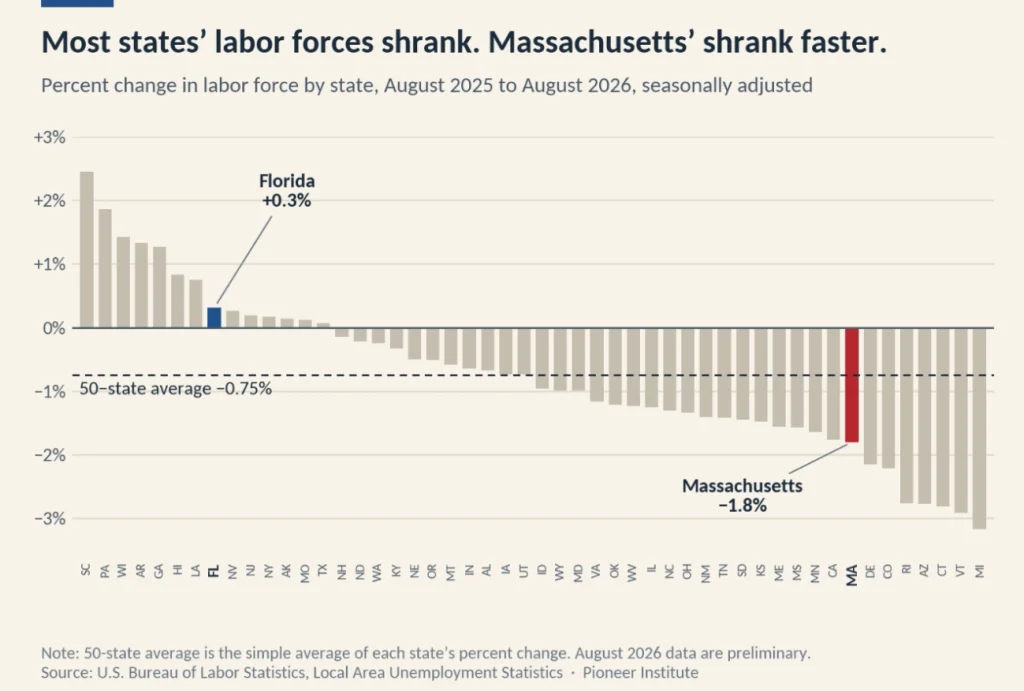
Florida offers a useful contrast. Its labor force grew by about 34,000 people, or 0.3 percent, over the same period, making it one of just 14 states to add workers. Since February 2020, Florida’s labor force has grown by nearly 8 percent, compared with 1.7 percent in Massachusetts.
Florida’s numbers aren’t all good news. Its unemployment rate has climbed from 4.0 percent to 4.5 percent over the past year, and from 3.0 percent before the pandemic. But the two states are moving in opposite directions for different reasons. In Florida, unemployment is rising as the pool of workers keeps growing. In Massachusetts, unemployment is falling because the pool of workers is shrinking. Only one of those describes a state that is still attracting workers.
Why the labor force is shrinking
Two forces are likely driving the decline: falling immigration and an aging workforce. Massachusetts has long relied on international immigration to offset the residents it loses to other states. The Bay State lost roughly 182,000 residents to domestic outmigration between April 2020 and July 2025 – only a historic surge in international immigration temporarily propped up its labor force.
That surge has now reversed. According to the U.S. Census Bureau, net international migration to the United States fell by more than half, from 2.7 million in the year ending July 2024 to 1.3 million in the year ending July 2025, and the bureau projects it could fall to roughly 321,000 by July 2026 if current trends continue, or a decline of nearly 90 percent from its 2024 peak. Massachusetts has already felt the decline directly. Census estimates show net international migration to the state fell from about 78,000 to 40,000 in 2025, while the state lost another 33,000 residents to other states. As a result, the state’s net gain from migration shrank from about 59,000 people in 2024 to fewer than 7,000 last year. Even after that drop, Massachusetts had the third-highest rate of international migration among the states relative to its population, a sign of how heavily it depends on immigrants to grow. At the same time, more baby boomers are reaching retirement age and leaving the workforce.
Massachusetts is especially exposed. A June report from Boston Indicators and the MassINC Policy Center estimated that, because of outmigration and an aging workforce, the state needs about 64,000 net international immigrants a year just to keep its labor force at its current size. It projected roughly 29,000 this year, less than half that number. With immigration expected to stay well below recent levels, the labor force is likely to keep shrinking and Massachusetts’ total population may as well.
What it means
While no one should read too much into a single month, state figures are preliminary and often revised, the August data fits a pattern that has been building for years. An economy that grows only when its education and health care sectors grow is not a healthy one, and it leaves the Commonwealth exposed if spending in those sectors slows. A shrinking labor force only serves to complicate the matter further; employers can’t grow without workers.
One thing is clear: Massachusetts can no longer count on immigration to offset the residents it loses to other states. The Commonwealth must act with urgency to keep the working-age residents it has. Without them, its labor force will likely keep shrinking, and its potential for future growth will shrink with it.
Related Publications

October 12, 2026
Boston Home Permit Process is Nation's 3rd-Slowest
October 7, 2026