




November 10, 2026
Behind Florida's Job Boom Is a Business Boom

Florida’s private sector is booming, with employment up 12.2 percent (966,800 jobs) from January 2020 to August 2026 — fifth-best in the nation. But what’s causing this explosive growth, and can we expect it to continue?
Job growth is a lagging economic indicator and is downstream of several factors that can impact the decisions of entrepreneurs and business owners to open a new business or expand their existing one. They include the cost of doing business and state policy environment, demand for goods and services, and the availability of workers.
Economic environments that are conducive to new business formation are especially likely to translate into job growth, as incumbent firms have historically had a net job creation rate close to zero percent over time while new firms have a net job creation rate of 15 to 20 percent. Thus, with a favorable business environment and significant population growth, Florida has been able to form employer businesses faster than it has been losing them for five straight years, at a pace few states have matched – leading directly to job growth.
Other states have failed to follow the same path. For example, during the same span of time, from January 2020 to August 2026, Massachusetts lost 40,400 private sector jobs. It also had the lowest rate of net business formation of any state from 2020 to 2024. The two statistics are intimately linked together.
A Tale of Two States Moving in Opposite Directions
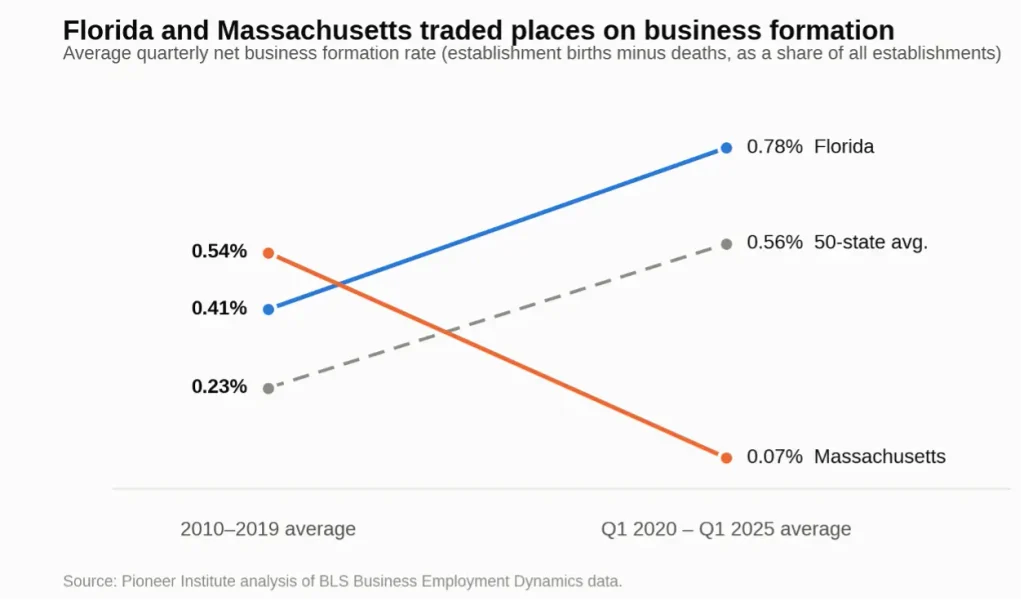
The Bureau of Labor Statistics’ Business Employment Dynamics series tracks every establishment covered by unemployment insurance as it opens and closes. From the first quarter of 2020 through the first quarter of 2025, Florida averaged a net business formation rate of 0.78 percent per quarter, meaning that new businesses grew the total number of employer businesses in the state by 0.78 percent on average each quarter. That was good for the eleventh-highest rate in the country (including D.C.) and well above the 50-state average of 0.56 percent. Massachusetts finished dead last at 0.07 percent.
What makes Florida’s performance notable is the direction of travel. In the 2010s, Florida’s average quarterly net formation rate was 0.41 percent, tenth nationally and unremarkable for a fast-growing Sun Belt state. Massachusetts, at 0.54 percent, ranked third. The two states have since swapped places entirely: Florida’s rate improved by 0.37 percentage points, while Massachusetts fell 0.47 points — the largest decline of any state.
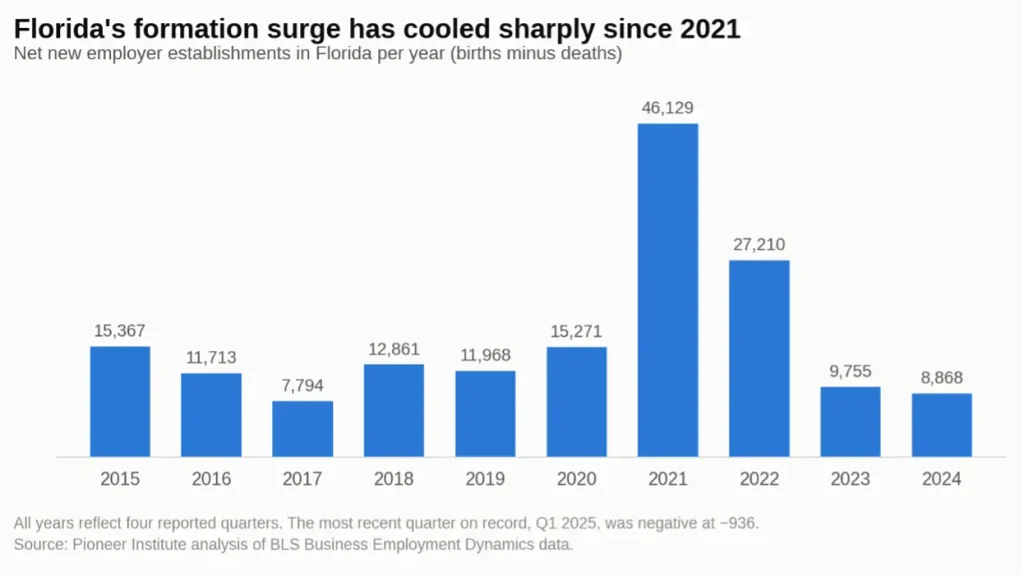
In absolute terms, the gap is enormous. Between the first quarter of 2020 and the first quarter of 2025, Florida added a net 106,297 employer establishments. Massachusetts added 2,873. Nationally, the figure was roughly 962,000, which means a state with 6.9 percent of the country’s population accounted for about 11 percent of its net new employer businesses. Florida’s single best year, 2021, produced a net gain of 46,129 establishments alone — more than Massachusetts has netted in the past decade combined.
The stock of businesses reflects it. Quarterly Census of Employment and Wages data show Florida operating 888,276 establishments as of the first quarter of 2026, up 159,071 — or 21.8 percent — since the first quarter of 2020. Massachusetts grew 14.3 percent over the same period. Florida now hosts 7.4 percent of all U.S. establishments, a share that keeps climbing.
Applications tell a more complicated story
The Census Bureau’s Business Formation Statistics, which count applications for Employer Identification Numbers (EINs), show Florida averaging 53,539 business applications per month in 2025, up 62.8 percent from 2019 and slightly ahead of the national increase of 60.5 percent. Massachusetts managed 37.0 percent.
But not every EIN application becomes a business with employees, and here Florida’s record is more mixed. Census flags a subset of filings as “high-propensity” — those with characteristics predicting actual employer formation. Florida’s high-propensity applications rose just 21.5 percent between 2019 and 2025, below the national 27.8 percent and barely ahead of Massachusetts. Applications from corporations actually fell 22.9 percent. In other words, a large share of Florida’s application surge has likely consisted of sole proprietorships and small non-employer ventures rather than the corporate startups that historically anchor regional economies.
The better test is the Census’s projection of applications that actually become employer businesses within eight quarters. On that measure Florida grew 25.4 percent from 2019 to 2025, versus 18.5 percent nationally and 14.9 percent in Massachusetts — real formation, not just filings. Florida is converting fewer of its applications, but it is generating so many more that the pipeline still outperforms.
Where the growth is
Florida’s gains are not confined to hospitality and construction. Professional, scientific, and technical services — the high-wage cluster Massachusetts has long claimed as its comparative advantage — reached 153,544 Florida establishments in the third quarter of 2025, a 14.9 percent increase since 2022 and a 5.0 percent jump in the last year alone — faster than California (4.4 percent), New York (1.4 percent), or Texas (1.1 percent). Massachusetts grew 10.2 percent over the same three years. The Business Dynamics Statistics show the same pattern in firm migration: Florida gained 1,721 net migrating firms between 2020 and 2023, while Massachusetts lost 149.
The caution flag
Florida’s business formation boom is decelerating, just like we are seeing with overall population. Annual net establishment formation fell from 46,129 in 2021 to 27,210 in 2022, then to 9,755 in 2023, before a modest leveling off of the trend in 2024. Quarterly net formation was flat or negative in three of the five quarters through the first quarter of 2025, including −0.2 percent in the most recent one. High-propensity applications peaked in 2023 at 19,668 per month and have declined every year since, to 16,738 in 2025.
None of this signals a Massachusetts-style collapse — Florida’s establishment count still grew 3.0 percent year over year through the first quarter of 2026, ninth-fastest in the nation. But it does suggest the post-pandemic surge is normalizing, and that Florida’s advantage will increasingly rest on fundamentals rather than migration momentum: no income tax, comparatively light regulation, and a cost structure that lets a new firm reach profitability.
The policy lesson runs in both directions. Massachusetts spent the 2010s as a national leader in business formation and lost that position in roughly four years. States do not hold these advantages by default. Florida’s numbers show what a favorable formation environment produces; its recent quarters are a reminder of how the trend line can shift.
Related Publications