



September 29, 2026
Florida’s Fading Population Boom
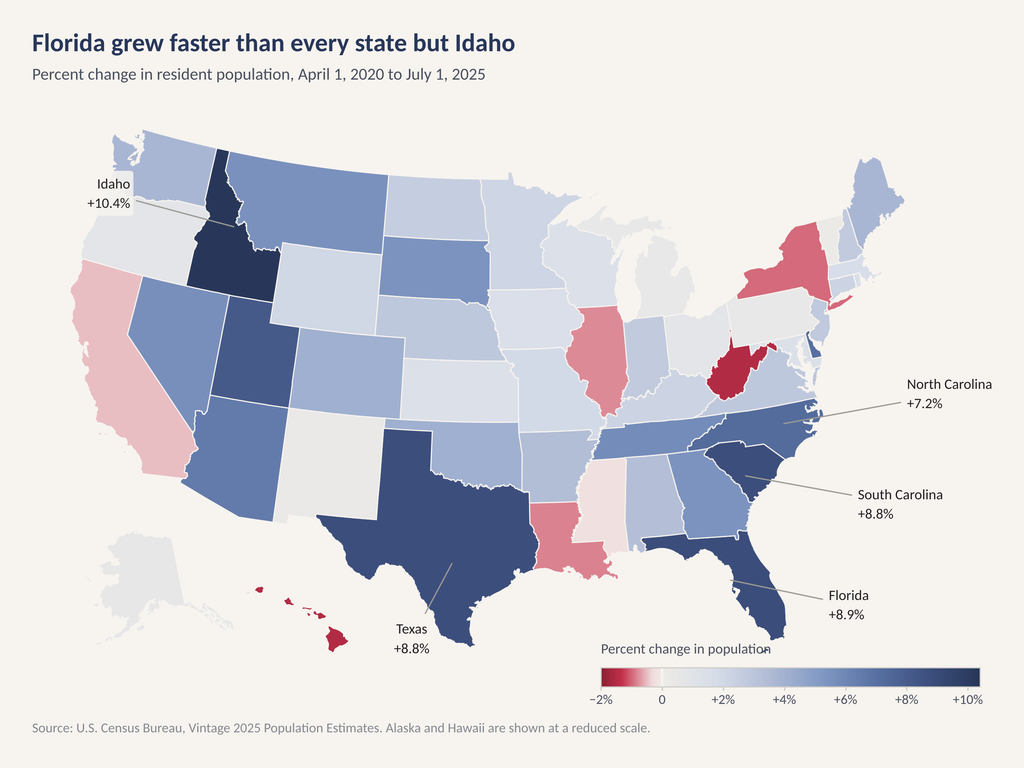
Florida has been one of the fastest-growing states in the country since the beginning of the pandemic. Between April 2020 and July 2025, its population grew by 8.9 percent (1.92 million people), the second-highest rate among states. At its peak, Florida added 577,291 net residents in 2022 alone.
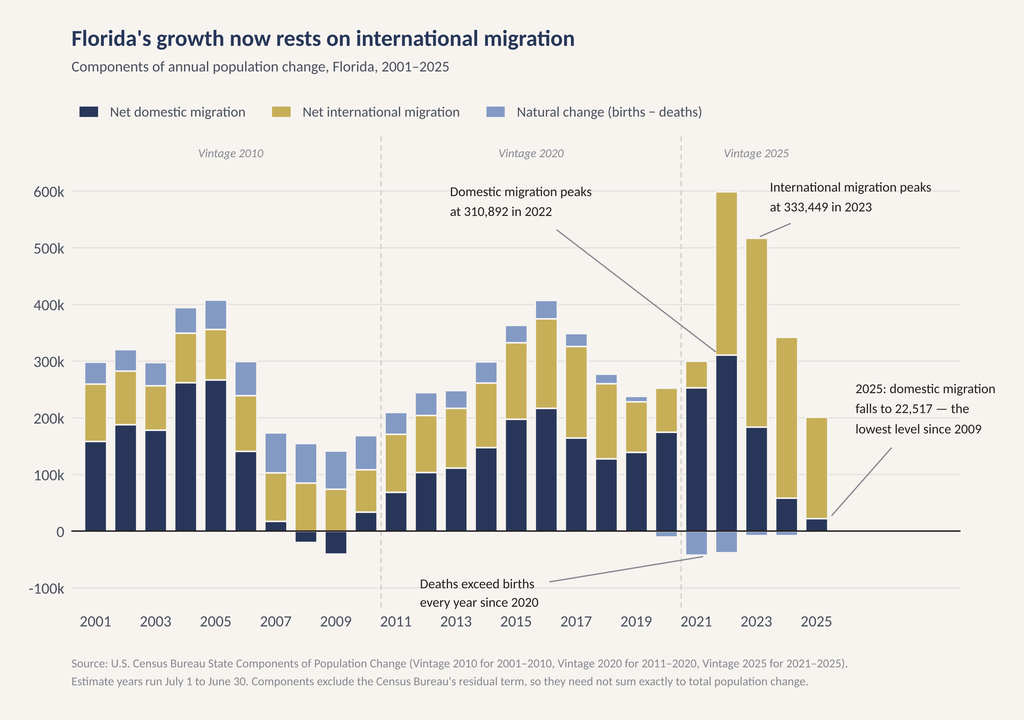
That growth was overwhelmingly driven by migration. In 2022, Florida gained 310,892 residents through net domestic migration (people moving from other states) and another 287,845 through net international migration. Natural population change was negative – Florida had 38,062 more deaths than births.
Three years later, the picture looks very different. Between July 2024 and July 2025, Florida added 196,680 residents, still the second-largest numerical increase of any state. But net domestic migration had fallen to just 22,517, its lowest level since 2009 and a 93 percent decline from its 2022 peak. While domestic migration fell in other popular destination states too like Texas (69% decline), Florida had the third largest percentage decline in the nation. International migration, at 178,674, is now responsible for the overwhelming majority of Florida’s migration-driven growth.
The Collapse in Domestic Migration
While Florida’s population continues to grow, the decline in domestic migration is the clearest indication that Florida’s population boom has begun to subside.
Florida’s appeal to domestic migrants has been built on a combination of low taxes, a lower cost of doing business, warm weather, and – until recently – relatively affordable housing and a lower cost of living. The expansion of remote work amplified those advantages, allowing workers to leave high-cost states without necessarily leaving their jobs.
Those conditions have not disappeared, but some of Florida’s cost advantages have weakened. Housing prices and rents rose rapidly during the migration boom, while property insurance has become a significant additional cost for homeowners. At the same time, other states including North Carolina, South Carolina, Tennessee, and Texas offer some of the same combination of relatively low taxes, economic growth, and lower costs.
On housing specifically, the comparison now runs against Florida. As of early 2026, the typical home value in Florida was roughly $379,000, compared with about $340,000 in North Carolina, $336,000 in Tennessee, $308,000 in South Carolina, and $304,000 in Texas. The gap is one of current price levels rather than appreciation: home values since 2020 actually grew faster in Tennessee (62 percent), North Carolina (59 percent), and South Carolina (56 percent) than in Florida (50 percent), but those states started from a lower base and remain cheaper today. Insurance is where Florida has become a significant outlier. Average annual home insurance premiums in Florida run about $6,400 for $300,000 in dwelling coverage – roughly double the $2,800 to $3,300 typical of the Carolinas and Tennessee, and well above Texas’s $4,600 – a difference of some $3,000 a year in carrying costs on an already more expensive house. For a household weighing a move primarily on affordability, Florida’s relative advantage has narrowed considerably.
The result is a much more competitive market for domestic migrants.
Where Florida’s Population Is Moving
The statewide figures also conceal a significant geographic shift within Florida.
Some of the state’s largest metropolitan counties are increasingly losing residents through domestic migration. Miami-Dade County lost 72,254 net residents through domestic migration in 2025, while gaining 54,204 through international migration. Its international inflow was therefore no longer large enough to offset domestic out-migration, as it had from July 2022 to July 2024.
Other large counties, including Orange, Broward, Hillsborough, Palm Beach, and Pinellas, have also experienced substantial domestic migration losses or declines from their earlier gains.
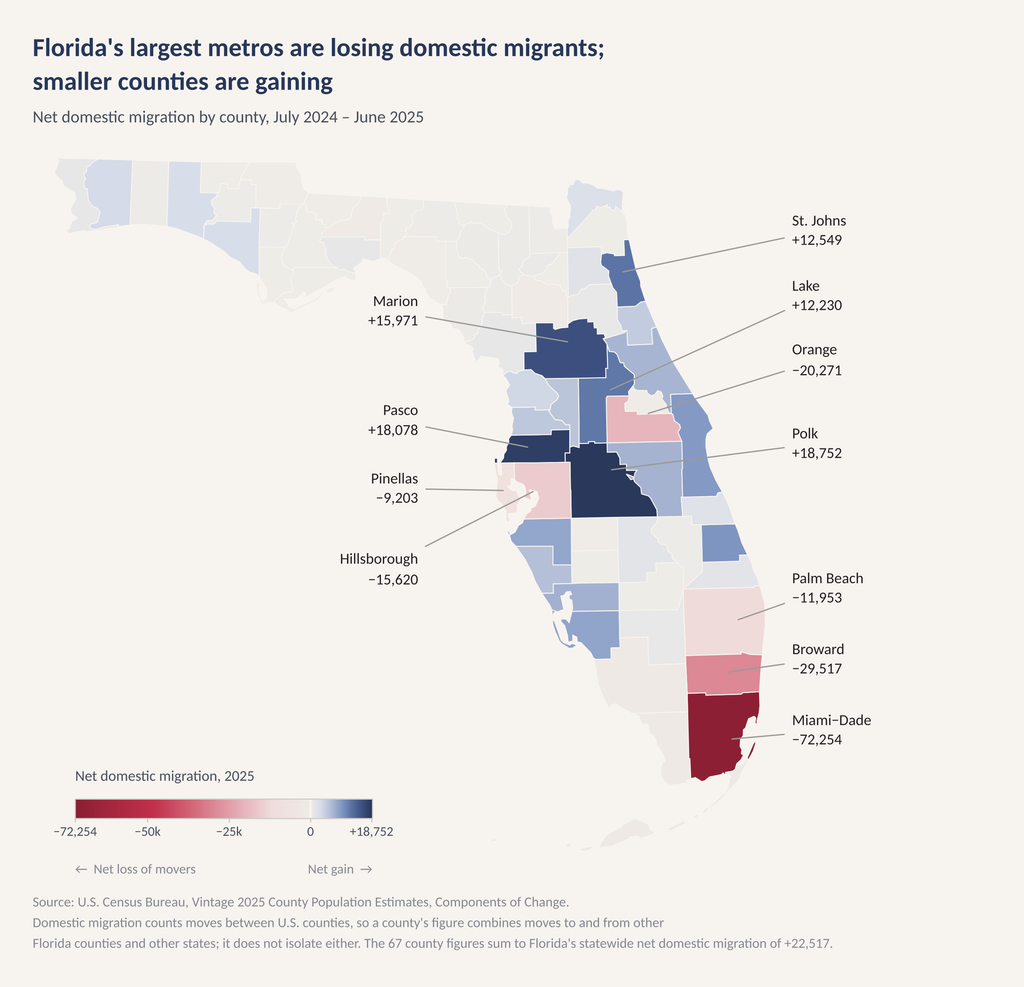
Meanwhile, counties such as Polk, Pasco, Marion, St. Johns, and Lake have remained important destinations for domestic migrants. These counties generally offer more housing and lower costs than Florida’s largest metropolitan areas.
The pattern suggests that Florida has not simply stopped attracting Americans. Instead, affordability is increasingly determining where migrants settle within the state. Population growth is shifting toward communities where housing can still be built and purchased at relatively attainable prices.
That distinction will become increasingly important if Florida wants to sustain population growth.
International Migration Is Now Carrying the Growth
With domestic migration flows diminished, international migration has become Florida’s primary engine of population growth.
In 2025, Florida gained nearly eight times as many residents through international migration as through domestic migration. International migration accounted for roughly 89 percent of the state’s net migration.
But international migration is declining too. Florida’s net international migration fell from 333,449 in 2023 to 178,674 in 2025, a 46 percent decline in two years.
The national outlook raises an even larger concern. The Census Bureau expects net international migration into the United States to fall dramatically in 2026. Compared with its 2024 peak, the projected level represents a decline of roughly 88 percent.
Florida will not necessarily experience the same percentage decline. But because international migration has become its dominant source of population growth, a continued national decline could have an outsized effect on Florida’s demographics. The state’s natural population change provides little cushion. Deaths already exceed births, meaning that without migration, Florida’s population would be shrinking.
Florida’s Next Demographic Test
Florida’s recent population growth is a remarkable success story. Its combination of low taxes, a favorable business climate, economic opportunity, and quality of life made it one of America’s most attractive destinations – and the state’s 8.9 percent population growth since 2020 is evidence of that appeal.
But the same data show why Florida cannot take that success for granted.
Domestic migration has fallen by more than 90 percent from its 2022 peak and is at its lowest levels since 2009. International migration is now doing most of the work, but it has already fallen substantially and could decline much further. And within Florida, migrants are increasingly moving toward counties where housing remains relatively affordable.
Slower growth may sound like relief to residents who have watched housing costs, traffic, and insurance premiums climb – and a gentler pace of arrivals would ease pressure on infrastructure that has struggled to keep up. But with one of the country’s oldest populations, lowest labor force participation rates, and deaths exceeding births in Florida every year since 2020, migration is not merely adding to the state’s population; it is adding valuable new working age residents who help staff the hospitals, classrooms, and construction sites that an aging population depends on.
The policy lesson is straightforward: if Florida can maintain its relatively low-tax, business-friendly environment while expanding housing supply and addressing rising insurance and other costs, it can remain an attractive destination. If those costs continue to erode its affordability advantage, the state may find that the population boom that once seemed unstoppable was more dependent on unusually favorable migration conditions than it appeared.