


UK U-Sussex's Andrew Hadfield on Edmund Spenser, The Faerie Queene, & Epic Poetry
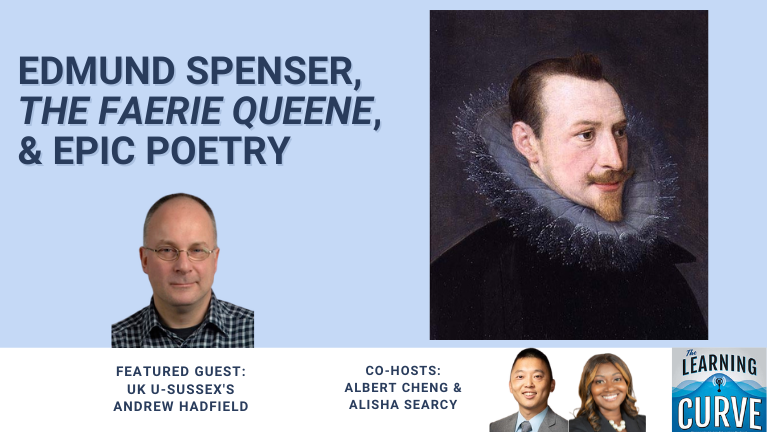
The Learning Curve Andrew Hadfield
Albert Cheng: [00:00:00] Everybody, welcome to another brand-new episode of the Learning Curve podcast. Hope you’re doing well. This is Albert Cheng, joined by my co-host, Alisha Searcy. Alisha, how’s it going?
Alisha Searcy: Going great. Albert, it’s election season, so things are very busy, but I’m excited about the future of our state and country. How about that?
Albert Cheng: Wow. Wow. Look, we need that optimism these days, huh?
Alisha Searcy: We do. I don’t always feel that way, but today
Albert Cheng: I do. All right. Great. Well, I wanna come back to that ’cause I know you’ve got an interesting news story, um, tied to civic education and civic formation. But what do we have on [00:01:00] tap today? Well, I’m excited for this episode, we’ve got Andrew Hadfield, who is a professor emeritus of English from the University at Sussex, UK. And this is a topic I’ve been keen on getting into Edmund Spenser, poet, English poet from the 1500s, well known for his epic, The Faerie Queene. So, yeah, I’ve never read it, heard lots about it, and really wanna dig into this. So I’m looking forward to this episode.
Alisha Searcy: Excellent. Well, it’s gonna be exciting.
Albert Cheng: Well, let’s circle back. You found an interesting news article about civic education, so let’s talk about news as we always do on this show.
Alisha Searcy: Yes. And so this one is Why Lack of Civic Education Is Making U.S. Politics Toxic by Joshua Dunn and William Lyons. And I will just say that it really just prompted for me thoughts about, you know, where we are as a country and just the importance of knowing and having civics education. I think we could agree that there’s been a tremendous focus, and there should [00:02:00] be, on math and reading. We need that not as much on social studies and science.
That’s a challenge. And specifically when it comes to civics education, and I think that’s been a movement for a long time. I will not place that on one administration. I think it started with, you know, the whole accountability piece as, again, it should be, but we’ve gone away from civics education probably for decades.
And I think we are really seeing, and the authors are really talking about this in the article, we’re really seeing the consequences of those decisions now. For example, they did a poll in Tennessee, and the majority of Tennesseans did not know that the state had its own constitution. That’s a little bit scary, Albert.
And I always say this, and I don’t say it to embarrass people, but when I was in office, I would often, you know, be out in the grocery store or wherever it was, and someone would always ask me, when am I going back to DC because they [00:03:00] thought that I was in Congress.
Albert Cheng: Hmm, interesting.
Alisha Searcy: It is. And so I think that we have a responsibility now, those of us in education in different areas, right?
Whether you’re a policymaker, you’re a researcher, whether you’re an educator, we need to push for more civics education in our schools because we want young people, we want adults, we want voters to be able to make sound decisions understanding how our government works, the three branches of government.
I think we have elected officials, and without making this political, I will say we have some sitting elected officials who don’t quite understand what’s within their purview and what isn’t. And so when you have that and you don’t have a respect for the Constitution, we certainly are an imperfect union.
We know that. We know that our history is challenging. We know that there are a lot of thorns in our history, and lots of folks don’t like to talk about that. But we also are a place that if you believe in democracy, if you believe that the system is for us, by us, and it needs to work, you need to [00:04:00] learn about it, right?
You need to understand how government works. And so I think where there is a lack of civic education, you see more toxicity. I’m not old, but I’ve been around for a long time, it feels like I just, I just have not seen this level of toxicity in this country. There’s so much division, certainly across political lines, racial lines, religion, all kinds of things.
And I think in addition to sort of who the candidates are and what their messaging is, I think some of that we could break through if our electorate was more informed. They understood our government. They were more civically minded. I think choices would be different. I think our policies would be different, and we wouldn’t be where we are now as a country, which is, I think, very toxic.
And so, uh, my call, right, from reading this article and why I said I feel optimistic about the elections that are happening, for us it’s tomorrow in Georgia, it’s our primary election, [00:05:00] but all over the country we’re having elections and conversations about redrawing maps and all of that. I have to be hopeful and believe that in some ways history will not repeat itself, and that we’ll find the greater good in people and the humanity, and think about the issues that really matter, and we will continue to perfect this union.
Albert Cheng: Yeah. Yeah. Well, thanks for offering those thoughts, and I’m with you on, on our need for civic renewal, civic formation. You know, and I’ll just add, yeah, I mean, some of it’s giving people information about how our government works, how it’s organized, the internal logic and rationale for it, and there’s the other part, too, of informing people, how do I get involved?
How do I practice civics? How do I make my voice heard or mobilize, that kind of thing. I wrote an essay for National Affairs a few years ago with Jay Green, and you know, one of the things we added to that list is, you know, we gotta focus on cultivating people’s affections. And what I mean by that is, [00:06:00] I think kind of along the lines of what you said, civic mindedness.
Too often I think we can figure out how government works and know how to get involved, but then what we end up doing is pursuing only what we want and not thinking about maybe what our neighbors need or want, what our communities need. And so I’m for even adding this piece about how do we get people to think about Yeah, how do I think about the good that we share in common and pursue that?
And how do we love pursuing that so that we’re orienting all our efforts towards doing that? So-
Alisha Searcy: Yeah …
Albert Cheng: you know, it’s a tall order, and maybe I’m sounding too Pollyanna-ish, but I think that’s the direction personally we need to be headed in, and I think we got work together to do to try to get there.
Alisha Searcy: We do. Not Pollyanna-ish at all. That’s exactly what we need right now.
Albert Cheng: Well, thanks for sharing that article. Real quick, I mean, I could go on and on about this article, but I do wanna get to Edmund Spencer. You know, my article here is opinion piece entitled America’s Math Crisis, and I’ll let you know, we can talk about math from time to time ’cause that’s my original academic love, I guess.
And this one’s interesting. I’m actually [00:07:00] disagreeing with it a bit, and I’ll tell you why. So the substance of this opinion piece is saying that, you know, the author, Ted Dinarsmith, is suggesting that what’s wrong with math education today, and his argument, which has some grounding, is that we’re not focusing on things that are practical and applicable.
And so he goes on to give a lot of examples about this. He talks about learning statistics and data analysis skills, being able to think through probabilities, which is all well and good. By the way, I don’t wanna throw him completely under the bus here, ’cause look, I do that stuff for a living . Don’t get me wrong. But you know, at the same time, I do think he is retreating from maybe what we call traditional math too quickly.
Alisha Searcy: Mm.
Albert Cheng: I do think there’s an importance for learning the tradition. That hey, look, I mean, we know a lot about Euclidean geometry, and sure, you can go ask ChatGPT about how do you prove or construct an equilateral triangle from a compass and a straight edge and all that.[00:08:00]
And learning how to do that maybe has no immediate practical value like data analytics does these days. But my view is, look, we’re not just learning– Education is not just for practical application. It’s about learning where we came from, rooting ourselves to a tradition, and math is this tradition. It’s a human endeavor.
And you know, I think this is tied to your point about civic education, that, you know, we need our education to be connected to our… There’s s-something about our humanity that calls us to be tied to those who came before us. And so I like being called to focus on some of these things like statistics and data analytics, but I would caution us from going too far and maybe cutting off too quickly a lot of the things that have informed the tradition and made us who we are. So anyway, that’s my piece. I just want to commend that article for others to consider as well.
Alisha Searcy: I like that, and of course, this is your background, so I trust, you know, your perspective on this. But I also like that sometimes it’s okay to have a difference of [00:09:00] opinion from these articles, so-
Albert Cheng: Yeah, yeah, yeah
Alisha Searcy: thank you for sharing that perspective.
Albert Cheng: Yeah, well, thanks for, uh, sharing the briefs with me about news as usual. We gotta get onto our show. Coming up, Andrew Hatfield on Edmund Spencer
Andrew Hadfield is Emeritus Professor of English at the University of Sussex in the UK and a fellow of the British Academy. He is the author of a number of books about English Renaissance literature, culture, and history, including Literature, Politics, and National Identity: Reformation to Renaissance, Shakespeare and Republicanism, Edmund Spenser: A Life, and Lying in Early Modern English Culture.
Professor Hadfield’s academic career spans multiple institutions, including teaching positions at the universities of Leeds, Ulster, Columbia University in New York, and the University of Granada in Spain. [00:10:00] He earned his BA in English from the University of Leeds and his PhD from the University of Ulster at Coleraine Professor Hadfield, welcome to the show.
Andrew Hadfield: Thank you very much.
Albert Cheng: Well, let’s start with an overview. You’re the definitive biographer of Edmund Spenser, the great Elizabethan poet and author of the epic, The Faerie Queene, which is a foundational piece of English literature. So could you start by sharing with us a brief overview of who was Edmund Spenser, and why does he remain so timelessly influential?
Andrew Hadfield: Spenser’s a poet who lives from, I think, probably fifteen fifty-four, dies in fifteen ninety-nine. He announces himself as the great English poet in the late fifteen seventies when he writes the Shepherd’s Calendar, and people are amazed at this particular series of poems that seems to announce an important career.
He then lives in Ireland for most of the rest of his life, where he gains an estate, having become [00:11:00] a secretary and a colonial administrator and civil servant. And then in fifteen ninety, he starts publishing The Faerie Queene, and a torrent of poems appear, and he becomes more and more celebrated as time goes on.
So by the time of his death, he has become the dominant English poet of the Renaissance. There’s a story that the historian William Camden tells that when Spenser dies, he’s buried in Westminster Abbey. All poets assemble, they write out verses and throw the verses along with pens into his grave because he is seen as the great poet, the first among all the equals.
Why is that so important? What claims does he have to fame? Well, he’s someone who probably single-handedly revives English literature and makes it an important force in the fifteen nineties. He’s aware that English literature hasn’t got that many precedents. There’s, of course, Chaucer, a few medieval poets, Sir Philip Sidney and a few others.
But it’s [00:12:00] Spenser who really takes the bull by the horns and says, “Look, if we want to have serious English poetry, we need to get much better. We need to imitate the classics, we need to interact with European poetry, and we need to smarten ourselves up and start producing things.” And he produces a vast range of poems across a whole series of different types of writing.
He’s probably the most experimental poet in the history of, of English writing. Invents his own stanza, genre, different types of verse, and so on. So he becomes this kind of giant poet. Why we might read him now? He’s famous for his allegory and symbolism and the way that he combines epic and romance in this great wandering epic, The Faerie Queene, which is his most celebrated poem.
But that’s why I’d say he has the principal claim to fame.
Albert Cheng: Well, we’re gonna look forward to getting into The Faerie Queene later on in the show. So let’s start at the beginning of his life, and, and you mentioned some of his influence, [00:13:00] classics. So I wanna ask a question about that. You write in your biography of Spenser, quote, “Spenser’s life will probably always be shrouded in a certain mystery.
We cannot be sure about his ancestry and immediate family.” Unquote. Could you tell us what do we know about his family and certainly about maybe his education, his, his religious upbringing? I mean, who influenced him? What poets from the classical antiquity perhaps played a role?
Andrew Hadfield: Good question. We don’t know all that much about Spenser, but that’s not unusual for people in this period.
There’s lots of blanks in people’s lives where you find it hard to fill things in unless they’re involved in property deals or court cases. So we know quite a bit about Spenser’s life because he was involved in court cases and property deals. We’re not certain who his parents are. He may have been the son of a man called John Spenser, who was a journeyman, a free journeyman in the Merchant Taylors’ Company.
He’s the most likely candidate for his father. Spenser tells you in his [00:14:00] poetry that his mother was called Elizabeth, but we can’t find a John Spenser who’s married to an Elizabeth, unfortunately, which is a bit of a shame. But he’s probably from somewhere in the kind of moderately affluent middle class.
He goes to Cambridge, and he’s a sizar, which means he’s a student who has to work for his living there. He’s clearly not an aristocrat. He may have connections to the Spensers of Althorp, one of the really upcoming families of this period, whose most famous member was, I’m sure you know, Princess Diana is from the Spensers of Althorp.
So Spenser may have a connection there, and he certainly has a connection to them later on because his second wife, Elizabeth Boyle, has some connections to the Spensers of Althorp. So he tells you in a poem that he’s kind of linked to them, but whether that’s through birth or through marriage, we don’t really know.
So he has connections to powerful families, but that’s not that unusual. His own background probably isn’t that wealthy, but he’s [00:15:00] obviously not that badly off. As for his education, well, we know that he goes to the Merchant Taylors’ School and then to Cambridge. At the Merchant Taylors’ School, he’s taught by an influential and important headmaster called Richard Mulcaster.
Mulcaster becomes one of the most famous headmasters in London, particularly keen on getting his charges to learn languages. He has other famous pupils, among them Thomas Kyd, the playwright, who may have written an awful lot of plays if certain arguments are proved, most famous for The Spanish Tragedy.
And Lancelot Andrews is another pupil at the school. What Spenser would have studied at school, he’d have been drilled fairly comprehensively in languages. Most of the classes would have been held in Latin. What you would learn are the skills of rhetoric, how to argue, including the great skill of arguing on both sides, which is clearly something that helps develop drama in this period.
And Spenser, we know he wrote some lost plays and [00:16:00] may have, had the dice fallen another way, have ended up becoming a playwright. He’s certainly interested, I think, in, in that sort of dramatic writing. But he would have been schooled in an awful lot of Latin and classical poetry. Particularly, he’s influenced by Ovid.
Ovid is somebody he references an awful lot in his writing. He’s clearly very influenced by Virgil, the great Roman epic poet who starts off writing eclogues and moves towards writing an epic, and Spenser may well have copied that career trajectory, although that’s somewhat controversial. So those would have been the main kind of people he would have been influenced by.
He’s very obviously influenced by Cicero when he writes his prose tract. He clearly has learnt Latin eloquence from reading Cicero. He probably would have learnt some Greek and possibly Hebrew, and he would have studied a lot of the Bible at school. As I say, Mulcaster’s very keen on languages. It’s very likely that Spenser would have learnt Italian [00:17:00] and French at school.
He’s certainly very influenced by contemporary Italian poets, Tasso and Ariosto. The romance writers are very, very important for him, and he tries to put them together with Virgil in terms of setting a matrix for how you can rethink English. And he translates some poetry from French, possibly from Dutch at school.
Mulcaster is in touch with a lot of expatriates from the Low Countries, and it’s very likely that Spenser has a serious interaction with a lot of these Low Country intellectuals, and he translates the work of a, of a poet, Jan van de Noot, although I think he’s really translating from the French, not from the Dutch.
So he has a, he has a very, very thorough education in languages, and he would have known all about rhetoric, poetry, how to argue, and people who could master that kind of education were in a very, very good position to then expand and become significant writers should they want to do that.
Albert Cheng: Well, thanks for filling in those details about his family and the [00:18:00] classical education that he got.
I’d like to have you fill in the details about being alive during, uh, Elizabethan England. You wrote in, in Spenser: A Life, quote, “England might have seemed the center of the world to many, but it was under siege from hostile Catholic enemies, and its own future was uncertain because of Queen Elizabeth’s refusal to marry.”
So tell us about the complex political landscape of England during her reign.
Andrew Hadfield: Very good question. There’s that famous thing that people often quote of it being a curse, “May you live in interesting times.” Well, Spenser certainly lived in v- in very interesting times, but whether they were fun to live through is another question.
The 1590s, which are one of the sort of great fertile decades of English writing, is where Spenser spends most of his time producing his important works, were a pretty terrifying decade. Queen Elizabeth is really, really old by the 1590s. People had expected her to die [00:19:00] sometime in the 1580s, and she goes on and on and on and becomes the oldest living monarch for about 400 years at some point.
So people are discussing the succession question for years and years and years, and they’re not sure what they’re going to get or whether this will lead to a religious civil war, whether it’ll lead to economic disaster, all sorts of problems. So that’s one context for the 1590s, and Spenser’s clearly very, very interested in that, dedicating an epic to the queen, The Faerie Queene.
That is a work that is as much about the problems and the issues of the monarchy as it is a poem praising the Queen, and there’s lots of very critical comments, as I’ll expand later. Allied to this, it’s also a period of terrible harvests. There’s lots of famine, there’s lots of riots, there’s lots of economic misery in this period as well.
And of course, it becomes really obvious at some point in the early 17th century when things work out really well. People are very frightened about James VI, [00:20:00] who becomes James I, becoming king. They think Scotland’s going to drag England into a whole series of unpleasant wars and lead to instability.
Scotland’s a notoriously unstable country. That doesn’t happen. They think the Spanish are very likely to invade and destroy the Protestant Reformation. That doesn’t happen either. Spanish power declines rapidly in the early 17th century. But Spenser can’t see that and doesn’t, obviously doesn’t know that all those things are just around the corner.
So when he dies in 1599, things look pretty grim. A few years later, the Spanish are defeated in Ireland, and the Spanish threat withers away. But in the 1590s, there’s tremendous anxiety. As for religion, Spenser Writes very harshly, as many English writers do, about the Pope and about the Spanish and the power of Spanish Catholicism.
This doesn’t necessarily mean that he is a Puritan writer or a [00:21:00] hot Protestant, as, as was once assumed. Most people are pretty scared of the papacy and the, the Spanish forces. You didn’t have to be an anti-Catholic particularly to feel scared about those things. My sense of Spenser is that he’s a much more conciliatory and conservative figure who thinks it’s important that the church remains unified, remains powerful, unites people, and can accommodate lots of particular beliefs.
And I think that’s the sort of message you get in a lot of his poetry, particularly The Shepherd’s Calendar, which stages a series of debates between conservative and more radical Christians. So I think Spenser, like many other figures I suspect, wants to limit change, limit the possibility of catastrophe, curtail disasters, and tow a much more conciliatory line.
And that’s how I think how he sees himself navigating through that very turbulent decade.
Albert Cheng: That’s [00:22:00] fascinating. So let’s talk about Shepherd’s Calendar. You, you say that this is one of his themes, so this is his first major work. So give us an overview. I mean, there are themes of love, religion, politics. And tell us also, how did this launch Spenser’s literary ascent?
Andrew Hadfield: Spenser in some ways appears from nowhere. In 1579, when the Shepherd’s Calendar is published, he’s in his mid-20s, and that’s quite late to start a writing career. Most writers seem to be writing a lot when they’re teenagers and try to be publishing things. People go to university very, very young in this period.
So Spenser’s quite long in the tooth to be starting out. He’s clearly been reading like a madman, and that’s what I suspect he does when he leaves Cambridge is at some point he decides he knows in 1579 he’s going to get married. His first wife is a woman called Machabees Childe, about whom I could find absolutely nothing, which was quite sad when I was writing the biography.
But I think he’s been reading and reading and reading in this period [00:23:00] and embarking on a literary career by embedding himself within a, a wide-ranging culture because he’s an extraordinarily well-read and carefully read poet. So The Shepherd’s Calendar appears like a sort of literary bomb in some ways.
It’s a really, really strange, challenging book. It’s produced like a classical humanist book with these eclogues, these 12 eclogues, January to December, articulated by different shepherds, imitating a whole series of different styles of writing, a whole series of different themes, some about religion, some are about love, some are about the nature of the universe.
Some are clearly very, very politically motivated, and I’ll say a bit more about that in a minute. But he produces this extraordinary literary work, which clearly has a massive influence. Sir Philip Sidney in The Apology of Poetry says it’s pretty much the only thing worth reading in the last sort of 30 or 40 years, which gives you a sense of just how significant it is as a poem.[00:24:00]
And it’s a strange book because it imitates, as I said, humanist texts. It’s got lots of footnotes. It’s got introductions. It’s got woodcuts. It’s very much a production of a particular book that challenges the reader to read it and to make sense of it. A lot of the footnotes are clearly either misleading or slightly sly and undermining or don’t quite say what you think they’re going to say.
So the book itself is a literary puzzle. As I said, some of the eclogues deal with religion, where you have debates between conservative and radical figures. It’s always inconclusive, these debates are. Some are about Spenser’s own life. The first one, it’s very clear that it’s about him getting married, if you look at it.
So he’s, it’s got Colin Clout, the figure, taken from the English poet John Skelton, a sense that he’s looking back to an English tradition of writing as well as looking to European models and classical models, that Colin is somebody who [00:25:00] is madly in love with a woman called Rosalind, and he has a friend called Hubwonk, who is a type of his tutor at Cambridge, Gabriel Harvey, who he was very close to at this point.
And there’s a whole series of jokes about Colin being really fed up because Hubwonk keeps giving him all these presents, and he says, “I don’t know why Hubwonk keeps giving me all these presents, because I’m just gonna give them to Rosalind anyway.” The sense of the rite of passage, where he’s moving on from his close male relationship.
Many people had very close relationships with senior male figures until they got married. The book, I think, tells you that Spenser is about to get married and that his status is about to change, and that’s one of the reasons why he ends up going to Ireland, I think, because he gets a very lucrative job there.
Some of the eclogues deal with his own life, some deal with religion, others deal with politics. There’s a number about what’s called the Alençon match, where Queen Elizabeth in the late 1570s was planning to marry a much younger man, the Duke of [00:26:00] Alençon. Many people were quite hostile to this, m- most famously Sir Philip Sidney, who had emerged as one of the key literary figures.
He was very, very hostile to the idea of the Queen marrying someone from France. It looks like Spenser is doing the same thing. The book is published by a publisher called Hugh Singleton, who is involved in the publication of a notorious tract called The Discovery of a Gaping Gulf by a man called John Stubbs, who publicly insults the Queen, tells her that what business has she got marrying this Frenchman?
No patriotic Englishman will stand for it. Stubbs is quite severely punished, and his hand gets cut off, and Singleton just about escapes, but then he uses the same printing press, it seems to be, to produce The Shepherd’s Calendar. So the Book is associated with hostility to this French match, which I presume Spenser and others thought would just plunge the country into chaos.
So it’s a really, it’s a really interesting book that does all sorts of [00:27:00] fascinating different things, religion, personal life, meditations on the nature of life and exile, and hostility to con- to contemporary political positions. So it sets Spenser up as a dominant voice who needs to be reckoned with
Albert Cheng: Well, that is complex and all that woven into a single poem or book here.
Um, now this is not to, uh, look, Faerie Queene, I think people are even more familiar with Faerie Queene, so let’s get into Faerie Queene and unpack that as best we can in the time we have. So this is Spenser’s epic poem published in two parts in 1590 and 1596. Now, this is a complex moral political allegory honoring Queen Elizabeth, I believe you mentioned that earlier, and we’ve got knightly quests for virtues and fantasy and chivalry, good versus evil.
Let’s start with an overview, and then I’ll have Alisha jump in to ask a few questions about some particular parts.
Andrew Hadfield: We have six and a bit books of the Faerie Queene. [00:28:00] Spenser may have been planning 12. There’s a letter that he appends to the first edition, which may or may not help you understand it.
Spenser is very clear about how you can use printed books to do all sorts of things, some of which may force readers to think very carefully about things. But there are six books following six virtues. The first three are holiness, temperance, and chastity, and then three more appear later on along with these first three books, which are friendship, justice, and courtesy, and then later on, a small fragment of a book of constancy appears, which are known popularly as the Mutability Cantos.
So what you get is, I would say it’s more an exploration of the twin issues. One is monarchy and the other is personal behavior. So he talks about fashioning a gentleman. That’s true. Obviously, the virtues follow men in lots of ways, but they also have virtues [00:29:00] that follow women as well, and Spenser is nothing if not keen to think about a female audience too.
So we follow the three knights in the first book who, first one is Holiness. This is the Red Cross Knight. The second one is Temperance, and the third one is Chastity, and that’s where you get the first female knight, Britomart. The trajectory of the first book is extremely odd. So it starts off where you think holiness is going to be the chief virtue.
You would think that’s where it’s going. In a religious age, people will start off thinking about religion. Well, what happens in the book is that it moves sideways almost immediately and becomes much more about erotic relations and sexuality and marriage, and then moves on to temperance and chastity. So you get the virtue of holiness.
There are 12 cantos. The Red Cross Knight goes through a whole series of different tests, and the book’s actually quite funny. I mean, one of the things that is very obvious about the Red Cross Knight is that [00:30:00] he’s not very good at being holy. He kind of means to be, but he doesn’t really understand what he’s doing, and as soon as any form of attractive woman turns up, he immediately forgets his quest and makes a total hash of things And he’s supposed to be getting married at the end to this figure, Una, who is the figure of the true church, but he doesn’t actually manage to do that because various false women, o- one particular false woman turns up and claims him for herself, and we then move into allegories of temperance and chastity.
What I think the first edition is doing is telling you that you can’t just leap straight to holiness. You may want to be a holy person, but we’ve got to live in the world. We have bodies, we have needs, we have desires. One of the key biblical verses is St. Paul’s injunction that, you know, it’s better to marry than to burn.
What life is about is about controlling your sexuality and your appetites, and it’s much better if you get married than if you don’t get married and you kind of allow yourself [00:31:00] freedom to do what you want. You need to have everything regulated. And it’s a complicated allegory about regulation and how you regulate the individual self, the first three books of The Faerie Queene.
And we move from the Red Cross Knight who thinks he can be holy but clearly can’t to the virtue of temperance, where you have the knight Sir Guyon. Sir Guyon is very much a thou shalt not sort of person who resists temptation by just resisting temptation and actually trying to destroy anything that’s beautiful and lovely and ends up with this beautiful garden on a wandering island at the end, and Guyon decides that the only way he can control the bad things that the garden encourages is to just smash it to pieces.
And this is clearly a limited virtue. So we come into chastity, and Britomart, the Knight of Chastity, is someone who actually has to think through what it means to have a body, think through how you control your desires, how you kind of channel your emotions and your sense of self [00:32:00] into productive areas.
So you get a kind of strange allegory in the first book where it deliberately moves you away from saying you can’t be holy straight away. You’re gonna have to think about how you live in the world and gradually moves you towards a sense of individual self with Britomart, the knight who’s going to get married to another knight, Artegall, at some point in the future when things are resolved.
So what people often say about the first three books of The Faerie Queene is that they are private virtues. The second series of books, they are much more public virtues. Starts off with friendship, then moves on to justice, and then moves on to courtesy. The second three books are often seen as much darker as Spenser becomes more disillusioned, more at sea with what’s going on in England, and I think that’s right.
The last two books, Justice and Courtesy, the Faerie Queene at the end of the legend of Justice calls the knight away too early, and there is no chance of [00:33:00] establishing proper justice at the end of that book, which leads to then book six, which is Courtesy, where you should be building on justice to have the arts and graces of proper behavior, actually is one in which the knight doesn’t know what he’s doing.
There’s a lot of black humor in that book too, where he’s actually extremely discourteous in lots of ways and fails to understand what other people are saying and turns up and interrupts lovers at various points and then disappears a bit himself because he doesn’t know what he’s doing. And at the end of the book, he captures the creature he’s supposed to be capturing, a dragon called the Blatant Beast or the Blatant Beast, the Beast of Many Tongues, but he fails miserably, and the Blatant Beast then escapes and goes out into the world slandering everybody.
So you get a sense in the second part of the Faerie Queene that Spenser is saying you cannot control these things as easily as you’d want to. These are dangerous times. The conflict that we are facing is between order, [00:34:00] and you start off trying to order the body, and you end up with chaos. So order and chaos are the two themes that you get in the Faerie Queene, which are then explored in the final legend, the fragment of Constancy, which involves the battle between mutability and the idea of justice.
So the Faerie Queene is a complicated, difficult allegory that in the end may well give way to despair, saying, “Look, we can’t sort these things out. There are too many forces raged against us. Goodness knows what’s gonna happen if we don’t try and get a grip on things.”
Alisha Searcy: Well, Professor, thank you for the very thorough review of the books.
It’s very helpful, and I’m looking forward to kind of digging deeper. So I want to talk for a second about the Spenserian stanza, which is- Yeah … a nine-line poetic form invented for The Faerie Queene, and it consists of eight lines in iambic pentameter, followed by a ninth line in iambic hexameter. It’s known for its musical plotting quality used in narrative poems.
Could you [00:35:00] talk to us about how Spenser developed this poetic form, maybe some of its literary origins, and some of its wider influence across English poetry?
Andrew Hadfield: It’s a development from what’s called rhyme royal. Rhyme royal is a seven-line stanza with a rhyme A, B, A, B, B, C, C, complicated interlaced series of rhymes.
The Spenserian stanza goes A, B, A, B, B, C, B, C, C. Mm-hmm. It’s a difficult stanza to write. You know, one of the things that’s notorious about English is there aren’t that many rhyme words. You can write lots of nice rhyming poetry in French and Italian, which are synthetic languages, which have got a lot of endings that are the same.
English being an analytic language, depending on word order, this is much, much harder to do. So it really places very, very heavy demands on the poet. You can see what Spenser’s doing. He’s saying, “I’m gonna go beyond rhyme royal.” Rhyme royal is in some [00:36:00] ways the top form of writing. It’s most famous for Geoffrey Chaucer’s Troilus and Criseyde.
Chaucer is most celebrated for that poem rather than The Canterbury Tales for many years after his death. Spenser is saying, “Well, I can go one better in, in creating a much more difficult form of poetry.” And you know, 18th century poets like Alexander Pope provide Spenserian imitations right up to poets in the 20th century.
Dylan Thomas tries to write a number of Spenserian stanzas when he’s learning his poetic craft, so it becomes something you cut your teeth on. It’s complicated. It enables you to link all sorts of words, and one of the things that Spenser likes to do in his poetry is link particular words, refashion them, recite them in different contexts to make you think about them.
The way that his poetry works then is to emphasize a lot of really important words such as savage and salvage is a rhyme he particularly likes. All sorts of ways of making you think about the connections between [00:37:00] seemingly unconnected words through rhyme. And the last line gives you– You get a couplet at the end, which should have a heavy emphasis as you move into the next stanza.
But because the last line is a hexameter, it doesn’t quite work. It kind of undermines the couplet, and often you’re left with stanzas which look like they’re moving towards a conclusion, but you’re not. There is something delayed, and you have to think again about whether that rhyme word actually tells you something emphatic and important, or whether it’s something trite and foolish at the end of a line.
Spenser’s very keen on proverbs and thinking through proverbs as he is in kind of gnomic poetry and thinking about maxims and those kind of things feature a lot in The Faerie Queene, but they often don’t mean what you think they’re gonna mean. So everybody who imitates him knows that he writes this very complicated poetry that undermines itself often and gets you to move on to the next stage.
Alisha Searcy: [00:38:00] Wow, thank you for that. So the first three books of Spenser’s The Faerie Queene, you’ve talked about just a little bit, blend Arthurian romance with allegory. It follows knights on quests representing specific virtues, and you’ve touched on a couple of these, holiness, temperance, and chastity. Would you briefly tell us about the importance of these knights and virtues?
And I think maybe temperance in particular is one you may not have touched on as much.
Andrew Hadfield: Temperance is an important but very limited virtue. It involves you resisting things, and that’s why temperance moves on to chastity. Chastity is something where you absorb the kind of issues. You, you have to be much more effective and sympathetic and empathetic in your thinking.
Temperance is just about saying no to very bad things, like you won’t have that extra helping of pudding, and you won’t stay up too late, and so on. Chastity is something where you have to, you have to acknowledge that you desire these things and work against them. So that’s something that Spenser thinks very, very deeply [00:39:00] about, and many people think that was the first version of The Faerie Queene, which he then transforms and transfigures into something which has holiness as the first book.
I mean, what I can say as well is that it’s interesting that the three knights start off with two fallible men, the Redcrosse Knight and Sir, and Guyon, and move towards a much more impressive woman in Britomart. So what you get is Britomart, in some ways, is the type of queen that Elizabeth should be. You can kind of praise and attack people at the same time by giving perfect types of the roles they should have fulfilled.
And Britomart is somebody who, in many ways, features as an anti-type as well as a type of Elizabeth. She’s someone who’s going to get married, and one of the things that I think Spenser is frustrated by as you get into the 1590s is the fact the Queen has not married and not secured the throne, not secured an heir.
And he is obsessed with the idea of marriage, which, as I’ve [00:40:00] said, is, is very, very important after the Reformation when people need to get married. The religious houses are all dissolved. The single life is no longer an option for most people. You’re supposed to go out in the world and get married and secure your life there.
Elizabeth doesn’t do this, and in some ways, The Faerie Queene represents that, I think, as an error that she hasn’t secured the succession. One can be quite sympathetic to Elizabeth. Spenser doesn’t know half of what’s going on and how difficult it is for the poor woman. But that’s one of the things that I think you get in the first edition of The Faerie Queene, that movement towards, well, if we’re gonna be married, we’ve got to think about it.
How are we gonna live as married people? And Britomart becomes the kind of heroine of the first part of The Faerie Queene.
Alisha Searcy: Got it. Okay. So let’s talk about books four through six of The Faerie Queene, where we continue the Arthurian romance and allegory with a focus on additional knights and virtues. And again, you’ve mentioned a couple of these, but friendship, book five is [00:41:00] justice, book six courtesy.
Tell us about those
Andrew Hadfield: Friendship is often seen as the most diffuse book. For a few readers, it’s their favorite book, but for many it’s a complicated allegory that doesn’t quite fit together and seems to be a bit of a miscellaneous ragbag of all the stuff that Spenser couldn’t fit, fit in elsewhere. That may be wrong.
It may be that we’re just not reading it right. But friendship is the bridge from the private to the public virtues. The idea– Friendship is very important in the Renaissance, the idea that you have a proper, serious, equal relationship between people where you can exchange ideas, and anyone who’s read any of the classical works on friendship understand that it’s an extremely important thing.
In a hierarchical society, it’s important to have the virtue of friendship where you can take people on equal terms and trust them, and that’s something that features in an awful lot of literature from the period. So that forms a bridge, I think, between the private and the public. Justice. [00:42:00] The book of Justice is the book that is perhaps most disturbing, where Archangel, the Knight of Justice, is Archangel Art’s eagle.
Equal is the sort of etymology there, that he’s trying to be someone who is equal to Arthur. He’s trying to be equal and fair dealing like the blind figure of Justice with the scales. But he’s incredibly violent, Archangel, and he has this sidekick, Talus, the Iron Man. So when Archangel can’t sort a problem out, he generally gets the Iron Man to move in and destroy people.
And people are divided as to whether Spenser is simply endorsing that view of justice or whether there’s something very, very disturbing in it that in the end, it’s showing that in a horrible, stony, violent Iron Age, we have to rely on violence when the arguments run out. The book ends with Archangel trying to sort problems out in an obvious allegory of Ireland, where Spenser lives, Ireland being seen as the [00:43:00] backdoor to England, the place where the Spanish and Catholic forces are likely to invade.
Archangel is destroying a lot of these forces through, through the use of the Iron Man, Talus, and he’s called back to the Faerie court prematurely, which for many is one of the key moments in the poem, this idea that it’s not finished. You can’t finish off this project. The Crown is failing to understand just how grim and terrifying the situation is in the second half of the 1590s, where there is a massive war in Ireland that is developing and Spenser is caught in the middle of because he’s a resident in Ireland.
Then Book Six, which in many ways I think is a disturbing but brilliant book, is the Knight of Courtesy called Calidore. Calidore kind of flits in and out of the narrative. He, he’s not really sure what he’s doing, and he doesn’t really want to be the Knight of Courtesy, and he doesn’t understand what being a Knight of Courtesy means.
And I think the central message you probably take away from the book of Courtesy is courtesy without [00:44:00] justice- is pretty useless. If you haven’t set up justice first, what’s the point of courtesy? And courtesy becomes a very decayed virtue in this book where it’s all about pretty manners, insincere speech.
It’s not the kind of deep thinking about virtue that courtesy should be, I think, according to Spenser. And so The Faerie Queene ends on a very depressing note with the kind of beast of many tongues going out throughout the world, blundering everybody, including, as he said in one of the last few stanzas, engulfing the poet’s rhyme.
The idea that his own poem, which is trying to fashion gentlemen think about monarchy, is gonna be engulfed by unfair, ridiculous, and foolish criticism
Alisha Searcy: Thank you for breaking all that down. It certainly helps us to understand better. So what I found interesting, Spenser was a colonial administrator whose career and literary work were shaped by his time in Ireland, where he served as a secretary to the Lord [00:45:00] of Deputy of Ireland.
His controversial political pamphlet entitled A View of the Present State of Ireland of 1596 was described by C.S. Lewis in 1936 as the, quote, “instrument of a detestable policy in Ireland,” and goes on to say, “And the wickedness he had shared in begins to corrupt his imagination,” end quote. Would you talk with us about Spenser’s shockingly brutal views on Ireland?
Andrew Hadfield: The Lewis’ quote is a brilliant quotation. C.S. Lewis is often full of insight about Spenser. He’s a particularly good reader of Spenser. Even when I think he’s absolutely wrong about things, he asks the right question. The View of the Present State of Ireland is not easy reading. It’s a foul treatise. It says all sorts of horrible, racist things.
You can read it in various ways, I think. It’s something I’ve done quite a lot of work on. It’s not always a nice thing to work on. You can see it in some ways as a desperate treatise. [00:46:00] It’s probably written about 1596. By 1596, it’s very clear that the attack on English forces in Ireland by Hugh O’Neill is really dangerous, is really going places.
And Hugh O’Neill, the great Irish lord who, who leads the resistance against the English in Ireland, is pretty likely to succeed. Spenser does eventually get burnt out. He has this castle, Kilcolman, on the Munster plantation in the southwest of Ireland. He flees Ireland before he’s killed, but dies in Westminster almost immediately afterwards.
So Hugh O’Neill triumphs at that point, although eventually he’s defeated by kind of some canny and equally violent English warfare against him. But the View of the Present State of Ireland, you can read it as a very, very desperate treatise that is basically saying, “Look, you at the court, you don’t understand what’s going on here.
Things are [00:47:00] much worse than you could ever imagine. All that’s going on in England at the moment is being threatened in Ireland. If you don’t send over a great big army to sort things out, then we’re going under. And it’s not just us, it’s the rest of you as well, because the Spanish will clean up and the, the Irish will become more and more powerful and England will shrivel and be overwhelmed.”
Obviously, that doesn’t happen, but Spenser’s not necessarily to know that in 1596. But that may be seen as a fairly generous reading of the View of the Present State of Ireland. It is a desperate treatise. It tries to explain, I think, to a reluctant English audience just how bad the situation is in colonial Ireland.
It’s also full of really, really unpleasant prejudice against the Irish. The Irish are seen as inferior, barbarous race. Everything about their habits is disgusting and filthy. I mean, Spenser’s not the only one who says that. All kind of English settlers in Ireland say something [00:48:00] along the same kind of lines.
It’s a brutal treatise. I’m not convinced that Spenser absolutely believes everything in it. I think it’s a rhetorically crafted message that’s saying, “Please, come over here. Save us. For God’s sake, save us.” Although it is true he is heavily invested in what’s happening in colonial Ireland. Some people see this as Spenser being a particularly wicked person.
I wouldn’t go down that route, but what I would say, and this is kind of a more disturbing message, I think, it’s a sign of what happens in colonial spheres, that lots of people who elsewhere, lots of colonists who would otherwise be perfectly ordinary, normal people with normal mainstream views or even, you know, intelligent views, become hideously corrupted and ape and say all sorts of terrible things.
If you’re part of a dreadful project, it will in the end corrupt you, which is [00:49:00] why I think C.S. Lewis’ quotation is so brilliant. He’s quite right. It does corrupt Spenser’s imagination and his thinking The one thing I would say in Spenser’s favor, and it’s not a great thing in his favor, he draws attention throughout The Faerie Queene and A View of the Present State of Ireland to violence and the need for violence.
He’s not somebody who just says, “Well, yeah, you know, these people are inferior. We need to sort it out. That’s the end of it.” He’s very, very well aware of all the horrible things that you’re gonna have to do. There’s a famous description of the Munster famine where, you know, he talks about people desperately kind of eating shamrocks, creeping out of the woods, and eventually eating and consuming each other.
He doesn’t shy away from the effects of violence, and there’s, and there is a side of it where he’s saying to his English audience, “Look, if you wanna go through with this stuff, this is what you’re gonna have to do. It’s horrible. It’s really horrible. You’re gonna have to kill lots of people, [00:50:00] do all sorts of things that you think you don’t have to do, but you do because the world’s a nastier place than you might think it is.”
So I think Spenser is a complicated and interesting thinker about violence. I do think he’s painfully aware that he’s up to his neck in it, that he is involved in this because after all, he gets a massive estate in Ireland that he’d never have in England, and he’s very, very well aware that he does very well out of Ireland, and then he does very badly because obviously he’s overrun and thrown out and eventually dies, possibly as a result of what’s been done to him.
Who knows? But the violent stuff is stuff that you can’t shy away from that in Spenser because he draws your attention to it.
Alisha Searcy: Definitely. That context is very helpful, though. So my final question for you, the decision to bury Spenser near Chaucer was the first step towards defining the collection of graves of writers in the south transept of Westminster Abbey, “Poets’ Corner,” quote, end quote, you write in Edmund Spenser: A Life.
He was called the, quote, “poet’s [00:51:00] poet,” end quote, and admired by the likes of John Milton, William Blake, William Wordsworth, John Keats, Lord Byron, Alfred Tennyson, among others. Could you briefly discuss Spenser’s legacy as amongst the greatest craftsmen of the English language?
Andrew Hadfield: Spenser is a phenomenal poet.
He’s phenomenal in terms of his range. He writes sonnets, he writes an epithalamion, a marriage hymn. I only realized this when I was writing the biography, and this is a bit embarrassing. He’s the first poet in English to write an epithalamion about his own marriage. Usually, you write it about someone else’s, so he clearly wasn’t short of ego.
He writes all sorts of different types of writing. There’s the complaints, which are a miscellaneous collection of different forms, where you often have a female figure lamenting the state of the world. So he’s a poet of great range and great imagination. What he’s really good at is connecting difficult, interesting themes in poetic form and using poetry to [00:52:00] think about things by emphasizing particular rhyme schemes, making you think about the sentence structure of things.
He’s very good at ambiguity in his writing, where you think things mean one thing, and they actually mean something else. One of the words you always have to be very careful of in Spenser is seems. When something seems like something else, you know that it isn’t like that thing. It just looks a bit like it.
And yes, he is imitated by poets who want to imitate the Spenserian stanza. He invents a new type of sonnet, which people imitate as well, and the, the sonnet sequence, “The Amoretti” is really good, celebrating his marriage to his second wife, Elizabeth Boyle. He’s very good at what’s called polyphonic narrative, weaving different pieces of narrative together.
That’s quite difficult to do in poetry, and that’s something that he does a lot of. He’s very influential in terms of the Gothic, the fairyland, and this land full of ruins and knights and ladies and dragons and monsters has an amazing influence on one of the most [00:53:00] popular genres of literature today, the Gothic.
It’s Spenser who they all look back to in the 18th century when people are finding the Gothic. And he’s very good at mixing lyric and narrative. That’s another thing that’s quite hard to do, to have lyric moments of great potency and power within long poetic narratives where you think through lots of things.
The one thing he’s perhaps not so good at is being quotable. He’s often described as the least quotable poet in the English language. You can’t often get a handle on some of his lines, and other poets are much better at writing particularly memorable lines. Spenser is much better at writing stanzas or writing little bits of narrative that kind of capture your imagination.
He’s not very good at the pithy phrasing. Maybe he doesn’t mean to be, maybe he doesn’t really want to be. But it’s that range and ambition that I think other poets respond to. They want to be as big and as serious as Spenser is in terms of capturing a whole ethos, really.
Alisha Searcy: Very good. Thank you very much.
Well, [00:54:00] Professor, before we close with you, we have to hear you read a short passage from your book. Um,
Andrew Hadfield: well, I was given the choice of reading a passage from the book or reading a bit of Spenser, and I’ve gone for the bit of Spenser because I think I can’t really compete with his writing, and I’d probably rather read a bit from the Faerie Queene, if that’s okay.
Alisha Searcy: Of course.
Andrew Hadfield: So this is a little bit– this is two stanzas from the Mutability Cantos, which are my favorite bit of Spenser, where he thinks about the nature of the universe and this battle between the forces of order and the forces of chaos. And one of the things that he does quite movingly, I think, is to say the end of the world might be coming any moment soon, and we need to kind of prepare ourselves for it, and it’s happening just outside my house on this hill, where the forces of order and chaos will battle for the soul of the universe.
And he has this great allegory about Ireland, that Ireland is the cursed land that [00:55:00] used to be the sacred land. It’s the land that has fallen most from being the most blessed island in the world to being this kind of desperate, desolate place. And the allegory that he comes up with is taken from Ovid.
It’s the idea of Actaeon seeing Diana naked, and Diana being furious at this man seeing her naked, turning him into a deer and getting him chased by her dogs, where he’s torn to pieces. Spenser adapts that allegory with a character, Faunus, who’s like Pan the poet, and he, of course, is a figure of Faunus himself.
And what he’s saying really is Ireland is the place that I understand. Ireland is the place where the queen’s pretensions fall apart, where she is exposed naked, and it’s the place that needs to be saved if we’re going to save everything. So these are two stanzas from the Mutability Cantos, which talks about the destruction of Ireland.
Arlow Hill is one of the [00:56:00] mountains near Spenser’s house, and the River Suir is a river near there. But I’ll read these two stanzas, and this is after Diana has been seen naked by Faunus. Madeleth Diana full of indignation thenceforth abandoned her delicious brook, in whose sweet stream before that bad occasion so much delight to bathe her limbs she took, and only her, but also quite forsook all those fair forests about Arlo hid, and all that mountain which doth overlook the richest champaign that may else be rid, and the fair sher in which are a thousand salmons bred.
Them all and all that she so dear did weigh thenceforth she left, and passing from that place thereon an heavy, hapless curse did lay. To wit, that wolves where she was wont to space should harbored be, and all those woods deface, [00:57:00] and thieves should rob and spoil that coast around. Since which those woods and all that goodly chase doth to this day with wolves and thieves abound, which too, too true that land’s inn dwellers since have found.
Alisha Searcy: Well said, and I think you might be right. It’s hard to compete with that. So thank you for choosing that passage. That was perfect.
Albert Cheng: Thank you. A wonderful reading, Professor Hadfield, and wonderful to have you on The Learning Curve.
Andrew Hadfield: Thank you very much.
Albert Cheng: Well, Alisha, that did not disappoint. I’ve always wanted to learn much more about Edmund Spenser, The Faerie Queene. You know, I don’t know about you, what do you have any reactions to this?
Alisha Searcy: Well, this is actually new for me, and so I was excited to just learn more. Very fascinating time period, and so I particularly enjoyed listening to the conversation between the two of you.
Albert Cheng: [00:58:00] Yeah. Yes. I appreciate that, and maybe just to return to a theme. Look, part of education is attaching us to traditions and things and those who came before us, and, and certainly Edmund Spenser and his work certainly permeates our culture today, so appreciate that look into this. Well, let me leave everybody with the tweet of the week.
This one comes from Gene Twenge, and it’s about test scores. Quote, “Reading scores, third graders to eighth graders, 2015 to 2025. This is a national tragedy.” And maybe it’s not news to you, Alisha, I know we’ve talked about the declining test scores for quite a bit. Mm-hmm. But still, take a look at that tweet, ’cause it’s a nice figure, and I want to point out, a lot of arrows pointing in the negative direction, but a couple arrows pointing in the other direction, Mississippi being one of them, interestingly enough.
Alisha Searcy: Of course.
Albert Cheng: Uh, yeah. Well, Alisha, thanks for joining me as always.
Alisha Searcy: Yes. Great to hang out with you, Albert.
Albert Cheng: Yeah, and join us again next week. We’re gonna have Leslie Hiner, vice [00:59:00] president of Legal Policy and Choice, for another episode of this podcast. Until then, be well, and we’ll see you next time.
Alisha Searcy: Take care.
In this week’s episode of The Learning Curve, co-hosts Prof. Albert Cheng of the University of Arkansas and Alisha Searcy of the Center for Strong Public Schools speak with Andrew Hadfield, Emeritus Professor of English at the University of Sussex and British Academy Fellow, about the life, works, and legacy of the great poet Edmund Spenser. Prof. Hadfield explains how Edmund Spenser’s uncertain family background and humanist education at Merchant Taylors’ School and Cambridge, grounded in Virgil, Ovid, Petrarch, and Chaucer, shaped his literary imagination within Elizabethan England. He situates Spenser amid the many political and religious tensions of Queen Elizabeth I’s reign, and traces Spenser’s rise through The Shepheardes Calender and patronage under the 4th Earl of Leicester, Robert Sidney. Then, Prof. Hadfield turns to The Faerie Queene, its epic allegorical knights, virtues, and the Spenserian stanza, all of which widely influenced British literature and ultimately the English language across the globe. He addresses Spenser’s controversial Irish writings and reflects on his enduring reputation as a foundational “poet’s poet.” Prof. Hadfield closes the interview with a reading from The Faerie Queene.
Stories of the Week: Alisha highlights an article from Knox News on why a lack of civic education is making US politics toxic. Albert reflects on a story from Time on America’s math crisis.

Andrew Hadfield is Emeritus Professor of English at the University of Sussex, UK, and a Fellow of the British Academy. He is the author of a number of books about English Renaissance literature, culture, and history, including Literature, Politics and National Identity: Reformation to Renaissance (1994); Shakespeare and Republicanism (2005); Edmund Spenser: A Life (2012); and Lying in Early Modern English Culture (2017). Prof. Hadfield’s academic career spans multiple institutions, including teaching positions at the Universities of Leeds; Ulster; Columbia University, New York; and the University of Granada, Spain. He earned his B.A. in English from the University of Leeds and his Ph.D. from the University of Ulster at Coleraine.