


NYT-Best Seller Dr. Kevin Gutzman on the Jeffersonian Presidents
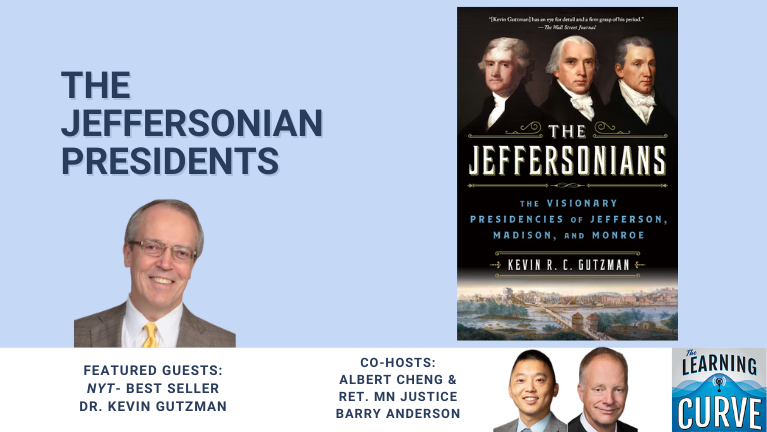
The Learning Curve Kevin Gutzman
Albert Cheng: [00:00:00] Well, hello again, everybody. Welcome to another brand-new episode of The Learning Curve podcast. I’m one of your co-hosts this week, Albert Cheng. And joining me this week is Justice Barry Anderson. Justice Anderson, good to have you back. How’s retirement?
Barry Anderson: Uh, retirement is just fine, and of course, the highlight of my retirement is talking to our audience about the Jeffersonians and those early presidents.
So I’m all in on this great and important and very interesting task.
Albert Cheng: That’s right. We’re gonna have Professor Kevin Gutzman come, and he’s gonna talk to us about his book, The Jeffersonians. And in case you haven’t heard of that [00:01:00] term, it refers to Presidents Jefferson, Madison, and Monroe. So looking forward to this episode as you are, Justice Anderson.
And so, you know, glad you’re keeping up, you’re being a student of history in your retirement, but I’m sure you’re also keeping tabs with what’s going on in education news, right?
Barry Anderson: I am indeed, and I have a news item that I want to bring to the attention to everyone that actually connects with our topic today, which is actually the announcement from the Center for Civic Education out of California of the winners of the 2026 national finals of the We the People competition on the Constitution and Bill of Rights.
Hmm. We’re gonna hold the suspense here for a minute before I announce who the winners are. Can find out yourself by looking, I guess. But just to say a word about the program, because I have deep connections with it- It is a wonderful opportunity to connect high school students to constitutional history and our history as a nation.
And of course, this year in particular, given the 250th anniversary of the Declaration of Independence, it’s [00:02:00] particularly significant. And this year’s champion among all the high schools in the country that participated was Foothill High School from California. The second place winner was from Virginia, the Maggie L.
Walker Governor’s School, and the third place finisher was Grant High School from Oregon. And the questions that they debate come directly from the textbook that is published by the Center for Civic Education. It’s in multiple versions now. I haven’t keep- I think it’s the third version, but if you’re teaching a class on civics, government, and history, this textbook is well worth consulting.
And even more so, if you’re teaching such a class, you should be thinking about participating in the competition. You can find the details at the webpage. I think there are just short of 40 states that are participating, and it’s, like, various issues, uh, the philosophical and historical foundations of the American political system.
How did the Framers create the Constitution? How has the Constitution been changed to further the [00:03:00] ideals that are set out in the Declaration of Independence? And of course, this year that has particular salience. And then there are various unit winners as well, which I won’t run through just in the interest of time, but it is a great program.
I had the opportunity to serve as an assistant coach, complicated history as to how that happened. And then when that program ran its time, the, uh, center invited me to be a nat- one of the national judges. I’ve had the opportunity to do that for most of the last two decades, and I can’t recommend the program enough.
If you’re trying to connect with students about civic education, this is a really great way to start. And they do much more than that. The center does much more than that. Its origins go back to 1965, and I commend their webpage to you. There’s lots of interesting information there. So I could go on at great length, but that would interfere with our interview with the professor.
So I’ll just stop right there and say it was, as it is each year, a great experience, and I look forward to next year’s competition as well.
Albert Cheng: Well, thanks for sharing that, Justice Anderson, and congratulations to Foothill High [00:04:00] School. Fun fact, that was actually the opponent of my first tennis match when I was a freshman in high school way back when
Did they beat you, too? They did. Did they beat all the high schools in the country? They did, I, I will admit. But anyway, th- thanks for sharing about that program. That’s great to hear, particularly this year. Real quick, let me just share my story, speaking of the way our government works. You know, this is a story about the Federal Tax Credit Scholarship program, and as you know, or I think most of you listening would know, that states have to opt into this, and so it’s kind of an interesting case study in how federal policy interacts with state policy.
But the news article- Is from Chalkbeat, and it’s an announcement that New York Governor Kathy Hochul intends to opt into the Federal Tax Credit Scholarship program. And so this is an interesting development given that New York is a blue state and perhaps doesn’t have as much of the gumption to jump into this program as, as many red states [00:05:00] have been doing.
So interesting development, and I’ll just flag that article for our listeners to consider. But other than that, let’s get onto our discussion on the Jeffersonians, shall we? Justice Anderson, we’re gonna have Professor Gutzman join us coming up next.
Kevin Gutzman is the professor and former chairman in the Department of History at Western Connecticut State University. He’s the New York Times best-selling author of James Madison and the Making of America; Thomas Jefferson, Revolutionary: The Radical Struggle to Remake America; and The Jeffersonians: The Visionary Presidencies of Jefferson, Madison, and Monroe.
Gutzman holds a BA from the University of Texas, a JD from the University of Texas School of Law, a Master of Public Affairs [00:06:00] from the LBJ School of Public Affairs, University of Texas, and a master’s and a doctorate in history from the University of Virginia. Professor, welcome to our show. It’s a pleasure to have you on.
I’m happy to be here. Let’s start with an overview. You’re the New York Times best-selling author of books on American constitutional history and The Jeffersonians: The Visionary Presidencies of Jefferson, Madison, and Monroe. So could you just give us a, an overview of your book, The Jeffersonians?
Kevin Gutzman: Ah. Well, it happens that there has never been any other time when we had three consecutive presidents from the same state, and actually, not only were these three from the same state, but Jefferson and Madison were each other’s best friend in the world.
And Monroe, after being Jefferson’s law student as a young man, served in both of the highest positions in Madison’s administration. They [00:07:00] essentially understood what they were doing is implementing exactly the same program across 24 years. Most of it they did implement. Some of it was a spectacular success, so we have huge expansion of the United States all the way to the south tip of Florida and all the way to Oregon, and some of it was a gigantic debacle As a foreign army marched into Washington, burned down the Capitol, burned down the White House, burned down the War Department, State Department, Treasury Department.
The Library of Congress was then housed in the Capitol, so that burned too. It’s hard to say what could have been a more spectacular event, but by the time we get to the end of the period, the other party has essentially ceased to exist. So people think of the Jeffersonians as having been so successful that, well, why would you even vote for those other people?
And that’s what my book’s about.
Albert Cheng: Well, let’s get into some of the contents [00:08:00] about those times and then what the flavor of all that was. So let’s start with Jefferson. And so on his gravestone, folks may know, it reads, quote, “Author of the Declaration of American Independence, of the Statute of Virginia for Religious Freedom, and Father of the University of Virginia,” end quote.
And of course, folks might be aware that he strangely excluded the mention that he was the third president, despite, as you just said, his political party, the Democratic Republicans, essentially dominating US politics from 1800 to 18- the 1850s. So describe to us his overarching political and constitutional philosophy.
Kevin Gutzman: When it came to the federal government, his primary principle was federalism. That is the idea that virtually all authority in government in the United States had been reserved to the states. And he was a very strict reckoner of where the line between state and federal authority was. [00:09:00] This was after republicanism.
Federalism was his most important political principle, I think. That’s, of course, republicanism was a given. And his two successors’ administrations rested finally on that idea, that while there were essential functions the federal government had to perform, if there were a conflict, he once said, “Well, if there were a conflict between the federal government and the states, of course, I would prefer the states.
But then within a state, I’d prefer counties, and within the counties, I’d prefer wards.” And the way I understand this is as his conclusion, having thought through the question, how can we allow or how can we make it the case that the typical person has ultimate practicable amount of authority over his own life?
And the answer was, well, this principle of subsidiarity or decentralization, however you want to look at it, that was the main thing. And of course, he was a [00:10:00] stout proponent of a very straightened spending for the federal government because he was opposed to taxes in general, and famously also an advocate of religious freedom or what in those days would be called freedom of conscience.
And in general, both Madison and Monroe shared these principles. I think he’d have a hard time trying to devise a list of ways in which any two of them disagreed in principle.
Albert Cheng: Well, you know, speaking of disagreement, why don’t we unpack the Jeffersonians’ political agenda in contrast to the Federalist Party?
I mean, you just mentioned in your answer here that their political view was in opposition to that party. So sketch for us the differences between the Jeffersonians and folks like John Adams and Alexander Hamilton and John Marshall.
Kevin Gutzman: Well, of course, Jefferson was not involved in writing the U.S.
Constitution and in fact didn’t really [00:11:00] know Hamilton before he found himself in the cabinet with him. And I think very early on in the Washington administration, Madison shared his notes from the Philadelphia Convention with Jefferson, notably that speech early on in the convention in which Hamilton stood up all day long and outlined the kind of government he would like, which was very similar to the British government.
And not knowing him as Madison did, for example, Jefferson seems to have read that in the harshest kind of way. And so we end up having party conflict in the 1790s as no one had anticipated. Between people who are organized to oppose Hamilton’s program on one side and then ultimately people who are organized by Hamilton to support his program on the other, this maybe fortuitous development was disappointing to [00:12:00] everybody who was involved.
Nobody thought party should be a normal feature of American life. That is, nobody said that he did anyway. Although, of course, Madison did mention the idea in The Federalist that party was probably inevitable. I think Jefferson didn’t believe party was inevitable, neither did Monroe. So anyway, we have this very unhappy political situation in the 1790s where people who had thought they were going to be implementing this new constitution together ended up in this very fraught political situation.
And what were the differences of principle? Well, back to what I said before about Jefferson’s favoring principle of federalism or subsidiarity or decentralization, whatever you want to call it, overall, Hamilton didn’t really have any sympathy for that idea. So this was the main sticking point, I think.
And the [00:13:00] federalism principle runs through Jefferson’s entire career from 1774 when he first became famous on a continental basis. With a pamphlet called A Summary View of the Rights of British America, made essentially that same federalism point within the British Empire context. And all the way at the end of his life, at the end of my book, he’s unhappy with John Quincy Adams’ inaugural address because it seems that, well, there we are right back to Hamiltonian principles when it comes to federalism.
So he hurries off a lengthy diatribe to Madison that he hopes the Virginia General Assembly will adopt as its new position right back to 1798, and Madison talked him into keeping it to himself. But the point is that one last time he was ready to go to the barricades in defense of the decentralization idea.
That really was, for him, the first thing. And [00:14:00] you might think, “Well, why would that be the first thing?” And the answer is, if you were a really democratically oriented politician and you thought, “Well, how could Joe the blacksmith have the maximal feasible influence on his own life?” One part of the answer would be, well, having the government be decentralized would be the, the first starting point for that.
So I think Hamilton didn’t really have any patience for this idea, and Washington himself at one point referred to these, these petty pretenders to the sovereignty kind of sneeringly. Uh, the two of them had, of course, been in the army during the war and seen that Congress had been unable to provide adequate manpower or adequate supplies to the army, pay the army on a regular basis.
And so they thought, reasonably, that the first thing a government ought to, has to be able to do is to defend the country. But Jefferson had no experience in the military and so didn’t end the [00:15:00] revolution with this attitude. Instead, he remained ideologically committed to this idea of decentralization, and considered himself to be a kind of watchdog, lest the federal government grab authority that it wasn’t really entitled to.
Albert Cheng: Let’s, um, connect some more dots here about Jefferson’s political views and, and approach. Um, so y- I, I wanna get into geopolitics a little bit. You write in your book, quote, “The year 1803 also saw the most important success of the entire Virginia dynasty period, the Louisiana Purchase. This greatest of all land sales seemed to Jefferson and James Madison to validate their longstanding approach to foreign policy.”
I’m quoting. So could you discuss the Louisiana Purchase? I mean, Jefferson had some concerns over the constitutionality of the deal, but how does it fit into the Jeffersonians’ thinking about geopolitics?
Kevin Gutzman: Well, first on that, that constitutional question, I don’t [00:16:00] think Jefferson ever was persuaded that the Louisiana Purchase had been exactly constitutional Yeah.
But apparently he was the only significant Republican who had this feeling about it. So he responded to the news of it by telling Madison to draft him a constitutional amendments, and he himself scribbled about a constitutional amendments. And soon enough came word from the American representatives in Paris, “Hey, you better hurry up and agree to this because Bonaparte seems to have changed his mind.”
Now, it may be that Bonaparte just wanted to hurry up and get his money and thought telling these rubes, “I’m thinking of changing my mind,” was a way to speed them. Whatever the reason was, Jefferson instantly brought an end to discussion with Madison about constitutional amendments. Actually, there’s an interesting story in my book in which John Quincy Adams, who was a senator from Massachusetts at the time, says that he had offered [00:17:00] Secretary Madison that he, Adams, would propose an amendment in the Senate.
And he says Madison told him, “Well, if I were on the floor of Congress today, I could not argue that this was constitutional, but we don’t want an amendment.” And why didn’t he want an amendment? Well, because he thought people who might tacitly be opposed to the idea could be foursquarely against it at that point, and you don’t know…
He didn’t know what share of the Senate they would end up being. This might thwart the project entirely, and so we’re just gonna have to go ahead and, and do it even though he, Madison, had constitutional qualms about it, apparently. Jefferson, I think, was never persuaded that this had been constitutional.
What he said was that, well, sometimes if you’re the chief executive, you just have to take advantage of fleeting circumstances and hope the people will forgive you. And what ended up happening as a result of the Louisiana Purchase, of [00:18:00] course, was that the Republicans became invincible. That was really the death knell of the Federalist Party.
Why would you… If you were a typical American voter, why would you favor the Federalists at this point? You know, my university’s in Connecticut, and I tell my students, at the time we’re talking about, typical couple in Connecticut had 12 pregnancies, and Connecticut was more or less entirely farmed at the time.
So what were you gonna do with all these kids when they grew up? And now the answer could be, well, move west. There’s all that land out there So even in Connecticut, by the end of the… And Connecticut was one of the last two states that slipped over to the Republicans, in fact never voted for Jefferson for president.
But even in Connecticut, why would you vote against these people at this point? This is just a godsend. And, well, Jefferson saw it as kind of a godsend too, but as I said, he, I think, never was really satisfied on the constitutional question. He’d famously [00:19:00] said to a friend at one point that our particular blessing was in h- having a written constitution, quote, “Let us not make it a blank paper by construction.”
Well, maybe this wasn’t even really construction. This was just kind of doing something that he didn’t think it should be done. It wa- it wasn’t any particular different reading of Article II that he employed. It was just, “Well, we’re gonna ratify it because we can and it’s a good idea.” So it’s an outstanding event in terms of the success of it, but it’s also an outstanding event in Jefferson’s career in which, as I said before, federalism was a central point from 1774 until the very last political letter he wrote.
He was always talking about that except when it came to this Louisiana issue.
Albert Cheng: Fascinating to hear hi- the way he wrestled, um, with, you know, what could be thought of as an inconsistency. Let me ask you another question just to unpack the political worldview of, of Jefferson. I wanna [00:20:00] get into the Embargo Act.
So you write in your book, quote, “Congress on December 22nd, 1807, passed the classic Jeffersonian answer to war fever, the Embargo Act. Jefferson viewed this measure, which barred all foreign trade, as a kind of quarantine.” End quote. So tell us about the Embargo Act. How is this a key element of Jeffersonian political worldview, and what impact did it have on his political opponents in New England, whose economy was really centered around maritime trade and commerce?
Kevin Gutzman: Jefferson had opposed, a- and his party congealed around Madison in the House in opposition to war preparations that the Federalists proposed in the 1790s. And famously, George Washington said, “If you want to avoid war, prepare for it.” And Jefferson simply did not believe that. So we end up with, well, Madison early on had the [00:21:00] idea that the United States could substitute trade regulation for traditional balance of powers, military calculations, and international relations.
And I think he persuaded Jefferson to try this, and it did not work. It did not work. And the reason why it didn’t work is because, well, Napoleon Had three million men in the field. He was ruler of the mightiest country in Europe, which had a population of 25 million. Britain, meanwhile, controlled all the oceans, and there was no way that the United States were going to overcome either France or Britain in any sense militarily.
So this was a ready field for plowing the let’s try the embargo approach project that Madison already had in mind. And actually, maybe the most interesting aspect of the embargo period is that after a [00:22:00] while, it became pretty clear that Americans were engaged in a lot of smuggling and various other subterfuges to get around the embargo.
And so Albert Gallatin, who’s with Madison and Jefferson, one of the three leaders of the Jefferson administration, the Treasury Secretary, wrote a lengthy letter to the president explaining what kinds of new authority he was going to need if he was going to enforce the embargo successfully. Though he was the fellow responsible for tariffs and, you know, excluded goods and so on.
So he wrote the president this long letter. If you read the letter aware of the fact that Gallatin was essentially a libertarian, you can’t help but think he’s kind of hoping that the president will take this letter as kind of a slap in the face. “Come on, Tom, wake up. What are we even doing here?” But instead, Jefferson read the letter and he passed it on to Congress, and he said, “Please pass these laws.”
So Gallatin got new authority I don’t think he really wanted, and still it didn’t work. Even [00:23:00] if the United States had completely denied New England fish or South Carolina rice or Virginia tobacco, whatever it was, whatever it was going to be selling in Europe to one of the warring parties, there was just no way that an American embargo was going to make either the British or the French change their attitude in this war to the death between the two superpowers.
So it was a forlorn hope, and as I say, I think Gallatin realized this before they even tried it. And it was just a gigantic economic disaster in the United States. So I think we can see it as being overwhelmingly ideological, really. One way to understand the Jeffersonian period is we had these realpolitik types led by Hamilton, and then we have these completely ideological types led by Jefferson or Madison or however you want to look at it
Barry Anderson: You know, Professor, we have presidents who are somewhat, th- they’re, they’re successful and it’s somewhat a surprise [00:24:00] that they’re successful.
At the risk of starting a bar room fight, you know, I would put maybe Truman and Reagan in our more s- more recent era as examples of this. Now we turn to James Madison, who’s the father of the Constitution. He authored the Bill of Rights. He co-wrote The Federalist Papers. His notes on the Constitution are themselves- Mm-hmm
historic documents of amazing importance. And yet, as your book points out, as the fourth US president, he led the nation into a disastrous war, the War of 1812. You call it the nadir of the Jefferson dynasty. Could you discuss Madison, this brilliant constitutionalist and key figure in the founding of the country, and why his tenure as president went so wrong, including, but not limited to British troops burning the White House, the Capitol, and in fact, I think we very nearly lost the Declaration of Independence as part of all the buildings that were damaged or destroyed in Washington.
Kevin Gutzman: I agree entirely. Certainly the War of 1812 or his presidency in general [00:25:00] is the low point of Madison’s otherwise spectacular political career. And people usually have a hard time hearing me say this because, well, you’d think being president was the high point of somebody’s career. Th- that would be true if his goal were just to climb the pole.
But Madison isn’t famous because he climbed the pole. He’s famous for the reasons you mentioned. So he ended up in this situation in which he describes very harsh measures that- The French and the British were taking against the United States, and he decided essentially that he would spotlight the British.
And he called more or less for Congress to declare war. It, in a pretty spectacularly underwhelming bit of rhetoric that he used there. And even at the time that they were voting for a declaration of war, they had the longest ever debates in the Congress over whether to pass a declaration of war, and then they had the narrowest votes in both [00:26:00] houses ever in favor of a declaration of war.
And one of the leaders of the Republican, that is the Jeffersonian Madison’s party, John Randolph of Roanoke, congressman from Virginia, as they were doing this, said, “What, you’re gonna declare war on Great Britain? We have no men. We have no ships. We have no money.” So it was totally ideological. The things that you mentioned that make Madison somebody we think of as one of the half dozen most important Americans were not ideological.
In fact, his not being ideological is what made him such an outstanding constitutionalist. But he was just completely out of his depth once the war started too. It w- it was just so amateurish. Besides the fact that he chose completely unfit people to be his Secretary of Navy and his Secretary of War, and then did not supervise them, and they just ignored his…
One of them, the War Secretary, ignored his [00:27:00] repeated injunctions to prepare defensive positions on the approaches to Washington, and he did not do that. And so we end up with the completely awful result you mentioned, a foreign army burning down the White House. I understand actually that nowadays you can, if you c- take a private tour of the White House, you can still see smoke stains from 1814 inside the White House.
So apparently the people who’ve lived there since have decided, “We need to keep this as kind of a, a reminder,” you know? So they still have smoke stains in the White House. But anyway, Madison, I think we’d have a higher opinion of him if he had not been president. In fact, I’m sure I would have a higher opinion of him if he had not been president.
I think
Barry Anderson: you’re not the only one, professor. I would agree with that. In 1811, he does nominate one of America’s sort of leading academic and legal lights, Joseph Story from Massachusetts, for the United States Supreme Court. And you write in your book, you tell us, “Story served as the first professor [00:28:00] of law at Harvard Law School.
He wrote several legal classics. But his preference for judge-made law over legislation and extreme nationalism could not have been more at odds with Jeffersonian dogma.” Talk a little bit about his jurisprudence, as well as how he and other Jeffersonian judges like William Johnson, the first dissenter, interacted with Chief Justice John Marshall, Supreme Court of the United States.
Kevin Gutzman: Well, by all accounts, Story got along extremely well with Chief Justice Marshall The two of them were completely in sync about how to understand the US Constitution. The most famous precedent of the Supreme Court that’s associated with Story actually didn’t really establish what it’s said to have established.
It’s, it’s said to have established that the US Supreme Court can issue orders to state supreme courts about particular cases. And well, in that case, the Virginia Court of Appeals never did what it had been ordered to do. The case did not actually establish that, [00:29:00] although that’s what everyone else is taught it did do.
Story was long the leading legal light at Harvard, and that meant that his and also John Marshall’s understanding of the Constitution was inculcated in people who were studying to become attorneys at Harvard. And well, I think from James Madison’s point of view, certainly from Jefferson’s, this was entirely undesirable.
It, it was a very, really a spectacularly successful appointment on one hand. That is, that it was very effective and in general, people in, with legal education have high opinions of Story. But I say in the book, if the measure of an appointment is the degree to which it, it leads to the, the appointing president’s understanding of the Constitution being more clearly reflected in the work product of the Supreme Court, you could argue that Story’s was the [00:30:00] worst appointment ever.
He was a thoroughgoing Hamiltonian when it came to the Constitution, and made no bones about it. And in fact, people knew that before he was appointed. When Jefferson heard that this was going to happen, he said, “Well, he’s a Tory.” Right? He, he didn’t say it to Madison, but people… It’s not that he, you know, was like people in the last three or four decades who were appointed to the Supreme Court and then, quote-unquote, “grew in office.”
Story was already full-grown when he became a Supreme Court justice.
Barry Anderson: Perhaps Madison did not have the teams of lawyers checking everything that Story had ever written
Kevin Gutzman: before appointing him. Jefferson knew it when he was appointed. In fact, there had been kind of headbutting in the House of Representatives over Story’s constitutional views, as I recall.
So it’s an interesting development. It’s really odd, I think. But to our benefit probably, but to our
Barry Anderson: benefit. So we talked earlier about Madison being a, a, shall we say, a, a less than successful president. Let’s [00:31:00] talk a little bit about somebody who is perhaps underappreciated, and that’s President James Monroe.
In your book, you note him as underappreciated. His administration best known for the Monroe Doctrine, which has been in the news lately, the acquisition of Florida, the Missouri Compromise, and the overall Era of Good Feelings. And as you said earlier, he didn’t have to worry too much about political opponents.
Could you discuss President Monroe and why he was perhaps the most successful
Kevin Gutzman: president of the Virginia dynasty? Well, you left out the Transcontinental Treaty, which said that the United States extended all the way to the coast of Oregon. Actually, my, maybe my favorite little factoid in the book is that the Transcontinental Treaty that had Spain agreeing that the US extended all the way to the coast of Oregon was signed by John Quincy Adams, the Secretary of State at the time, on the same day as the Supreme Court was deciding the case of McCulloch versus Maryland.
Okay. So I ask you, what day in American history was a more important day than that? [00:32:00] That McCulloch and the Transcontinental Treaty on the same day. The people who are not familiar with constitutional law may not know that McCulloch is essentially the basis of American constitutional law. And people who were in John Quincy Adams’ boarding house had spent their day, while he was signing the treaty, arguing that.
The thing about Monroe is that he had two really brilliant people at the head of his cabinet. Those were John C. Calhoun at War and John Quincy Adams at State. The two of them gave him extremely good advice, and he almost invariably took it, and they were right. Actually, the relationship between the two of them is really interesting.
I, my next book is probably gonna be about the relationship between the two of them. Adams, you may know, kept copious diaries for decades and decades. Every day he wrote lengthy entries in his diaries about his diplomatic career, which began when he was a teenager in Europe, and, and all the way [00:33:00] till he died, he was still making these daily entries.
When he describes the first cabinet meetings in the Monroe administration, he’s generally got a kind of a jaundiced view of everybody else, except he says, “Calhoun is certainly the most intelligent of these people. He’s the best educated. He always reasons to the right conclusions.” So this really stands out in a diary in which famously he never says anything positive about anybody who’s not named Adams.
Mm-hmm. And a few days later, the two of them were walking home from, uh, the White House to their boarding houses, and they got to talking about slavery- And Calhoun said, according to Adams, “Well, you know, in South Carolina because of the climate, there’s some kinds of labor that a white man just won’t do, so we have to have slavery.”
And Adams says, “Well, do you think if there was some kind of disagreement, do you think if your state decided to leave the union, we’d just let that go? We think that would [00:34:00] just go by, nothing, nothing would happen?” And in the end of the entry he says, “I think that Calhoun just sounded like any other southerner.”
He said, “I think all these people think of this the same way, and they don’t seem to be reasonable about it.” So from that point, there’s less adulation for Calhoun than there had been before. But in general, the two of them guided Monroe to make the right decision in virtually every significant case. So for example, it was Calhoun who persuaded Monroe to sign off on the Missouri Compromise, even though we know and people must have realized at the time, John Randolph of Roanoke said at the time, it was going to mean the end of slavery.
Because as Randolph put it, “Well, that settles it. Eventually all those territories are gonna come into the union as new states, and as we’re not allowing slaves there while they’re territories, they’re gonna send senators to Washington who represent [00:35:00] constituents who don’t have slaves, and they’ll eventually vote for an amendment to get rid of slavery.”
Well, James Monroe signed off on this at John C. Calhoun’s instigation. So that’s kind of an interesting datum, I think. The other people who were in the cabinet with them are just kind of non-entities, but Calhoun in general was the most successful, the most important war secretary before the Civil War.
He was the one who was responsible for the fact that there came to be a general staff, there came to be a regular system for promoting men through the ranks. There came to be plans of the American military for wars in various contexts with various powers. And so, you know, it came to be an actual department.
When he was appointed war secretary, it was just him and a few clerks, and he made it into a real department, which actually the most recent biographer of Calhoun says when the Civil War came, the South had Calhoun’s constitutional ideas and the North had his army. And to a large [00:36:00] degree, that’s true. And of course, Adams was the fellow responsible for that transcontinental treaty I was talking about before and for the Monroe Doctrine you mentioned, and various other really important fundamental positions in regard to our foreign policy.
So I went into writing this book not knowing as much about James Monroe as I knew about the other two, and I concluded that he was clearly the most successful of the three presidents as president. He, I think, should be remembered as one of the half dozen most successful presidents, and is mainly because of Calhoun and Quincy Adams
Barry Anderson: As you’re talking about how Monroe interacts with John Quincy Adams and Calhoun or whatever, I’m, I’m reminded of some business management work that I did very early in my career and the importance of hiring really talented people and giving them significant responsibility.
And it may be that Monroe’s success, this… I’m stating this as a premise and you can tell me I’m wrong, but that Monroe’s success has a lot to do with [00:37:00] his willingness to appoint people who were potential threats from a political standpoint in terms of their power, but were really very good at what they were asked to do.
Kevin Gutzman: Yeah. Well, that’s true. Actually, Calhoun in a, uh, I think in 1844 campaign autobiography said, “Well, of course, Mr. Monroe was not brilliant, but he had sure judgment. So if he had the right kind of constellation of facts presented to him, he would always reason to the right conclusion.” And of course, this is what you want in a president.
You know? Mm-hmm. And that’s how you could, you could describe George Washington that way, too. You don’t have to be a genius. The point is that you have to think to the right conclusion. Right. And so we could think of people who’ve been extremely smart in our own recent lifetimes- Mm-hmm … who’ve been president and have not been that successful.
Mm-hmm. But Monroe, who we don’t really know what his IQ was, he, he was of the cohort that had to drop out of William & Mary to go join the Continental [00:38:00] Army when the war started, so he never finished off his education. But he could hear people reason to whatever conclusions they reason to and then almost always make the right decision.
So you can certainly contrast him with Madison, who often was the smartest guy in the room and we said before was a very unsuccessful president.
Barry Anderson: So let’s turn for our last question of the day to another Adams, American historian Henry Adams, and who, who I believe is related to the Adams, wrote a nine-volume history of the administrations of Thomas Jefferson and James Madison.
I confess to never having read any of it. I highly recommend reading it.
Kevin Gutzman: Yeah, this is what I hear, that it is well worth reading. There’s a Library of America edition. You can buy either the Jefferson volumes or the Madison volumes in one volume, and the- they are just… The writing is superb. Besides which, he also apparently had access to British after action reports about the naval [00:39:00] affairs of the War of 1812.
He was given this access only because he was John Adams’ descendant. So for all I know, nobody’s seen those papers since he wrote the book. Anyway, really excellent.
Barry Anderson: Can you tell us a little bit about where you agree or disagree with his appraisal of this history of the administrations of Jefferson and Madison?
And maybe more generally, what should we remember about the legacy of the Jeffersonian presidents?
Kevin Gutzman: Well, the constitutional questions that- Are at issue throughout their administrations are still hot issues today. In fact, we have four square before us the same, more or less the same argument about how to read the Constitution as people had then.
In general, today’s Democrats are Jeffersonian-era Federalists when it comes to the Constitution. They are John Marshall people. And on the other hand, the Republicans, today’s Republicans, the ones who are ideological about it at least, are Jeffersonians when it comes to how to read the Constitu- [00:40:00] actually, some of them call themselves Madisonians, which nobody would have done in Madison’s own day.
They would’ve referred to Jefferson. So there’s that. And when it comes to foreign policy, of course, they were in a completely different world. America was a, an international pipsqueak, and today, you know, the United States government decides which Korean’ll rule South Korea. It’s kind of it’s virtually opposite the position they were in.
So I’m not sure exactly what lessons you’d take from that, except I do think there’s something appealing about the generally leave the citizenry alone attitude that people like Jefferson had about government. We- we’ll do what’s essential, but we won’t do more than that because what? Well, it requires taking away people’s money, for one thing, and we also want to avoid foreign military entanglements was their attitude, which they followed, we said before, almost to a suicidal extreme.
But this is still a, an [00:41:00] attractive attitude about international affairs too, I think. So of course, it’s virtually impossible to translate 200-year-old attitudes to our own day, but I think, myself, I can study these people and feel sympathetic even if I don’t think their ideas would work in my own day. I guess that that’s my attempt to avoid answering your question
Barry Anderson: directly.
And there perhaps is no answer to my question- Yeah … directly or otherwise. You know, one of the things that we ask our guests to do, Professor, is to share with us, you know, a paragraph or so of their book so that our listeners can get some sense of what you’re writing here. And I just wanna recommend to everyone that if you wanna get a picture of these Jeffersonian presidents, your book is a great way to s- to do that.
And to that end, I wonder if you could share a paragraph with
Kevin Gutzman: us. Well, I do have one. It’s about James Monroe’s second term beginning, [00:42:00] and it says: Besides putting off taking his oath, Monroe had recently come under pressure from, quote, his Virginia friends to forgo the opportunity to give an address.
Raising this idea with Adams, he received the response that if he decided not to speak, he had better make his intention known ahead of time, lest the large assemblage come to hear him be disappointed. Monroe said he would bring it up at the next Cabinet meeting, which he did Navy Secretary Smith Thompson took the nay side, noting that the Constitution did not call for an address, and saying that if the question were a new one, he would oppose giving one.
Adams replied that, quote, “There was a propriety in the thing itself. Indeed, the only one like it under our system that had been uniformly done, and it ought to be done again.” The other members agreed there was no adequate reason to discontinue the practice. As Clay was no longer speaker, this inauguration ceremony could take place in the House of Representatives chamber.[00:43:00]
The president asked the secretaries to meet at his house and to travel with him. As the Secretary of State described the scene, quote, “The president, attired in a full suit of black broadcloth of somewhat antiquated fashion, with shoe and knee buckles, rode in a plain carriage with four horses and a single colored footman.
The Secretaries of State, the Treasury, War, and the Navy followed, each in a carriage and pair. There was no escort nor any concourse of people on the way, but on alighting at the Capitol a great crowd of people were assembled, and the avenues to the hall of the House were so choked up with persons pressing for admittance that it w- was with the utmost difficulty that the president made his way through them into the House.”
So here we have the image of not quite excitement at the idea of James Monroe’s being inaugurated a second time.
Barry Anderson: Well, Professor, thank you for that paragraph, that vivid introduction into, um, what that second inaugural speech was going to look like. [00:44:00] Maybe we see a little bit of a spectacle that we have these days, but also a sense maybe of history being made.
And I just wanna thank you for your time today, and once again recommend to our listeners The Jeffersonians. It’s a wonderful recounting of three presidents. We often view them separately. By the time you’re done reading this book, you will see a theme that extends through all of those presidencies, even if one of them wasn’t all that successful.
Professor, thank you very much. You’re entirely welcome.
Albert Cheng: Well, that was another great show, uh, Justice Anderson. Again, I just enjoyed being a, a student of history with you.
Barry Anderson: Well, and, you know, the professor’s grasp of these early presidents … And what’s interesting about it is everybody knows Jefferson, and they may know Madison as the founder of the … one of the founders, key founder of the [00:45:00] Constitution.
But they may not know Madison and Monroe as presidents. And they were both significant in various ways, and they tend to get lost in that early 1800s history. So we recommend the book highly to people who are interested in learning more about those three very significant presidents.
Albert Cheng: Indeed. So, uh, well, thanks for joining me on this episode.
Uh, look forward to seeing you next time. Indeed Before we sign off here, let me leave everybody with the tweet of the week. This one comes from Education Next. Quote, “Far from the promised revolution, we appear to be witnessing an unprecedented experiment in cognitive attrition.” And this is a book review of a new book by Jared Cooney Horvath entitled The Digital Delusion.
So perhaps a critical view of some of the new technological developments that are coming out. And then make sure to join us next week for another episode of the Learning Curve podcast. We’re gonna have Rachel Kantor join us. She is the [00:46:00] director of education policy for the Reinventing America’s Schools project at the Progressive Policy Institute and the founder of Mississippi First.
Until then, have a great day and be well.
| In this week’s episode of The Learning Curve, co-hosts U-Ark Prof. Albert Cheng and retired MN Supreme Court Justice Barry Anderson speak with Prof. Kevin Gutzman, Professor and former Chairman of the Department of History at Western Connecticut State University, and New York Times best selling author of The Jeffersonians: The Visionary Presidencies of Jefferson, Madison, and Monroe. Prof. Gutzman examines the political and constitutional legacy of America’s “Virginia Dynasty,” beginning with President Thomas Jefferson’s philosophy of limited government, states’ rights, and religious liberty. He explores Jefferson’s sharp political differences with the Federalists, the importance of his first inaugural address, and major events such as the Louisiana Purchase and the Embargo Act. Turning to President James Madison, Prof. Gutzman discusses the “Father of the Constitution’s” disastrous administration during the War of 1812, and reflects on how the conflict severely tested Jeffersonian political ideals. He also considers the jurisprudence of President Madison’s nominee Justice Joseph Story and his relationship with Chief Justice John Marshall and other members of the U.S. Supreme Court. Prof. Gutzman highlights President James Monroe’s often overlooked achievements, including the Monroe Doctrine and the “Era of Good Feelings,” while assessing the enduring legacy of the Jeffersonian presidents in shaping the Early Republic. He closes with a reading from The Jeffersonians: The Visionary Presidencies of Jefferson, Madison, and Monroe. |
Stories of the Week: Albert highlights an article from Chalkbeat New York on how New York Gov. Kathy Hochul intends to opt into federal education tax-credit program. Barry shares a story from Civic Ed announcing the winners of the annual “We the People”: The Citizen and the Constitution national civics contest.

Kevin Gutzman is Professor and former Chairman in the Department of History at Western Connecticut State University. He’s the New York Times Best Selling author of James Madison and the Making of America (2012); Thomas Jefferson – Revolutionary: A Radical’s Struggle to Remake America (2015); and The Jeffersonians: The Visionary Presidencies of Jefferson, Madison, and Monroe (2022). Gutzman holds a B.A. from the University of Texas; a J.D. from the University of Texas School of Law; a Master of Public Affairs from the LBJ School of Public Affairs, University of Texas; and an M.A. and Ph.D. in history from the University of Virginia.