

Julie Young, Julie Petersen, & Kay Johnson on Virtual Schools, Actual Learning
The Learning Curve Petersen, Young, Johnson
[00:00:00] Albert Cheng: Well, happy holidays everybody, and welcome to another episode of the Learning Curve Podcast, our last original episode for this year. I’m one of your co-hosts, Albert Cheng, and I’m joined with my partner in crime, Alisha Searcy. Alisha, what’s going on? Happy holidays. Happy holidays.
[00:00:39] Alisha Searcy: It is feeling like that time of year. It is. We put our tree up. We’re having our Christmas party this weekend. I’m in the spirit for sure.
[00:00:48] Albert Cheng: Great. Well, i’m excited for our show. I think it’s a nice way to wrap up a long and Wow. Really happening year. Yes. The twists and turns for sure. That’s right. That’s right. Well, we’re gonna have Julie Petersen, Kay Johnson, and Julie Young, three guests to close this out.
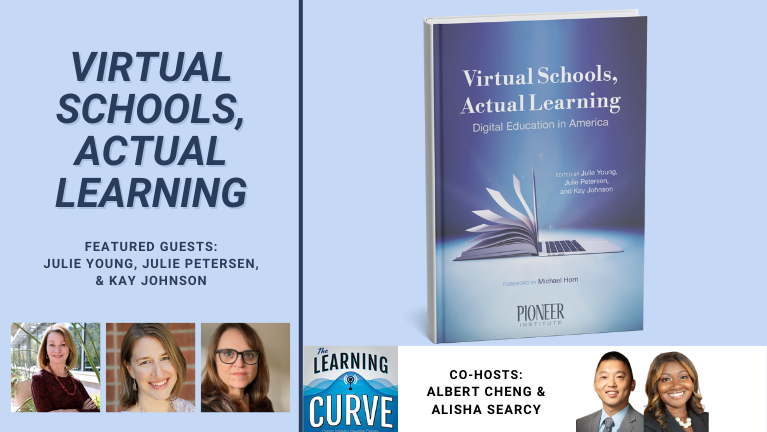
[00:01:06] They’re the co-editors of a new book just released by the Pioneer Institute Virtual School’s, Actual Learning Digital Education in America, which, by the way, is ranked number one on Amazon in the category of ed policy and reform. So how about that? Very cool. Before we get to that interview though, Alisha, we should talk news.
[00:01:28] I’ll start this year. ’cause you know, we’ve been talking about the end of year. I, I guess maybe I’m a little sucker for these kind of articles that try to summarize the year and so I wanna flag the one from the 74, 20 25, the year in charts. Now I like this one ’cause there’s lots of pictures now, now like cartoon pictures, but graphs.
[00:01:48] So I, I don’t know, of course, maybe that’s just me. I think it’s an excellent article. It’s just a rundown of some of the topics that we’ve talked about on the show regarding ed policy, absenteeism, achievement test scores, school choice, cell phone bans, teacher pipeline issues, student enrollment. I mean, this is all sounding very familiar, but I, I really appreciate the 70 four’s work in curating some of the facts and figures that we might consider when we’re thinking about these issues.
[00:02:19] Alisha Searcy: I love that.
[00:02:21] Albert Cheng: Well, what did you find?
[00:02:22] Alisha Searcy: Speaking of kind of the year end, this year is ending with a little bit of sadness because we’ve lost one of our nation’s, I think giants in education. That would be Rod Page, who was our nation’s first African American Secretary of Education who died at 92 December 8th or ninth.
[00:02:43] And so Albert, the reason I chose this is I really looked up to Rod page. People would find that odd because I’m a Democrat and he worked in a Republican administration. I don’t even know if we knew his party affiliation, but a little bit about. Rod page. He was an educator coach and administrator who rolled out the legendary, no child Left Behind law, as I said, was the first African American to serve as US Secretary of Education.
[00:03:11] And he served under the Bush administration and we know there’s a Texas connection there. He was the superintendent of Houston ISD, and you know, made a lot of gains and national notoriety. And then of course, president Bush appointed him as Secretary of Education and he has a, you know, very interesting story.
[00:03:33] He started out as a football coach. Mm-hmm. Among other things, went into education. He was a interim president of a college. Very interesting history. And he’s also a personal hero of mine in education, not just because of, you know, what he attempted to do with No Child Left Behind, and I’ll talk about that in a second.
[00:03:54] But personally, when I ran for state school superintendent in 22, I really wanted to have a bipartisan. Focus and I wanted to bring people together because I think education should be bipartisan. So one of the first events that I held was a virtual meeting with Rod Page and Arnie Duncan. And as someone who is like an education nerd and.
[00:04:21] You know, all of that, like Rod Page and Arne Duncan are like Beyonce to me, you know, in education. So it was one of the coolest things I’ve ever been able to do in my career, to bring these two individuals together, to have them answer questions, my questions about public education and the direction that we were heading.
[00:04:40] And it was just so beautiful to see these two very well-known figures in education, talk about what was happening, bring other people together. And so the fact that he was willing to do that for me says a lot. And, you know, had the opportunity to interact with him a few times as well as his wife, who’s very, very involved and very well respected in Texas.
[00:05:01] And so people can criticize No Child Left Behind. It certainly had its challenges, but what I appreciate, Albert, is that No Child Left Behind for the first time in this country, made us disaggregate data. Mm-hmm. And understand how students were doing, whether they were. Low income students, students with special needs or disabilities, breaking out the data by race.
[00:05:27] It really made us have to look at how each group of students were performing instead of just putting it all together and hiding essentially. Mm-hmm. And so anyway, I appreciate his life. I appreciate his work, his contributions to education, and of course we honor him today. And we send our condolences, Anthony, his wife and his family, and all those who loved him.
[00:05:49] Albert Cheng: Yeah. Well, thanks for sharing that, Alisha. And, and yeah, what a, a fitting way to commemorate his life and legacy. I mean, I’ll just add one quick story. I had the chance to meet him very briefly at the International Conference for School Choice and Reform over 10 years ago now. I can’t believe it’s been that long.
[00:06:05] Wow. He was a keynote at that conference that year. I was, I was still a grad student then, and yeah, I just remembered it being a, a real treat to meet him. So what a man. And we lost a good one Yeah. This year and him, so thanks for sharing that. Let’s move on to our main event, which is to discuss this new book.
[00:06:23] So, uh, let’s get ready for that. Alisha, it’s gonna come up on the other Sydor, this break.
[00:06:38] Well, welcome back everybody, and it’s my pleasure to introduce Julie Young, Julie Petersen and Kay Johnson, who are the co-editors of Pioneer Institute’s new book, virtual Schools, actual Learning Digital Education in America. Well, Julie, Julie and Kay, welcome to the show. Thanks for giving us your time.
[00:06:58] Thanks for having us, Julie Young, let’s start with you. You’re the founder of Florida Virtual School and CEO of ASU Prep Digital. And you know, one fun tidbit is, I don’t know if our listeners are aware, you got a shout out from Paul Petersen’s Saving Schools book and you know, he placed you essentially alongside some of the most important pioneers in the history of American education, Horace Mann, John Dewey, and others.
[00:07:25] Could you share with us just some of the larger principles of educational leadership that you worked with to establish Florida Virtual School and ASU Prep digital?
[00:07:35] Julie Young: Absolutely. First of all, I always want to share that I am often called the founder, and I make sure I say I am the founding president and CEO, because Florida is the founder.
[00:07:48] So that’s one thing. But thank you for the question. The work at FLVS and ASU Prep was really built on three foundational principles that challenged conventional thinking about education, delivery, and leadership. We believe students should be at the center of every single decision, and that sounds obvious, but in the late 1990s, designing a school around when and how each student learned best rather than around bus schedules and building capacity was revolutionary.
[00:08:23] We asked the question, what if students could learn algebra at 10:00 PM or biology at 6:00 AM. What if they could move faster in subjects where they excelled and take more time? Where they struggled, again, sounds logical, but practically never happened. Second, we trusted teachers as professionals. This was probably one of our hardest things to get others to understand, as silly as that sounds.
[00:08:51] But at FLVS teachers were not constrained by 50 minute periods or classroom management issues. They could focus entirely on instruction and building relationships with students. We gave them autonomy over when and how they delivered their curriculum, not over the curriculum development, but how it was delivered and held them accountable for student outcomes and not seek time.
[00:09:18] That was revolutionary. This attracted exceptional educators who wanted to innovate, and our teacher retention rates were significantly higher than traditional schools. They loved the autonomy and they felt like professionals. And third, we proved that quality could scale through technology without sacrificing the human element.
[00:09:42] Virtual education isn’t about replacing teachers with computers. It’s about using technology to extend excellent teaching to more students. We built a model that served 77 students in year one, and eventually reached over 2 million students across all 50 states and six eight countries maintaining quality throughout that growth and that scale.
[00:10:06] So the through line in both FLVS and ASU prep was really about rejecting the factoring model constraints and asking ourselves as professionals, as people, as parents, and as educators, what actually works best for student learning and then following our heart.
[00:10:25] Albert Cheng: Well, thanks for that. Julie Petersen, I wanna turn to you and start talking about this new co-edited book, again, Virtual Schools, Actual Learning Digital Education in America.
[00:10:36] Could you just give us a brief overview of the key elements of the book and what’s important for state policy makers and school leaders to pay attention to?
[00:10:45] Julie Petersen: The book really takes a look at the last three decades of online learning in K-12 education and really puts it in the context of lessons and early attempts by pioneers like Julie Young, as well as infrastructure that state policymakers tried to put in place over the years.
[00:10:59] And the book really makes a few key points that I think are worth noting for both policy makers and practitioners. First of all, online and virtual learning, were really started to respond to some pretty unique needs. You know, kids who were way ahead and wanted more, or sometimes way behind and needed to catch up on credit recovery or maybe struggled with bullying or medical or logistical issues.
[00:11:18] But over time it really came to serve all sorts of students, even today in more traditional schools and classrooms through what’s called blended learning or using online coursework to supplement what’s happening in the classroom. And that growth has really made it more possible for teachers to start micro schools and parents to choose homeschooling.
[00:11:35] And so we think those are all sort of really positive moods toward giving more kids teaching and learning that’s tailored to what they want need and what they might respond to. I think the other thing we really try to point out throughout the book is that online and virtual learning are really just as variable as online or offline or face-to-face learning.
[00:11:51] When it’s done well, it can kind of tap into some unique features. You know, immersive video, kind of dynamic communication between teachers and students, maybe some cool connections to college and workforce learning. And of course, lots of virtual schools and online schools are using artificial intelligence.
[00:12:06] I mean, when teachers are trained well and the materials are strong, that student learning can really skyrocket. But it’s important to point out that just as a traditional classroom with a ineffective teacher or incoherent curriculum can lead to lackluster outcomes too. So really the point of this book is not that online’s for everyone or that online, somehow a magic bullet, but rather that online courses, content in schools can be released useful when they’re built carefully to leverage online capabilities and to address individual student needs.
[00:12:33] The last point on the book that I’d really make here, and this is probably pointed mostly at policy makers, is that with online learning, what you get out of it is very much what you put into it. So the policies that state legislators and offices of education put in place matter really tremendously, just like everything else in public K-12 education.
[00:12:49] So the states that set up restrictive policies with limited funding and restrictions got kind of a limited supply of providers and not necessarily the highest quality. But other states have put in place more supportive funding models, solid training, really strong accountability policies, and they’ve found that there’s sort of possible to make online learning options available to kids and that it can serve kids really well alongside some of their traditional options.
[00:13:13] Albert Cheng: Okay. I, uh, wanna bring you in here. I mean, you have had an impressive career at FLVS and ASU Prep digital working at, at the intersection of education, policy and innovation. I wanna ask you to describe a little bit of history here. I mean, you and your co-editors. I offer the readers some key dates and milestones in the development of virtual schooling.
[00:13:35] What are some of those pivotal historical moments and how have they shaped digital education, both here in America and worldwide?
[00:13:42] Kay Johnson : Thanks for having me. I’m excited to be here, and I was just listening to Julie talk about the importance of policy, Julie Petersen, and I couldn’t agree more. As I look back on milestones, I have to say that policy has been a major factor, and since I worked at Florida Virtual School, of course I naturally think of it’s launch in 1997 as a milestone just because of the influence that the program had.
[00:14:06] But there were other states already experimenting with virtual learning even then. Certainly by the early two thousands you saw some other players coming on board. But a major turning point came in 2003, and that was when Florida became not only the first statewide public virtual school, but also the first statewide IC school to be funded through the State’s regular per pupil funding model. And with a major caveat being that the funding was tied to student outcomes. Hmm. So that was a game changer, not just for virtual learning, but for all education. It was a big shift. It was a mind shift and a big shift in education towards mastery-based learning models for online learning.
[00:14:51] It really provided a model for scaling those programs with accountability. Like we said, okay, we believe this works. We’re gonna put the onus on ourselves for performance after that, in the first decade or so of the two thousands, expansion varied by state, and a lot of this, I will say it was tied to policy where you saw creative policy, you saw growth.
[00:15:11] For example, in Michigan, Michigan became the first state in 2006 to require an online course for graduation. Michigan had a virtual school as well, and Florida followed suit not long after that. And what that helped to do was make digital learning. More normal, right? Gave more exposure to families and to students about what it looked like.
[00:15:33] Certainly by, in the latter part of the decade before the pandemic, there were online options available in pretty much all 50 states, mostly as supplemental, not full-time. That was less common. Some states built pretty robust ecosystems like Colorado as one example. They allowed district, they were kind of providing all kinds of ways for people to get into the virtual learning game.
[00:15:57] They could do it by district, they could do it with a multi-district partnership. They created all kinds of creative ways to serve kids, and it was more bottom up than top down. Utah created a statewide program that was a. Open entry, open exit for online courses, allowing any kids to take online courses.
[00:16:16] But then there were other states that were less friendly and we’ll talk about those on.
[00:16:21] Albert Cheng: Yeah,
[00:16:22] Kay Johnson : but I would have to say the pandemic was another important inflection point, and it was not a positive one for online learning. Unfortunately, the emergency zoom school that happened during that time became kind of conflated with really established, well designed, thought out online learning programs, and because of that, there was a lot of suffering of public perception of online learning as a result.
[00:16:49] So the upside is though some states since then Texas being one, have reflected on lessons learned and have gone to work, modernizing their policy as a result to kind of build, they saw the lack of resilience and they, they’ve changed their tune a little bit in their legislation. So that’s a good thing.
[00:17:06] Albert Cheng: Well, thanks for that very brief history. Julian. I wanna come back to you and let you talk a little bit about the history of FLVS. So as you corrected, you’re the founding president. Hope I got that right this time. And could you just tell us about the origin story? Your origin story, as in as youpreneur at FLVS?
[00:17:27] What were some of the early challenges creating this, you know, new technology driven, student-centered mode of delivering K-12 education?
[00:17:36] Julie Young: Sure. I’m laughing and smiling. You know, some of the early challenges FOBS started with a $200,000 grant from the Department of Education from the Florida Department of Education.
[00:17:48] And one simple question, could we use emerging technology internet technology to give students more options? Now, in 1997, this was audacious to use a baby. When I say most people didn’t have reliable internet at home, we were in the midst of the beginning stages of dial up. Yeah, skeptics. And there were many.
[00:18:12] Really felt like students needed classroom structure of a building and that online learning would be socially isolating and that it couldn’t possibly work. So the early challenges were immense. We had to build everything from scratch. Curriculum learning management systems. Yes, we helped build them with vendors, teacher training protocols and student support structures.
[00:18:37] There was no playbook. And when I was hired, Bob Williams, the deputy superintendent, said, how do you feel about doing something that has no rules and no playbook? And there was no playbook for virtual education. We had to prove that students could learn effectively online, and that teachers could build genuine relationships with students they had never met in person, and that this model deserved public funding.
[00:19:05] So one of our biggest obstacles, as you might imagine, was legitimacy. Our biggest questioners were traditional educators who questioned whether virtual schools were real schools. We had to demonstrate repeatedly that our students were learning that completion rates were strong and that they were valid, and that graduates were succeeding in college.
[00:19:27] So every success story became ammunition for proving that this model was working. We also faced immense technical challenges that seem almost quaint now, but our brains and our vision were so far ahead of the technology at the time, you know, students were losing internet connections in the middle of a lesson and losing all their work, the limitations of dial up and getting textbooks delivered to homes initially.
[00:19:55] But these obstacles kind of forced us to innovate constantly, and again, to keep students at the center of the actual circumstances. So when I think about what made this entrepreneurial rather than just innovative, it was the constant resource constraint combined with the need to build a sustainable business model within public education.
[00:20:19] Number one, we don’t talk about business model and public education typically in the same breath. We couldn’t just burn through venture capital, hoping to figure it out later. Every decision had to balance innovation with financial viability. We had to repeatedly and constantly convince the legislature to fund us based on student success rather than enrollment.
[00:20:43] We built partnerships with districts that saw us as competition. I called that coopetition. We created revenue streams through course sales to other states and countries. At the time, you didn’t hear about schools or school districts selling to other schools or school districts. We thank Governor Bush for that.
[00:21:07] This wasn’t a pilot project that was, you know, had unlimited runway. It was building a plane while flying it, proving that the concept worked, and then making sure we could sustain it financially all at the same time. It was moving very fast. And that’s the essence of entrepreneurship, creating something that’s both educationally transformative and operationally sustainable.
[00:21:33] Albert Cheng: I just appreciate you recounting all that. I mean, this is fascinating to think about this, and particularly the entrepreneurship business, Sydor things quite amazing, the work you’ve done. So thanks for sharing that. Thank you. Julie Petersen. I wanna turn to you. Let’s talk about the forward to the book.
[00:21:48] Michael Horn is the author, and I think I may our listeners know him as the co-founder and a distinguished fellow at the Clayton Christensen Institute for Disruptive Innovation. And you know, we know Michael’s been in this space for quite a bit. Could you talk about Michael’s forward and what lessons he offers to readers, policymakers, and state leaders?
[00:22:10] Julie Petersen: Absolutely. Yeah. No, I’m sure your listeners are pretty familiar with Michael. He is been a prolific author and scholar in the K-12 and more recently in the career space. I’m not sure when he was last on the learning curve, but it may have been back in the pandemic. He was promoting his book from Reopen to reinvent back then.
[00:22:26] Mm-hmm. But what people may not know is that one of his earliest forays into K-12 was a book he co-authored back in 2008, back in those early online learning days with Clayton Christensen. It was called Disrupting Class, and it was focused on the potential of online and personalized learning. One of the things that book became sort of famous or infamous for was a really enthusiastic prediction that half of all K-12 classes would be taking in online by 2019.
[00:22:51] And we’ve all seen that hasn’t exactly come true. But one of the things those guys really did foresee is that the growth of blended learning and sort of the more daily use of technology that’s happened in traditional schools and classrooms, I don’t think a lot of folks really thought that we were gonna get as far as we have back then.
[00:23:05] But Michael’s forward really does help set up one of the core thesis of the book, which is that online learning has the potential to meet individual student needs. So in the forward, Michael does a really nice job of sharing some of his own sort of awkward experiences with online learning in his early career.
[00:23:21] And then also really talks about the fact that thousands of teachers are actually themselves being prepared to online to teach in our schools. Kinda looking at those sort of different aspects of online learning, to kind of remind us that just because something is online doesn’t mean it’s inherently positive or negative, that pedagogy and design really matter enormously.
[00:23:39] I think the other big sort of point that Michael tees up in the forward is that online learning is still really part of a larger public education system that hasn’t quite evolved to measure and meet individual student needs. So he’s a big advocate for sort of this notion of personalizing and individualizing learning to, you know, kids with lots of different strengths and challenges.
[00:23:59] And he really points out that the research on online learning has been greatly limited by the fact that it hardly ever compares it with what students might otherwise be choosing if they didn’t choose online learning. And then lastly, you know, Michael’s a really big advocate of what’s called the Jobs to Be Done framework, where you sort of consider what folks are looking for a school or classroom to do for them.
[00:24:17] Then evaluate that success based on how well it achieves that goal. And I think there’s just a lot of room for some additional research to kind of help us kind of get down to that specific goal or job to be done that students are using when they choose an online class or an entire online school. And really comparing what they get out of it compared to what they would’ve gotten, you know, whether they had other options or not without choosing that option.
[00:24:41] Albert Cheng: Kay. I wanna come back to you and in your previous answer you, you alluded perhaps to some states that weren’t doing a great job at, you know, promoting quality virtual schooling. How would you grade the quality of state regulations around digital schooling? Are states doing a good job, bad job? Generally, what are some strengths and weaknesses that you see, you know, perhaps some leaders and laggards, if you will.
[00:25:04] Kay Johnson : I think the real challenge, real policy challenge always, always from the beginning has been about separating the learning process from restrictions on time, place, and pace. So if you think about traditional schooling, you know, everything’s scheduled out for the kids, right when they go to class, where they go to class, how long they’re in classes and so on.
[00:25:27] And online learning kind of turns that on its head. But you can imagine then, you know, getting policy to catch up with that. Right? That has always been the challenge. You know, how do you fund that? How do you fund it when a one teacher is teaching kids from one district in another district, like that hadn’t been done before.
[00:25:44] Mm-hmm. Right. That was a new development in online learning, so it took a a long time for policy to catch up. Certainly, again, Florida remains a leader because they’ve just had a long time to work this out and to work out some of that outcome-based funding that I had mentioned earlier. Other leading states, Utah’s been pretty proactive.
[00:26:03] They even developed a statewide and other states have done similar things, but they developed a statewide digital master plan to like proactively plan for training their teachers and making sure their infrastructure was in place and that kids had access. Other states that are stand out and that have had state virtual programs in one form or another include Michigan, Georgia, Pennsylvania, and North Carolina.
[00:26:26] And there’s, there are others. Other states like North Dakota, Indiana, and Arizona have even added language to recent legislation to allow for mastery-based learning. Over seat time. In other words, like kind of challenging district leaders like you tell us what that looks like. And that’s even beyond online learning.
[00:26:46] They’ve opened some of the doors to, you know, regular classrooms to think about that. So Massachusetts is a state, and even Texas is another state that have been a little more heavy handed. And I will say in general, the Northeast in general has always been a little more heavy handed on regulation. And it kind of has limited the innovation things like growth caps and when and where it happens, that kind of thing.
[00:27:12] You know, that limits the innovation that you’re actually trying. Like I said, time, place and pace is what you’re trying to find a way to open up. And a lot of these policies end up closing them back down. Right. And it’s exciting to me to see really flexible mastery learning models spreading beyond even this false choice between classroom and online.
[00:27:36] Like now we’re seeing hybrid models and AI technologies that are driving all kinds of new possibilities. And the leaders of those. Innovations are building on some of the very funding and governance structures that came about when we were trying to push online learning, right? Mm-hmm. And so they should thank Julie Young and people like her for asking those what if questions that have at least provided some precedents for them to build on and to point to when they’re trying to do some really out of the box things and say, look, kids learn everywhere.
[00:28:08] How can we facilitate that? We capture that.
[00:28:11] Alisha Searcy: Well, let me jump in and say thank you, Julian, for asking the hard questions. And now I’ve got a question for you and I’ll have to tell you. It’s very cool for me to hear this conversation, especially in that last question. Just the states that are doing things.
[00:28:25] Well, and here, Georgia mentioned, I was in the legislature years ago when we started these conversations about virtual learning. And I’ll never forget sitting on the house education committee and it was sort of the first introduction, if you will, to virtual learning. And I had, I didn’t know anything about it and I asked a hard question and got a real education about it, and now I’m a huge fan.
[00:28:49] So it’s just so important, the work that you guys have done. And so, Julie, I wanna ask you this first question. Much of the K-12 American public education system based on the factory model and agricultural calendar is fundamentally outdated for students and their instructional needs in the 21st century.
[00:29:08] I think we can all agree. On that. Can you talk to us about what you would say are the key lessons drawn from FLVS, Khan Academy, ASU Prep, and other high performing countries about digital learning that American policy makers and educators need to be embracing?
[00:29:28] Julie Young: Sure, sure. You know, the most important lesson, the most important lesson is that time-based education is obsolete.
[00:29:37] Students are not the same. Yes. And FLVS proved that mastery-based progression works. We did it in a very rudimentary manual way. Almost 30 years ago. But students advance when they’ve mastered content, not when the calendar says it’s time to move on or go on summer vacation. So Khan Academy reinforced this with their brick and mortar lab school in California with personal learning at scale.
[00:30:07] Higher performing countries understand that seat time is a terrible proxy for learning. They were ahead of us in the us. Singapore emphasizes mastery learning with flexible progression rates. While Finland achieved superior results, which shorter school days, their kids go home a lot earlier than our do, and the teachers determine the pacing.
[00:30:29] New Zealand and the Netherlands have implemented flexible learning pathways where students progress based on demonstrated competency rather than time spent in courses. So time-based education is obsolete. Okay. Second, the teacher’s role transforms, but does not diminish in digital. I think that’s the one thing that people think the most is that if you’re in a digital environment, that you know it’s all about the technology and high quality programs.
[00:31:00] It is not all about the technology. We rarely ever even spoke about the technology. The best virtual teachers are more engaged with individual students than many classroom teachers can be with 30 kids at once in one classroom, and I emphasize can be policymakers need to stop viewing digital learning as a replacement for teachers, a cheaper replacement for teachers sometimes, and start seeing it as a means to empower teachers.
[00:31:31] Third, digital learning enables true personalization that the factory model simply cannot deliver. When a student can review a concept 15 times or skip ahead three grade levels in math while working at grade level in reading, you’re finally meeting that child’s actual needs. We do not do a good job in our traditional programs of diversifying the educational needs of students simply by the nature of how a classroom works and how a school works.
[00:32:05] Fourth, digital infrastructure is now educational infrastructure. We can thank COVID for that. The pandemic exposed, how unprepared we were, but in my opinion, the real lesson is that equitable access to technology and connectivity, it is not a luxury. It’s a civil rights issue. Countries that understand this are investing accordingly and have been for quite a while.
[00:32:32] And finally. Innovation requires regulatory flexibility. Those two words together almost make me chuckle, Florida, allowed FLVS to operate outside the traditional constraints, different funding models, flexible scheduling, and a teacher certification that was adaptable, that regulatory courage enabled innovation that traditional systems would’ve strangled.
[00:33:00] I remember the first meeting I had with Frank Brogan, who was our commissioner of education at the time, about the grant and about what we were doing, and his parting words were, Julie, nobody knows how to do this. Please go make it up and come tell us how to do it. And in the meantime, just don’t hurt anybody along the way, but you have flexibility not to follow the rules.
[00:33:26] And that was amazing and a gift that probably propelled us to become very innovative very quickly.
[00:33:34] Alisha Searcy: So many great things that you’ve said, a lot of teachable moments. I want our listeners to go and replay those. The answer to that last question a few times, a lot for us to learn and take from that about timing and flexibility and all of the things, so thank you for that.
[00:33:49] This next question is for Julie Petersen. Julie Young just mentioned pandemic, so I want to ask about that for a second. The 2024 NA results again revealed academic stagnation and decline, which we witnessed between 2011 and 19, and then only worsened during COVID. Can you talk about what virtual schools actual learning has to tell policymakers about addressing the national crisis of NAEP decline and learning loss?
[00:34:18] Julie Petersen: Absolutely no, thank you for unfortunately reminding us of the, the really sad reality that, you know, our, our kids just haven’t been learning at the levels we’ve wanted or needed them to learn at for a long time. And the pandemic really just brought that into sort of short perspective. But I wanna take a second to clarify.
[00:34:34] I think we, this has come up a little bit in some of what Kay has said earlier on, but clarify just quickly for listeners though, a difference between virtual learning and virtual schooling as it was emerging before the pandemic and the emergency remote learning is sort of the term that we use for what really arose in March of 2020 during the pandemic, when schools shut down.
[00:34:53] So online or virtual learning. You know, when done well is really carefully constructed to meet the needs of teachers and students in virtual environments. It uses materials that are designed for use online. It includes extensive teacher training, often uses learning coaches to kind of supplement parents and teachers to really make sure kids are on track, and really importantly, folks opt into it, right?
[00:35:15] Emergency remote learning was. Blanket thrown out for all students and teachers to use. Kind of no choice in the matter. Very little onboarding and professional development. Certainly some folks, you know, did it more carefully than others, of course, but it was kind of used across the board, a lot of awkwardly adapted print and offline materials that were kind of hacked together to be used online.
[00:35:34] And really a lot of, you know what people remember, not at all fondly, as in the Zoom school days of 30 kids on a screen. Rather than what you tend to see in a lot of really strong virtual learning programs around small group, asynchronous, individualized, you know, sort of different kinds of outreach to kids based on what teachers and students needed in the moment as opposed to everyone sitting on a screen together for minutes or hours.
[00:35:57] That said, I think there was some good that did come outta this time. You know, there was a huge investment in technology, infrastructure and devices, and with the pain of parents watching their kids at home all day, every day, came really like some pretty broad parent awareness of what their kids were learning in school and some of their unaddressed needs.
[00:36:15] I definitely remember realizing some of the supports that my kids needed, and particularly my second grader at the time, just didn’t really realize some of what wasn’t happening in school until it was sitting right in my living room at home. But I think unfortunately as we came out of the pandemic, a lot of this learning loss data and what folks saw with Zoom schools and other unfortunate remote learning sort of outcomes really led a lot of state policy makers, educators, you know, well-intentioned folks to kind of snap back to what they were doing before the pandemic rather than learning from what had worked and not worked during the pandemic, really, a lot of people went back to sort of low tech in-person supports like tutoring and counseling, which certainly have their role and are great in a lot of ways, but really backed away from some of the tech enabled supports like blended instructions and remediation software.
[00:37:03] And like the hardest part of all of this, I think, is that a lot of online learning policies and programs that were, you know, really benefiting kids and parents were often shut down or reversed, which sort of was a shortsighted backlash that just hasn’t really served some folks. I think as we go forward, we really need to think about how we embrace technology and use it to supplement and optimize for what people can do rather than kind of backing away from that.
[00:37:27] Alisha Searcy: Yeah. So important. I’m glad you made those distinctions and I, I don’t wanna go down this road, but I think we have to acknowledge that, sadly to your point, that there are districts and educators in general who shied away from digital learning as a whole because they had a poor experience during COVID, but they didn’t quite acknowledge that people weren’t trained.
[00:37:50] They may not have been using the best curriculum. So there are a number of reasons that may have contributed to that, rather than just abandoning it all together or not believing that it can be effective. So I appreciate that point. This question is for Kay staying on this conversation about COVID. And we know that there are some things that didn’t work, but well ahead of COVID -19. Proponents of virtual blended and digital learning have long believed that the future of K-12 schooling was going to be driven by online education during the pandemic. Remote schooling has had some successes, though the four many families and students saw, I didn’t entirely meet the moment. Would you talk about how ASU Prep successfully met the pandemic and helped address the learning loss that so many American school children experienced during that time?
[00:38:39] Kay Johnson : Sure. Yeah, and I’m so glad we’re having this conversation. I think Julie Petersen did a great job of delineating some of the differences there between, you know, designed online programs and what was just this hastily propped up scenario in the pandemic. But here’s the key. An established online program like ASU prep, they didn’t have to.
[00:39:00] This is what they were made for. Like this was our jam. Right. You know, we knew how to do this. That said like, we had the support systems, the teacher, the communication, it was all ready to go. So when the buildings started closing, the cool thing is that the learning didn’t have to, in fact, for us, the biggest challenge was just onboarding a lot of kids, a lot of kids at warp speed.
[00:39:22] Our enrollment alone grew up by 700% during that time. So you can imagine there were a lot of late nights just getting kids up and onboard and into their classes. But that’s the point. The infrastructure was there. We could move our entire, like ASU prep has. Campuses all over the Phoenix and Tempe area, and we were able to move them all online in about a week or so.
[00:39:47] Whereas, you know, you saw districts all over the country just scrambling for, you know, a few months to get everybody situated to get the computers and all of that in place for them. So it broke our hearts. Honestly, we hated seeing it because we wouldn’t have wished that on anyone. Right. And you talked about NAEP scores.
[00:40:07] I just wanna point out that like Utah, for example, saw zero decline in their NAEP math scores for their eighth graders. Now why was that? I mean, they had been working on their virtual infrastructure for. Probably a couple of decades, right? It was there. They were ready. They were prepared for that. I remember when Julie Young can help me here, but I think it was Hurricane Katrina and Florida Virtual was there to help some of those kids who were displaced and had no school.
[00:40:34] They didn’t even have a school much less, a much less, you know, infrastructure to continue their learning. So this is what virtual learning, it’s not made for disasters, but it certainly can accommodate in disastrous situations. It was a real wake up call and it should be treated as a wake up call. We have long had these tools in place, so disasters are happening all the time.
[00:40:56] Wildfires, earthquakes, you know, you name it, they’re happening all the time. But you know, if you have those infrastructures in place, then you’re not scrambling when, when that happens. It is encouraging to see that several states, like I said, have modernized their policy since then because they, you know, even with the kickback, let’s get back to the way things were.
[00:41:16] I think some thoughtful leaders have said, well, we can’t go back. Right. We, that’s right. Plan, we have to plan. So like I mentioned Texas earlier, they have outdated some really old virtual frameworks that they had with a recently passed Senate bill 5 6 9. Georgia has strengthened some course choice. North Carolina has invested in their teacher capacity, online teacher capacity, Indian Arizona updated some accountability to align accountability.
[00:41:43] More, like I said, with kind of getting it away from seat time and more towards mastery Idaho, South Carolina and others have expanded their access, but there has been some pushback to, you know, like I said, some kickback. So it’s been a little bit of a tug of war, but if there’s any positive takeaway. It’s that more states have done that work of aligning the policy with how it actually works because they’re seeing, there were some kids who didn’t miss Skip a beat because there was something there for them.
[00:42:12] That should be for every child, not just selectively here and there. You know, every child deserves that.
[00:42:18] Alisha Searcy: Absolutely. Thank you. My next question is for Julie, young states like Florida reimburse digital schooling based on student performance and course completion, and one of you mentioned that a few minutes ago, how do the cost structures for online learning work and are there other innovative policies or best practices that traditional public schools and emerging school choice models should be emulating from virtual schooling?
[00:42:44] Julie Young: I was just, as I’m listening to your question, I was thinking about all the things that we did that were pretty transformational and disruptive, and Florida’s performance-based funding model for FLBS was so transformational and could be the standard everywhere with a few key adaptations. We were not paid for enrollment.
[00:43:05] We were paid when students successfully learned and completed courses. This aligned our incentives completely with student success and fundamentally changed the approach and the attitudes of our teachers and staff. When we would interview teachers, we would tell them, if your students are not successful, you are not successful and we are not successful, and this is how we’re funded.
[00:43:32] If we had had more time when the model was conceptualized to look around corners, we would’ve allowed for students who left before completing a course, whether due to moving yes dying or other life changes or circumstances, we would’ve allowed for that. And unfortunately, that was not the case when students left.
[00:43:53] We didn’t receive a dime, we did not receive any funding. Even if we had worked with them for months, we still had to hire, train, and support those teachers throughout the year, regardless of student mobility. So I think this factor more than anything in the model is what scared the rest of the education sector off from implementing such a disruptive but very impactful model.
[00:44:19] So I would change that. A more equitable approach would provide some level of compensation for the instructional services that were delivered while maintaining the primary incentive for course completion. And, and this would recognize the real cost of serving a mobile student population while preserving accountability for results.
[00:44:38] But I very much believe in the performance-based funding model, based on student success. Now the cost structure differences are quite significant. When we became part of the state funding program, which is the FEFP, the Florida Education Finance Program, we received the average FTE, which is per pupil funding for the state, which was fair, and it was adequate to create a highly qualified academic program.
[00:45:10] We did not receive local tax dollars or capital outlay funds. We didn’t have a big building. It’s important to note that even though virtual schools don’t require large, expensive school buildings, sports facilities, buses, or significant facilities maintenance, we did have offices, we had company cars, we had furniture and other operational expenses.
[00:45:35] So those expenses had to be absorbed. Our FTE in our per pupil funding at FLBS and ASU Prep Digital, we demonstrated that with scale, you could deliver quality education through efficient uses of resources while paying teachers competitively. That was super important to us. This isn’t about virtual education being cheaper.
[00:45:58] It’s about investing resources where they matter most in teaching and learning rather than in brick and mortar. That is a huge savings, but here’s what traditional schools should understand. Performance-based funding forces you to focus relentlessly on what actually works for students. You can’t hide behind inputs like teacher credentials or per pupil spending or time spent in a building.
[00:46:25] You succeed when students succeed. That accountability drove completely new behaviors and every decision we made that changed lives. So for school choice models, I think the FLBS approach offers crucial lessons. First of all, quality and accessibility can coexist. We served everyone from gifted students needing AP courses Their schools didn’t offer to students.
[00:46:54] You know, they, they didn’t have room for them or they didn’t have a teacher for them, to the student that was recovering credits. Second, transparency matters. Our data was very public. Our results were measurable. We actually would invite the outside in as often as possible to scrutinize what we were doing very intentionally.
[00:47:18] And third, student-centered funding where the money follows the student creates a very healthy sense of competition and innovation. So the practices worth emulating, in my opinion, are competency and mastery-based progression, performance-based funding with some tweaks, professional autonomy for teachers.
[00:47:41] Using technology to scale excellent instruction rather than just digitizing mediocre teaching. And that’s what happened during COVID. Our high quality virtual schooling showed what’s possible when you remove the factory model constraints and you trust that students and teachers will thrive with flexibility and accountability, and you give them the responsibility, you give them the accountability.
[00:48:09] Alisha Searcy: Yes, yes, yes and yes. Thank you for that. I hope school leaders who are listening heard all of that. I feel like I need to share this a thousand times. So many great nuggets in that. This next question is for Julie Petersen. There have been many positive things said about digital schooling, and we absolutely heard many of those in this conversation today, but let’s talk about the drawbacks.
[00:48:34] For example, skeptics claim digital schooling can’t work for urban kids. Is that true or not? How does virtual schools actual learning address the criticisms of this mode of education?
[00:48:47] Julie Petersen: We’ve talked a little bit in this conversation about the drawback of online learning. That again, is pretty similar to the drawback for any school.
[00:48:55] The quality can be all over the map. There’s good programs and bad programs out there, and unfortunately we have seen that some of the bad players really can kind of spoil the perceptions of good programs, which is really a dynamic that happens in just about any innovation you see pop up in K-12 of education.
[00:49:10] I know I’ve seen it over the years. One bad charter school can ruin the reputation of a a hundred great ones. So I think as we looked at this for the book, we really just kept holding to the notion that all providers, regardless of their governance structure for-profit, non-profit, state operated, district operated, they all need to be held to high standards.
[00:49:30] And that they really need to take into account the starting points and struggles and, and real life needs of those students that they’re serving. Whether that’s an online course or school or, or a traditional one. But you know, that said, it’s important to come back to this notion that of course, students in quality online learning environments can be just as successful as students in face-to-face classrooms and sometimes even more so, you know, online and virtual learning can really reach kids in rural areas.
[00:49:53] As well as in urban areas, it can really, you know, allow kids with individualized education plans to work at their own pace, which is something that is a real struggle to do in a classroom of, you know, 20, 30 kids. So there’s definitely some assets, but yeah, there’s definitely some drawbacks and some criticisms and we try to kind of face those head on in the book.
[00:50:10] So we don’t talk about it as much in the book, but there was definitely some early criticism in the early years of, of online education that, you know, kids were just gonna be sort of stranded in front of their computers at home by themselves, kind of, you know, fending their way through, you know, some murky online curriculum.
[00:50:26] Maybe a parent was home to ask for help, maybe not. And frankly, a lot of that concern has gone away. There certainly was some work done in quality online learning providers. In schools to make sure that there are learning coaches that help kids navigate their online education. And frankly, you know, as more and more kids combine online learning and schooling with in-person activities, or take online classes on a physical campus, or frankly just do their traditional schoolwork in front of a screen, as my kids in traditional schools do pretty much every day, they’re sitting in front of a Chromebook with a textbook next to them, kind of mixing and matching between online and off.
[00:51:01] Line. So, you know, the sort of fear of the isolation is a not as, as unusual as it once was and not as scary even though it’s been three decades. You know, I’d like to say that we’ve resolved what makes a good online learning provider and what differentiates them from an ineffective one, or what kinds of kids can learn online and what kinds of kids can’t.
[00:51:20] And the reality is the research just isn’t really been there to kind of explain that completely, there are research out there that will control for specific variables, but it rarely takes into account what’s called the counterfactual or sort of what brought those kids to online schooling and what else they have to choose from.
[00:51:35] You know, where they bullied at school before they chose an online provider. Their outcomes kind of need to take that into account if they’re learning online, but not being bullied if they did their school offer the AP classes or electives they wanted to take, you know, or are they attending a school that was never gonna offer that?
[00:51:51] And then the online makes that possible for them. That’s kind of important to recognize. That’s sort of another challenge here, kind of inherent in this data gathering, which is that. A lot of the families in online schools tend to opt out of state standardized tests or find it really challenging to participate in state standardized tests to drive to a testing facility, to take those tests, to get the data about how their kids are doing.
[00:52:12] So there’s a few states that are looking into remote proctoring that kind of allow those kids to take those tests safely from home. But you know, the data challenges have been very real. So there’s just a lot of room for better infrastructure and better data to kind of help us understand which schools farewell in virtual schools and virtual environments and which don’t, and what the best of those schools and teachers are doing well, and what we can kinda learn from that.
[00:52:34] I guess to the point of the kinds of kids that can and can’t learn well online. I will say in listening to your recent podcast with the authors of, I’ll Do It Later, I think the book was called about Surviving School with your ADHD son that really gave me some food for thought as we were thinking about this episode and this book.
[00:52:52] Just thinking about students with ADHD and other attention issues and you know, is it concerning that they’re gonna be in front of devices more and more for their learning and schoolwork? I think that, you know, managing time and distractions can be a real issue for any student online or in a traditional school environment, and we have found that for some ADD and ADHD kids online environ.
[00:53:12] Kind of remove some of those classroom distractions that can really help them focus on their learning. This is definitely something that we saw during the pandemic where some kids just really found that being at home was just a great fit because they weren’t in a rowdy or distracting classroom with other kids, and they were able to kind of really drill in on the content they needed to learn.
[00:53:29] But that said, there probably are some kids for whom all I’m learning just isn’t gonna be a good fit. There’s definitely some severe disabilities that are just really challenging that, you know, there might be specialized hardware, like a screen reader that might help with visually impaired, but at the end of the day, there’s always gonna be some students who just learn better in person, face to face with the teacher and surrounded by their peers.
[00:53:50] But that doesn’t mean that online learning shouldn’t be an option, nor does it mean that we shouldn’t keep trying to find ways to accommodate those different kinds of learners online.
[00:53:59] Alisha Searcy: Excellent. Thank you for that. So, Kay, we’ve got the last question with you and then I’m gonna ask Julie why to read a key paragraph of your choosing from Virtual Schools Actual Learning.
[00:54:12] So let me get to Kay’s question finally, the concluding chapter of virtual school’s actual learning. You and Julie Young discussed the current state of virtual schooling, including launching virtual schools today, the way forward ai, which I’m very interested in, and building unbound learning ecosystems.
[00:54:31] Would you briefly summarize the book’s main policy recommendations in these areas?
[00:54:36] Kay Johnson : Absolutely. But before I dive into policy, I think it’s really important to think about the why. And by that I think it’s important to. Just think about learning as a process. Humans are always learning, so I just want you to imagine a system where we could capture learning anywhere, whether from the job, the sports field, travel, volunteer service, like not just what happens in a classroom.
[00:55:04] Imagine being out for kids, being able to. Capture what they’re learning from anywhere, whether it’s a, an apprenticeship opportunity or learning out in nature somewhere, right? So picture AI giving students instant clarity or guidance, wherever they’re learning. I mean, these things are happening right now, right?
[00:55:24] There’re already happening. And so the possibilities for. Creating new, engaging, personalized learning models are just enormous. And the fact that we’re even having these conversations are because we have some precedents now that have come about because of policy, because of great policy. So my number one encouragement to policymakers is to create policy that allows us to do exactly what we’ve been trying to do all these years to meet students where they are.
[00:55:51] So that might raise questions about, you know, things like grade bands or even state testing questions. You know, remove the barriers around time and place. Help every learner move at the pace that helps them reach their potential. That’s the same thing we’ve always been trying to do. So we. Created a toolkit actually for policy leaders that has a lot of practical suggestions in it.
[00:56:16] And that will come out in January. So it gets to some of the brass tacks of funding structures and models of legislation that have worked. And again, some of the precedents that have already been built that you can look back on. But I would just be remiss if I didn’t encourage every policy leader and education leader out there to think about a student, think about students first, but even better a student that you personally know and to remind yourself why this matters.
[00:56:47] And I’ll just leave you with a couple of stories that I’ve heard recently in my work at ASU prep. And these are very common stories. Like I heard a story about a tennis player that is with us who is nationally ranked, and because of this format, he doesn’t have to choose between education, a quality education, and his dreams, his athletic dreams.
[00:57:07] You know, he can go for both. But contrast that with a story I heard recently about a homeless student who’s bouncing around, you know, living in a car, living in Airbnbs, but this kid is now a sophomore, has college credit under his belt. He’s already been accepted into ASU College of Engineering. I mean, this is why we do this work, right?
[00:57:30] I could tell you dozens of stories like that, and I’ve heard them over the years, over and over, and I know Julie Young has as well. But these stories tell you what happens when policy, funding and program are designed to expand opportunities for kids rather than restrict those opportunities. So that’s our main recommendation.
[00:57:52] It’s simple but profound. Build policies that allow learning to happen anywhere, anytime, and at any pace, and invest. The infrastructure, the talent, the trust that is needed to make those learning ecosystems possible. Because when we do that, we go far beyond just modernizing our systems. We are actually unlocking the human potential of every young person that we are trying to serve.
[00:58:21] So check out the toolkit. I’m hoping it will spur some creative ideas for our policymakers out there.
[00:58:28] Alisha Searcy: Perfect. Julie Y will you close this out?
[00:58:31] Julie Young: This was hard coming up with like one favorite excerpt and after going through the book multiple times, I decided to start at the beginning and it’s page 11.
[00:58:44] It’s enabling competency-based learning, which gives us kind of the fundamentals of, of how we started. So virtual schools are part of what many educators hope is a transformation in the way students are taught using technology. Florida Virtual School was set up as a public entity working with Florida schools to fill gaps they couldn’t serve.
[00:59:07] It was also intended to provide healthy competition to challenge the status quo and redesign the education system around the needs of the student rather than the adults. A key concept that was applied at FLBS was deemphasizing seat time and putting more weight on student performance. According to Julie Young, president and Chief Executive Officer, FLBS was competency based from day one.
[00:59:35] The goal was to have students know the material well when they left the school, allowing students to be retaught if they failed or did poorly on a lesson or a test, and to resubmit their work without penalty. Expecting students to pass a course is not novel, but at traditional schools, teachers are required to cover subject material within a marking period.
[00:59:59] Students who struggle learning the lessons can ask for extra help or work with a tutor. But from September to June, the class as a whole continues along. Virtual students do not need to be bound by the calendar. Florida virtual School lives by the motto, any time, any place, any path, any pace. If a student isn’t ready to move on, he or she continues to work on the material in question.
[01:00:25] Rather than having students attend a class for a certain number of days, their seat time, essentially equating hours spent in a classroom with learning online education, accommodates different learning rates in children. In other words, it recognizes that not all students need the same number of days.
[01:00:46] Right now the common phrase is that we specify the amount of time in schools, but the amount of learning is variable says Bill Tucker, managing Director of Education Sector a, Washington DC based education Think tank. The flip to that is to specify the amount of learning and the amount of time is variable.
[01:01:09] It sounds simple, but it’s pretty profound because it begins to get into one of the biggest changes a lot of folks are talking about in competency-based learning.
[01:01:21] Alisha Searcy: Wow. Thank you ladies so much for being with us today. You all are doing incredible work. You’re very inspiring and quite informative. I’m positive that listeners will take a lot from what you’ve said today, and I hope that they will apply it because again, it’s just so impactful.
[01:01:38] So thank you so much for being with us today.
[01:01:41] Albert Cheng: Yes. And let me add my thanks as well. So appreciate your time and you joining us on The Learning Curve.
[01:01:46] Kay Johnson : Thank you.
[01:02:00] Albert Cheng: Well, Alisha, that was a neat teaser, maybe more than a teaser for the book. Really appreciate the work of these three ladies.
[01:02:06] Alisha Searcy: Yes.
[01:02:06] Albert Cheng: And caring about what they’ve done.
[01:02:08] Alisha Searcy: I’m encouraged. I am too. And they’re so sharp and they had a lot to share. I learned a lot and appreciate their work in, you know, paving the way in terms of Yep.
[01:02:17] Of visual education, so, yep. Great interview.
[01:02:20] Albert Cheng: Alisha, that’s gonna bring us almost to the close here for the final episode of 2025, or the final new episode, I should say. But before we do that, let me leave everybody with the tweet of the week. This one comes from the Pioneer Institute. Congrats to Ariella Helman on her editorial in the DC Journal this morning on Massachusetts honoring its commitment to special education children.
[01:02:45] So check that out. It’s there on X and there’s a link to her op-ed. And you know, maybe we’re picking up on last week, Alisha, or two weeks ago I should say. Uh, really insightful episode on Michael Goldstein and you know, his co-authored book on ADHD kids. So check out that tweet. And Alisha, pleasure as always.
[01:03:05] Hope you have a great holiday season and you too. Great start to the new year.
[01:03:11] Alisha Searcy: You too. I’m looking forward to great things in 2026, and hope that we all end 2025 with a bang with health and life and strength and good food and good company.
[01:03:22] Albert Cheng: That’s right. That’s right. We’ll be off for the next two weeks, at least off when it comes to having new episodes.
[01:03:28] But stay tuned because over the next two weeks we are going to replay the top 10 episodes of 2026, but we’ll be back January 7th with a brand new episode. We’re gonna have Katherine Haley, who is the founder and partner of the Oak Rose Group, and president of the Arizona State Board of Education. Until then, happy holidays.
[01:03:52] Happy New Year, everybody. I wanna wish you and your families and your friends the best. See you later. Take care.
In this week’s episode of The Learning Curve, co-hosts U-Ark Prof. Albert Cheng and Alisha Searcy of the Center for Public Schools speak with Julie Young, Julie Petersen, and Kay Johnson, co-editors of Pioneer Institute’s new book, Virtual Schools, Actual Learning: Digital Education in America. They explore the evolution of online education in the U.S., from the founding of Florida Virtual School (FLVS) to the innovations at ASU Prep Digital. Young, Petersen, and Johnson discuss key principles of educational leadership, pivotal historical milestones in virtual schooling, and the early challenges of creating student-centered, technology-driven learning models. The co-editors highlight lessons from states’ high-performing digital programs, the role of state regulations, and strategies for addressing national learning loss, including insights about shortcomings of remote education during the COVID-19 pandemic. They also examine state funding structures, policy best practices, and critiques of online education, including concerns about equity of access. They discuss the book’s policy recommendations, offer a forward-looking vision for “unbound” learning, as well as the future of K-12 digital education across the globe. In closing, Julie Young reads a passage from Virtual Schools, Actual Learning: Digital Education in America.
Stories of the Week: Albert reviews The 74 Million 2025 year in charts on moments that defined education. Alisha cites an Ed Week article in remembering Rod Paige, the first African-American U.S. secretary of education.
Guests:

Julie Young is an edupreneur—an educator, innovator, and visionary leader, renowned for her expertise in school design for diverse educational models, including virtual, blended, and technology-enhanced learning. As the Vice President of Education Outreach and Student Services at Arizona State University (ASU), and in her former role as CEO and Senior Advisor to ASU Preparatory Academy and ASU Prep Global, she has played a pivotal role in integrating innovative digital strategies into education. Young’s pioneering work began as the founding President and CEO of Florida Virtual School in 1997. In that visionary role, she not only embraced virtual schooling but helped lay the groundwork for an entire industry. She envisioned and built FLVS into a trailblazing incubator, continually testing and evolving innovative digital learning models while cementing Florida’s reputation as an epicenter of virtual school advancement. Young led FLVS as its President and CEO for over 17 years, building one of the nation’s first fully-online public schools, while exploding enrollment made it the largest state virtual school in the United States. Her transformative tenure set key precedents for the future of education reinvention in the digital age.

Julie Petersen is a freelance writer and editor based in California. As a former nonprofit communications director and journalist, her work has been published by Stanford Social Innovation Review, Harvard Education Press, EdSurge, and Education Next. Julie began her career as a venture capital reporter for Red Herring Magazine, where her print cover story on educational technology was featured in Best Business Stories of the Year. She went on to lead communications at venture philanthropy firm NewSchools Venture Fund. Since 2012, Petersen has written and edited papers, articles, case studies, strategic plans, grant proposals, impact reports, and other publications in partnership with more than 40 education nonprofits, companies, philanthropists, and government agencies. Julie holds a bachelor’s degree in English from Vanderbilt University and a master’s degree from the Medill School of Journalism at Northwestern University.

Kay Johnson is a strategic communications leader with over two decades of experience at the intersection of education, policy, and innovation. She has supported national initiatives that shaped the early growth of online learning, including legislative efforts that led to the first statewide virtual school funded through public education dollars. Kay has led executive communications, research, and thought leadership for education organizations across the K–12 and higher education spectrum, including Florida Virtual School. Her work spans policy analysis, internal and external communications, and strategic advising for executive teams. A seasoned ghostwriter and editor, she has contributed to numerous articles, white papers, and books on digital learning and education reform. Kay currently serves as Director of Strategic Communications for ASU Prep Academy, where she supports national partnerships, research, and storytelling that advance future-ready learning models.