

Florida's Julie Young on Virtual School Lessons for Age of AI
The Learning Curve Julie Young
Alisha Searcy: [00:00:00] Welcome to the Learning Curve Podcast. I’m your co-host, Alisha Thomas Searcy, and joined with our other co-host, Dr. Albert Cheng. Hey, Albert.
Albert Cheng: Hey, Alisha. How’s it going?
Alisha Searcy: Going well. You will never guess where I went this weekend
Albert Cheng: Oh, pray tell
Alisha Searcy: Do you remember we had a guest on to talk about Eudora Welty?
Albert Cheng: Oh, that’s right.
Professor Marrs, yeah.
Alisha Searcy: Susan Marrs. So my husband and I were in Jackson, Mississippi for a wedding for the weekend, and we had a personal tour of the Welty home by Professor Marrs. How cool is that?
Albert Cheng: Wow, that’s a treat. We didn’t [00:01:00] do that show that long ago, so that’s cool that you got to see that right after we did that show.
Alisha Searcy: It really was. And of course, you get to learn even more about Eudora Welty from, you know, seeing her childhood home, obviously where she grew up, but then also where she spent time as an adult. Books everywhere, quite a voracious reader and writer, and photographer, which I don’t know that much came out in the interview that we did with her.
Um-
Albert Cheng: I do remember that, the point that her photography inspired the short story as a genre-
Alisha Searcy: Yes …
Albert Cheng: the short story as a snapshot. So, uh- Yes … that’s, that’s cool you got to see that.
Alisha Searcy: Got to see a lot of her photography, bought one of the books that has her photography in it. Really powerful photos, particularly of Black families from the 1930s, and in different parts of the country, but New Orleans and a few other places.
Very, very interesting. Learned a lot of other stories about her life. What I didn’t realize during the interview either, that they were actually friends, Professor Marrs [00:02:00] and Eudora Welty. Hmm. So she spent a lot of time in her home as well during her latter years. So how often do you get to bring guests off of the podcast and meet them in real life?
And I don’t know if our listeners realize this, but none of us on this show have, well, I have not met any of the folks involved in this show in person. And so it is crazy that we got to do that, and just a real treat, as you said. So just wanted to share that. And for those of you listeners who listen to us every week and listen to our shows, we have some pretty cool guests, so to meet them in person and to benefit from their wisdom and brilliance is an incredible opportunity.
Albert Cheng: That’s wonderful you got to do that. And yeah, that’s one of our hopes for the show, that it inspires lifelong learning.
Alisha Searcy: Exactly. Exactly. And speaking of which, we probably should talk about some articles that are happening in the world. Would you like to go first?
Albert Cheng: Sure. I found one in The New York Times this week, or at least one caught my eye.
It’s entitled Syracuse [00:03:00] Drops 84 Measures, Including Classics, Ceramics, and Italian. And so, you know, this is not just happening at Syracuse, so we don’t wanna just throw them under the bus, but it’s reflective of a larger trend in our institutions of higher education, Alisha, w- of cutbacks in certain programs or consolidation of certain programs that are technically under-enrolled.
And, you know, this is just something that’s been happening in higher ed. Students coming to higher ed, you know, going into STEM majors or majors where the connection to employment and after they get their degree is a bit clearer. So you might ask, what’s the place of classics in the humanities? And it’s a trend that’s concerned me for a long time.
We’ve talked about, sure, the importance of education for preparation for work, but, you know, we’ve also talked on this show that, you know, education is not just that, that it’s not just for an economic end. We learn to be who we are as humans, and we ask [00:04:00] big questions about the human condition and, you know, growing in character and virtue so we can be good citizens.
I mean, there are all these larger purposes which, you know, historically and traditionally have been things that happen in humanities departments. You know, the opportunity to be formed in those ways. So a bit sad to see this, and I think the feature article here on Syracuse is just another example of this, and we gotta figure something out here to not lose that vision of other things besides economic ends in higher ed.
Alisha Searcy: Exactly. Such a great point, and I definitely would like to understand why. I get that in some institutions you have to update your coursework, right, the relevance of what students are learning and how you’re preparing them for the world. But to your point, if you are removing the humanities in a moment like this, particularly when we need more of that, not just the subject matters, but teaching people how to think, not what to think, but how to think, so important.
And to your point earlier, you know, we have to be lifelong [00:05:00] learners, and I think if everything is so concrete and economically driven, how do we have more inventions and thinkers and historians and others? So I’m very curious about what is prompting this. Now, I do understand why you might get rid of ceramics.
But I did not understand some of the other topics. So I hope that you’ll keep bringing up these issues, particularly in higher education. It’s all connected, right, when we talk about the P through 20 system and what we want our young people to be in this country in particular.
Albert Cheng: Yeah, that’s right, Alisha.
What did you find?
Alisha Searcy: Well, I’ve came across an interesting opinion piece from Jason Riley- Mm … who’s an opinion columnist at the Wall Street Journal. And what was interesting, the opinion is really directed towards folks in New York and the need to lift the charter cap. But he brings up a few other issues that I thought were important.
The first [00:06:00] line is, “Don’t let anyone convince you that we don’t know how to shrink America’s persistent academic achievement gap. The solutions are staring right at us. The issue isn’t know-how, it’s a lack of political will.” So while this article is highlighting the work of people like Eva Moskowitz in New York and Success Academy and just what they’ve been able to do with all students, particularly Black and brown students, and how they’re learning at high levels, he talks about what is possible, again, when you have the political will.
He also talks about how much money is spent in education in New York, which is staggering. Hm. If you live outside of New York, like I do, you do, the average per pupil spending in this country is 17,600. Do you know what the New York student per pupil funding is?
Albert Cheng: I’m gonna guess times two.
Alisha Searcy: Yes. All right.
Yeah. $36,000 per suit. Now, we know New York is expensive and all of [00:07:00] that, but it’s just incredible. And so he raises this issue of we’re spending all of this money, but we’re not getting the results. I just appreciate him saying that. And the last thing that I’ll mention, going back to my story about being in Mississippi, I was so refreshed, Albert, sitting at one of the tables, you know, at the reception.
I was sitting with two educators, longtime educators- Hmm … in Jackson, Mississippi. And they were telling me that one of their educators from the district moved to Atlanta to run KIPP schools in Atlanta. Hmm. And I was stunned because they didn’t say it with disgust or frustration- Oh, yeah … because these are educators in the traditional system.
And so as the conversation went on through the night, I was delighted to hear that they are fully embracing charter schools as educators. Hmm. It’s not a political issue, at least for them and the people that they know, and that’s just not my experience. You know, having been in politics for a long time, supporting charter schools, particularly as a Democrat, it’s very [00:08:00] unpopular.
And so it was just refreshing to sit with educators who are in a traditional system who said themselves, “Well, of course, the kids in charter schools are our kids, too. They’re all public school kids.” Mm-hmm. Mm-hmm. Mm-hmm. And I just, I almost wanted to fall out at the table- … ’cause I just couldn’t believe that I was hearing traditional educators say this.
And so I say all of that to say that given this article and what the author is saying, it is so possible to make sure all kids learn at high levels. We simply just have to have the political will to do it, and get the adult, and politics, and all of that out of it, and just focus on what’s best for kids.
Albert Cheng: Hmm. Well, thanks for sharing that article and that little story about your fellow wedding attendees. Yeah. Um, that’s encouraging to hear as we get folks that are, you know, behind expanding opportunities for our nation’s kids. So appreciate that.
Alisha Searcy: Exactly. Exactly. And you know, I don’t know about you, but when you do this work, you kind of just end up talking about education wherever you go, so what can you say?
It is what it is. Yeah. Anyway, we’ve got [00:09:00] a great show today talking about education. We have on with us a returning guest, Julie Young, who is an edpreneur, and she has a book called Say Yes: How Virtual Became Reality. And so we’re gonna be talking to her today about AI, which I’m very interested in hearing about.
So make sure you stick around to hear from Julie Young.
Julie Young is an edpreneur, an educator, innovator, and visionary leader renowned for her expertise in school design for diverse educational models, including virtual, blended, and technology-enhanced learning. She is the author of Say Yes: How Virtual Became Reality and co-editor of Virtual Schools, Actual Learning: Digital Education in America.
As the vice president of Education Outreach and Student Services at [00:10:00] Arizona State University, and in her former role as CEO and senior advisor to the ASU Preparatory Academy and ASU Prep Global, she has played a pivotal role in integrating innovative digital strategies into education. Young’s pioneering work began as the founding president and CEO of Florida Virtual School in 1997.
In that visionary role, she not only embraced virtual schooling but helped lay the groundwork for an entire industry. She envisioned and built FLVS into a trailblazing incubator, continually testing and evolving innovative digital learning models while cementing Florida’s reputation as an epicenter of virtual school advancement.
Young led FLVS as its president and CEO for over 17 years, building one of the nation’s first fully online public schools while exploding enrollment made it the largest virtual school in the United States. Her transformative tenure set key precedents for the future of education and [00:11:00] reinvention in the digital age.
Welcome back, Julie. We’re so happy to have you.
Julie Young: Thank you so much. It’s great to be here today.
Alisha Searcy: So for 30 years, from Florida to Arizona and globally, you’ve been a pioneer in virtual school at the K-12 and higher education levels. And your new book, Say Yes: How Virtual Became Reality, discusses virtual schooling lessons for the age of AI, which we’re all very interested in.
Give us a brief overview of those key lessons.
Julie Young: Yeah, there’s a few lessons. First of all, thanks for mentioning the book. I’m excited to be here and talk a little bit about it, as well as this journey. There are a few lessons that run through the whole book that I believe map directly into the AI moment that we’re in now.
The first is that technology is a tool. It’s not the mission. And when we built Florida Virtual School, we built it around personalization, mastery, and relationships. And the internet just so happened to be the vehicle [00:12:00] at the time. So when I think about AI, I believe it is the same story with a new vehicle.
If school leaders treat it as the goal instead of the tool, they’re gonna miss the point.
Alisha Searcy: Mm-hmm.
Julie Young: They’re going to, you know, thinking about what some of our early critics have already with AI missed the point, and then you look back on online learning, and it’s just such a similar scenario. So the second lesson is mastery beats seat time.
We spent years fighting to keep away from the idea that learning is measured by hours in a seat rather than what a student can actually do. And I think AI is going to make that fight urgent again because AI can help us measure and validate learning in ways that make rigid seat time and grade band structures look even more outdated today than they did obviously 30 years ago.[00:13:00]
Third, I think relationships scale better than rules. Relationships scale better than rules. Every technical safeguard we built at FLVS eventually ran into its limits, and what actually held the system together was teachers, teachers who knew their students well enough to recognize their voice, their thinking, and their work.
And that’s going to matter just as much and probably more as AI tools get better at mimicking student work. And then finally, I’ll say any time, any place, any path, any pace is becoming learning everywhere. And that was our motto. And if we think about it today, it is more true than ever before. We’re moving from mass standardization to mass customization, and I believe AI is the accelerant.
We’re seeing it in all of these models that are coming to be, and [00:14:00] the boundaries between formal and informal learning, between school and life, are getting more permeable. So our job as educators is to design for the fluidity instead of resisting it. It’s all about the design, and it’s just so interesting to me because whereas the internet was the tool 30 years ago, AI is the tool today.
Education is the mission.
Alisha Searcy: I love that. Thank you for that very much. So in your book, Say Yes: How Virtual Became Reality, you write about the founding of the Florida Virtual School. You said, I quote, “I enthusiastically shared our plan to harness emerging technologies to design a highly personalized and tailored instructional experience for high school students.”
End quote. Can you talk more about the central role that the mid-1990s technologies played in shaping and challenging the status quo in K-12 [00:15:00] education, as well as the school’s growing pains with technology among administrators, teachers, students, and their families?
Julie Young: People forget how primitive the landscape actually was back in the 1990s.
And for a little bit of a history lesson, the first website went live in 1991, which seems crazy. The first graphical browser didn’t show up until 1993, and we started in 1997, and when we launched, there were only a handful of internet service providers that even existed, and dial-up speeds topped out around 56K.
There were maybe 18% of American adults who were even online. And when I really try to put this in perspective, I think about the fact that none of the tools we have today existed. We did not have Zoom. We did not have Skype. We could not support video or audio. We couldn’t even put our photographs into our courses.
So our first courses were nothing but [00:16:00] text and rudimentary clip art, and we saw ourselves going head-to-head with textbooks, and frankly, the textbooks were much more visually appealing than those first courses were. So the technology itself both enabled us and constrained us, and the people were incredibly important.
The teachers were the secret sauce What the technology did do was let us imagine a school without walls and gave us the opportunity to dream. Our vision, our ideals were way ahead of the technology, and our school districts and our administrators were skeptical. Some of them were openly threatened. They worried that their kids might like it, and if their kids did like it, they would lose enrollment and funding.
We had one school district that was very outspoken about the fact that they were worried that if their kids liked it, that they would lose enrollment. And we also have to [00:17:00] remember that we were a very unfamiliar model, and even homeschooling was still considered incredibly radical by a lot of public educators at the time.
So we essentially considered ourselves to be somewhat of a double whammy of unfamiliar choices. We learned a lot. Probably the most important thing that we learned all along the way is that this is all about design. The technology is a tool. Education is the mission. And we’ve carried that, or I’ve carried that for the rest of my career, staying focused on the mission and the technology as a tool.
Alisha Searcy: Love it, love it, love it. So it’s time for the million-dollar question. You say in your book, quote, “When Florida Virtual School began making early inroads, the most common question I would get was, ‘Will online schools replace schools?'” Would you talk about your longstanding answer to that question and apply it to our current moment [00:18:00] when everyone is wondering if AI is going to make conventional learning or schools themselves obsolete?
Julie Young: I would love to. I think if I’ve had that question asked one time, I’ve been asked that question a thousand times. And truly, my answer has been the same for 30 years. It has always been consistent. Schools are not going to go away. They’re vital anchors for our communities, and for a lot of students, school is their safe place.
It may be the only place they get a decent meal or a real kindness during the day, or even just feel a sense of belonging, and that doesn’t change because the technology changes. What does change is the model, and I do believe schools are going to continue to evolve naturally and somewhat dramatically.
I think we’re seeing some of that now. The traditional five-day-a-week, one-size-fits-all approach gives [00:19:00] way to something more flexible and intentional, and I think it’s really encouraging how involved parents are becoming, and m- I think that’s a positive I do believe that students are going to come to campus for collaborative projects, different types of hands-on learning or tutoring or community connections.
They’re gonna come in different schedules and different reasons. I can tell you that a lot of the students, when we had students at ASU Prep Digital or Florida Virtual School, or I think any virtual provider would tell you, one of the key reasons that kids leave a virtual environment is because they miss their friends, and they miss the community of school.
It’s less about the fact that they don’t enjoy learning that way, but they miss the socialization and the community, and schools, virtual schools have to work really, really, really hard to provide that socialization through the tools. I [00:20:00] would give almost an identical answer about AI today. I do not believe that it is going to make conventional learning or schools obsolete.
I think what’s becoming obsolete is the fully face-to-face, siloed, one-lecture-fits-all classroom with little to no technology integration. I know right now there’s kind of an uprising against technology. I believe that’s probably gonna be temporary. I don’t necessarily think that it’s a terrible thing. I think it’s more of a opportunity to be cautious as we kind of usher in this new technology.
I do think that AI is not going to replace. I believe it’s going to enhance, and I think that’s super important because I think the fear is that it’s going to replace. And used properly, I do believe that it’s going to enhance. I think we’re on the cusp of a system where grade levels and [00:21:00] grade bands matter a whole lot less, where we can capture and measure learning on a continuum instead of at fixed points in time, and I think that’s extremely positive.
I think the physical school remains essential And its role keeps becoming more varied and more human. Again, I think AI is going to be a great asset once we learn how to use it.
Alisha Searcy: Well said. So my last question I think was the million-dollar question, so let’s call this the half-a-million-dollar question. Okay.
Because after people ask, “Is AI going to make traditional education obsolete,” the next question is about the academic integrity piece. As an early leader in virtual education, can you talk about the guidelines that FLVS implemented to ensure academic integrity, identify cheating and plagiarism, and to uphold the school’s protocols for academic ethics?
How should FLVS’ early guidelines [00:22:00] inform how school leaders address AI’s use in American K-12 education?
Julie Young: I was actually doing a little data mining earlier, just looking at what’s the latest data on cheating in school versus online versus homeschool, et cetera, and very mixed, very mixed depending on the study.
But I think academic integrity was the linchpin of everything that we did at FLVS, and honestly, we learned the hard way because we learned by doing something that had never been done before. So it was difficult to imagine all of the options and expectations that would go along with the learning medium.
But I readily admit, in the early days, we had students recycling work with siblings, sharing answers, and eventually we uncovered a paid cheating ring that we worked with law enforcement for over a year to dismantle. So even though this was not a new [00:23:00] problem, it was a problem, and it will be a problem today.
AI didn’t invent academic dishonesty. It just gave us a new delivery mechanism, gave us a new tool for academic dishonesty. So what did we do? We were very, very deliberate about policing ourselves, so we built an academic integrity team, and we added orientation models for students so they could understand what cheating actually meant.
We did use detection tools like Turnitin, but the technical solutions only got us so far. What actually worked was redesigning the curriculum themselves, and using more open-ended, more personal responses that were harder to simply copy and paste. And we were building a culture of trying to get kids really engaged in their own [00:24:00] thoughts.
And so we were trying to eliminate the incentive to cheat. And then as we did that, we also had to work on fear of failure, and we had to work on fear of failure with students and with parents because oftentimes students would share with us they were cheating because of the fear of failure at home. So very, very complicated issue.
I do believe it’s going to become even more complicated with AI, and that it is going to require the masses to really think about how they design their content and, and how they deliver their curriculum. You know, we knew we had to do that because we were, as I always say, making it up as we went along, so we were very much in a try, try again modality and expected to be so.
I think it’s going to be difficult for the masses who [00:25:00] many have used the same lessons year after year after year after year, and they’re going to have to redesign their curriculum and how they deliver their curriculum. I will say that for us, and still today, the single most effective tool that we built was the discussion-based assessment, which is a live one-on-one conversation where a teacher listens to a student explain their thinking in real time.
They have a conversation. They look at that particular student’s work, so every discussion-based assessment is different. And it really did turn out to be a real defense against dishonesty because the students had to talk about themselves and their work, and the relationship with the teacher was paramount in this regard.
Albert Cheng: Well, Julie, you know, I, I appreciate you sharing the lessons you’ve learned and your experience with this, and you’ve actually described some of these [00:26:00] lessons in a policy maker toolkit that you wrote with Pioneer, entitled Virtual Schools, Actual Learning: Digital Education in America. You know, that’s a report which I’ll flag for the listeners to look at on the Pioneer website.
You essentially ask the main question: How should states guide responsible AI use in virtual and traditional learning environments while fostering innovation and personalized learning? In addition to state policies, I’d like to hear what you think school leaders and teacher prep programs should be thinking about in terms of AI use among teachers
Julie Young: That’s a great question.
My consistent message to policymakers has been to design policy that removes barriers and keeps students locked into this time-based, seat-based structures. And I also believe that we are still teaching pre-service teachers in that way as well. So if states really want [00:27:00] responsible AI use to flourish, they’re gonna have to create room for schools to measure and reward mastery, not just seat time, because that structure, AI-enabled personalization actually requires it to work.
I don’t think we’re training teachers on how to teach To mastery. Teaching to mastery is difficult if you do not have the right tools. When we started, we did not have any tools. We did it all through teacher innovation and one-on-one instruction, and changing up the schedule, and so forth. So for school leaders and teacher preparation programs, I think the work is different but related.
Teachers need real fluency with AI, not just as a productivity tool, but as something that they truly understand well enough to make pedagogical [00:28:00] judgment calls. When is AI assistant work building a skill, and when is it replacing the struggle that builds the skill? And that’s not a question with a permanent answer.
It’s a question every teacher needs the training and confidence to keep asking one assignment at a time. They have to understand the difference between replacing the skill and building the skill. So I think teacher prep programs also really need to protect the relational core of teaching. My worry is that the AI tools become so good at flagging problems and even generating feedback that we lose the muscle of teachers actually knowing their students, and I think that’s something that we’re already seeing and hearing from colleges and universities about their students.
Had a conversation with Paul Peterson not too long ago, and that was one of his key concerns. I will say every [00:29:00] lesson I learned about academic integrity comes back to the same point: relationships scale better than rules, and no policy or platform replaces a teacher who knows a student well enough to notice when something is off or they are not using their voice.
And I think, again, it goes back to design. Teachers are going to have to redesign how they deliver content and what their expectations are for their students.
Albert Cheng: You know, I appreciate that, you know, ’cause one of my concerns with AI is just what’s gonna atrophy as AI automates some things, so I appreciate your weighing in on that.
I wanna talk about two more of your prior experiences and what we might learn about AI from those experiences. So you’re the former VP of Education Outreach and Student Services at Arizona State University, but also CEO and senior advisor to ASU Prep Academy and ASU Prep [00:30:00] Global. And so you’ve got some experience working both in higher ed and K-12 just as AI was emerging.
So what are some lessons that you’d like to share from your time at ASU?
Julie Young: Yeah, it was such a unique experience, one I never dreamed I would have. What made my time at ASU so unique was sitting at the intersection of both worlds at once, higher education through my role in education outreach and student services, and K-12 through ASU Prep and ASU Prep Global.
And I think you guys know ASU is going deep, deep, deep, deep on artificial intelligence. So it was emerging while we were building both of those programs, all of these programs, which gave us a real advantage because we could see how the same questions were playing out on both sides of that boundary at the same time, both in K-12 and within higher ed.[00:31:00]
ASU Prep leaned in early. We became an early adopter of AI in the classroom and formally began evaluating its use by running research to understand its adaptive potential and to figure out how to support both teachers and learners as AI became embedded in the daily instruction. We tried several things, piloted several things, and that mirrored exactly what we did with virtual learning decades earlier.
You know, you don’t just adopt the technology. You study its effects very deliberately and build safeguards based on what you learn, draw on those same lessons that we had learned, you know, years before, and then figure out how to put it all together and put it to good use. And so once again, we really took a deliberate approach that this was something new.
We did not have all the answers. We were very transparent about it, [00:32:00] and with every type of app, program, or tool that we used, we approached it with that type of integrity and curiosity. I think the bigger takeaway, though, is somewhat philosophical in that ASU’s founding belief, all kids can, and President Crow’s vision of a university that’s judged by who it includes rather than who it excludes, gave us permission to blur the boundary between high school and college.
And that same mindset, dissolving those artificial boundaries in the name of access, is exactly the mindset school and university leaders need for AI. The technology should expand who gets access to rigorous personalized learning, not just optimize outcomes for the students who are already being well-served.
And I think if we don’t really embrace the power that AI can [00:33:00] bring to personalizing the learning experience, we will have missed the boat with this tool in the education space.
Albert Cheng: Thanks for sharing what you’ve learned from that experience. Let me bring up another experience at ASU. You and your colleague, Amy McGrath, had the opportunity to work with Sal Khan, and you guys formed Khan World School at ASU Prep.
Tell us about this partnership and some of the things that you learned while working with Sal.
Julie Young: Absolutely. It’s a very, very cool partnership. I give Amy all the credit for this. I just got to say yes when she brought the idea forward. The partnership was formed with Sal because we truly shared a conviction that students deserved a genuinely student-driven Socratic model of learning.
We wanted it to be mastery-based, we wanted it to be personalized, and we wanted it to be different than a typical [00:34:00] virtual learning experience in that we wanted it to be anchored in live seminars and small house communities rather than a static schedule. So it’s very much of kind of like a spiritual successor to what we built at FLVS.
So you take out the traditional seat time structure, you anchor the experience in real human connection, and let mastery, not the clock, determine the progress. What is truly notable is how directly the model was designed to answer the exact cheating and AI questions everyone else in education is still scrambling to solve.
And I don’t know that we knew that this was important as it was when we started the project. But a large piece of this particular schoolhouse runs through Schoolhouse.world, which is Sal Khan’s peer tutoring nonprofit, where students prove mastery by [00:35:00] recording themselves and explaining their reasoning out loud on video, and then that recording gets peer reviewed by other students who are trained to catch when someone hasn’t actually done the work, which I think is just so cool.
It’s a live oral defend your thinking model, essentially taking our discussion-based assessment approach from FLVS and then scaling with video and peer review instead of a single teacher. Several major universities have started taking those mastery credentials seriously in admissions, which tells you the model is holding up under real scrutiny.
So once again, we kind of turned on ourselves to make sure that we were paying incredibly close attention to the academic integrity of the program Now, on the generative AI side specifically, [00:36:00] the approach had been to lean in very deliberately rather than to ban it outright. So Khanmigo, as I’m sure you all have heard, which is the Khan AI tutor, is built to act more like a Socratic guide than an answer machine.
So it’s prompting students to reason through a problem instead of handing them a solution. So when you think about writing as an example, where AI-generated shortcuts are the biggest worry, the model still requires revision cycles and human reviews, so a student can get AI-assisted feedback, but still has to keep working on the essay until it reflects real mastery.
And Sal Khan and Amy McGrath have both talked about how using AI to eventually help run live defend your work style assessments in the humanities too, not to replace them, but to support them. That’s the right instinct, [00:37:00] and it echoes exactly what I learned the hard way at FLVS. The strongest defense against cheating was never the detection tool.
It was knowing your students well enough and designing assessments so that the only way to succeed was to actually show your thinking out loud. Khan World School just built that into the architecture of the school from day one instead of discovering it through years of trial and error the way we did.
It’s very cool.
Albert Cheng: Well, thanks for sharing that. I mean, I’m, you know, encouraged to see just a different architecture. I mean, I don’t know what the technical term for all this is, but it seems fundamentally built in a different way that preserves what true learning and education entails. So thanks for, for sharing about that.
I think that’s given a lot of, uh, there’s a lot of food for thought there.
Julie Young: Yeah, it kind of takes the best of both worlds, of a traditional classroom, Socratic experience, as well as some of those components, and blends it with the virtual [00:38:00] school mentality and personalization drive to mastery.
Albert Cheng: Well, let me give you the last word here.
I mean, in the education policy blogosphere, you know, the conversation that we’re having, a lot of it’s on learning loss, lots of it’s on the declining NAEP scores, among other things. What would you like to see state and school leaders, like, do with technology and AI to address those issues and that might lead to systemic academic improvements in K12?
Julie Young: It’s a big question. I think the NAEP numbers are absolutely sobering, and I think a lot of us are trying to figure out how in the world this can be. We kind of shake our heads and think about how could the United States be in this circumstance. But I think what is most important is that this decline predates the pandemic.
We can’t completely blame the pandemic. It’s been building for over 15 years, even in states people [00:39:00] consider high performers like Massachusetts, New Jersey, New Hampshire. It isn’t just a COVID recovery problem, it’s a systemic design problem. One of the most important lessons from the pandemic, and the one I think we squandered, is that we had a real opportunity to reimagine teaching and learning, and largely snapped back to teaching to the masses instead.
Remediating learning loss became the priority over rethinking the model that produced the loss in the first place. And I believe that we have such a stubborn resistance to rethinking school design, and I think it borders on education malpractice. And I say that with love for the profession, not against it, but I cannot for the life of me understand why we are not seizing the moment to collectively reimagine teaching and [00:40:00] learning.
We have pockets, clearly, with the movement that we’re seeing now with micro schools and unconventional learning that is popping up everywhere, but they are pockets, and they are not driven by our public education system And I just wanna see from state to state, you know, school leaders have a genuine shift from mass standardization to mass customization, and I am hopeful that AI will be the tool that finally forces that shift, making it affordable, making it scalable, but also making it non-negotiable.
AI can identify exactly where a student is struggling, whether that’s a specific point in a math equation or a comprehension gap in a reading passage, and it can respond in real time instead of waiting for the next assessment cycle to reveal [00:41:00] the problem. So if we can allow ourself to use it well, there is a chance to close gaps much earlier instead of continuously remediating them year after year or even years later.
The technology is a tool. It won’t do it alone. It has to be paired with policy that funds outcomes and mastery rather than seat time. When we moved to a pay-for-performance, mastery-based funding model at FLVS, it changed everything. The mentality of everything we did changed, and the students were the winners.
And I think that if we can pair AI fluency and judgment with a design mindset that keeps relationships and human connection at the center, that combination of [00:42:00] human-centered design plus AI-enabled personalization is what might finally give us a shot at reversing a 15-year downward trend instead of just managing it.
So that is my hope. Well-
Albert Cheng: I’m certainly gonna hope with you, and let’s see how this all plays out. It’s hard work, but I’m an eternal optimist. I don’t know about you, Alisha.
Alisha Searcy: Absolutely. I’ve forgotten how much I enjoy listening to you, Julie, and appreciate how much you push us, all of us, on our thinking, particularly to reimagine education and mastery and what this really means for students in this country.
So thank you as always for your leadership, your work over the years, and for helping us to understand that AI needs to be a tool. I appreciate you today being with us. Thank you for all that you do.
Julie Young: Thank you, guys. I enjoyed it very much.[00:43:00]
Alisha Searcy: Albert, that was precisely what I was hoping to hear. Learned so much. This is, this AI issue is so important, and rather than folks talking about all of the guardrails and the things that we shouldn’t do, and we certainly need some, it’s so refreshing, again, to hear what we can do, what is possible in education when it comes to AI.
Great interview.
Albert Cheng: Yeah, yeah, yeah. No, I definitely appreciated it. I’m a AI skeptic, or at least if we think about AI defined as the chatbot stuff that we have. But, you know, I appreciate these conversations to just hear from others with differing views and to push my own thinking on this. So I’m glad I was here for that.
Alisha Searcy: Absolutely. Well, before we go, would you give us our tweet of the week?
Albert Cheng: Oh yeah, you bet. This one’s from Education Next. Digging in on the new federal scholarship tax credits. Quote, “This flexibility has a lot of practical and political appeal, but also some big vulnerabilities.” [00:44:00] So it’s a piece by Rick Hess, who, you know, I, again, speaking of folks kind of pushing back on conventional wisdom and not just parroting, you know, some kind of party line.
Yeah. Rick Hess, I mean, he’s, you know, at the same time a supporter of the program, but then in this article raises some really important questions for the program’s success. So anyway, he says this is why he doesn’t get invited to any parties. So I’ll leave that article for folks to read.
Alisha Searcy: That’s so Rick Hess.
Thank you for that. Thanks for joining us this week. Make sure you join us next week. We’ll have Carole Boston Weatherford. She is the New York Times best-selling children’s author of over 80 books, including Moses: When Harriet Tubman Led Her People to Freedom, a Caldecott Honor Book, and most recently, Black Hands: Builders of Our Nation.
So as always, Albert, great to hang out with you.
Albert Cheng: Yep, likewise. We’ll do it again.
Alisha Searcy: Yes, we will. See everybody next time. Take [00:45:00] care.
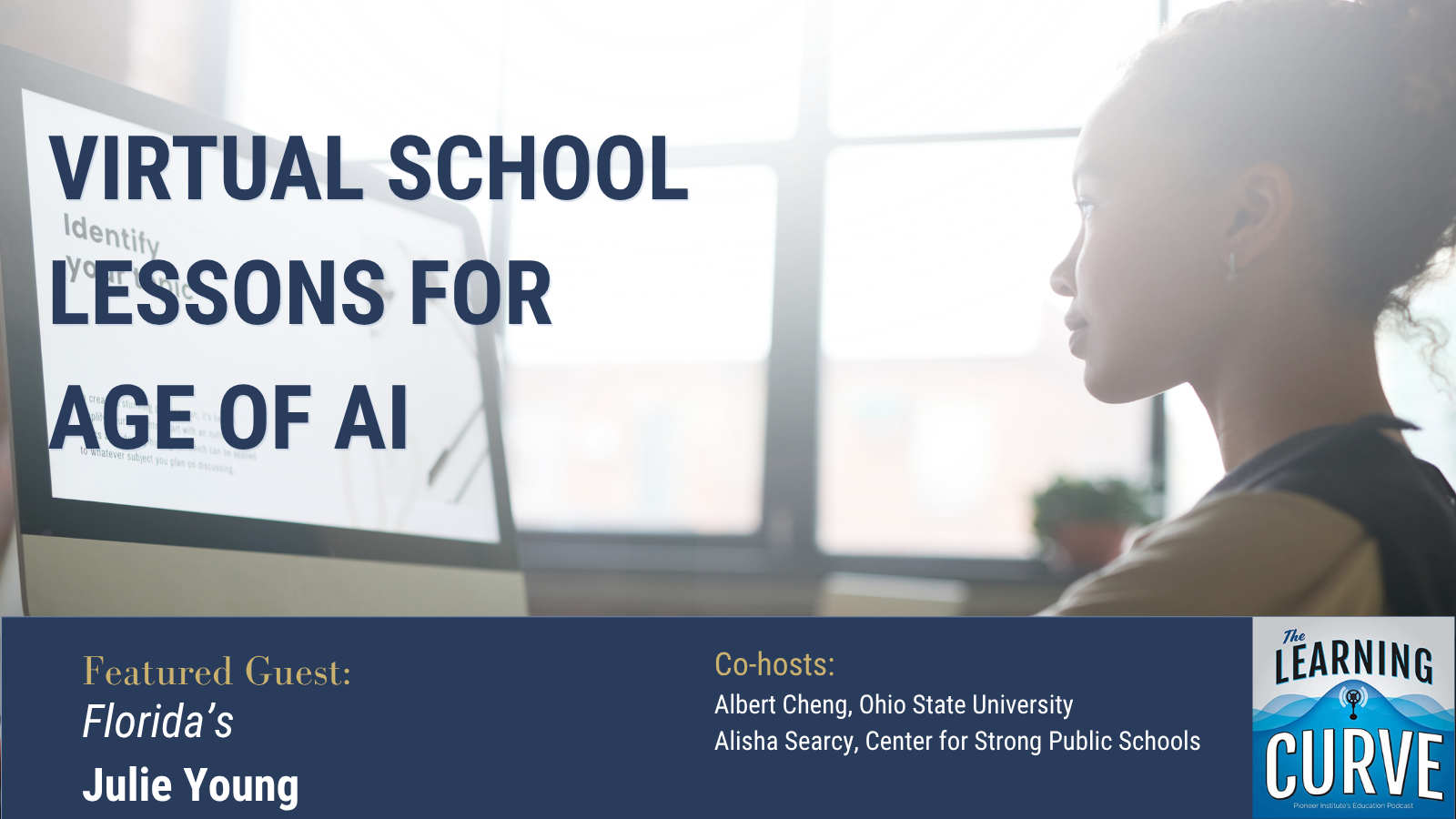
In this week’s episode of The Learning Curve, co-hosts Prof. Albert Cheng of Ohio State University and Alisha Searcy of the Center for Strong Public Schools speak with Julie Young, a pioneering leader in virtual education, author of Say Yes!: How Virtual Became Reality, and coeditor of Virtual Schools, Actual Learning: Digital Education in America. They discuss Young’s more than three decades of experience advancing virtual, blended, and technology-enhanced learning, beginning with her founding leadership of Florida Virtual School. Young explores the lessons virtual education offers as K-12 schools navigate the rapid emergence of artificial intelligence, including technology’s impact on personalized learning, academic integrity, and the changing roles of teachers and schools. Drawing on her work at Arizona State University and ASU Preparatory Academy, Young discusses how educators and students have responded to AI, as well as the innovative Khan World School @ ASU Prep, a full-time online honors program serving students in grades 6–12. Young also considers how technology and AI can help address declining academic outcomes and drive systemic improvements in K-12 education.
Stories of the Week: Alisha highlights an article from The Wall Street Journal on how public charter schools have proved a key to success for minority and low-income students. Albert shares a story from The New York Times on how Syracuse University has dropped 84 of its majors, including classics, ceramics, and Italian.
Julie Young is an edupreneur—an educator, innovator, and visionary leader, renowned for her expertise in school design for diverse educational models, including virtual, blended, and technology-enhanced learning. She is the author of Say Yes!: How Virtual Became Reality (2026) and coeditor of Virtual Schools, Actual Learning: Digital Education in America (2025). As the Vice President of Education Outreach and Student Services at Arizona State University (ASU), and in her former role as CEO and Senior Advisor to ASU Preparatory Academy and ASU Prep Global, she has played a pivotal role in integrating innovative digital strategies into education. Young’s pioneering work began as the founding President and CEO of Florida Virtual School in 1997. In that visionary role, she not only embraced virtual schooling but helped lay the groundwork for an entire industry. She envisioned and built FLVS into a trailblazing incubator, continually testing and evolving innovative digital learning models while cementing Florida’s reputation as an epicenter of virtual school advancement. Young led FLVS as its President and CEO for over 17 years, building one of the nation’s first fully-online public schools, while exploding enrollment made it the largest state virtual school in the United States. Her transformative tenure set key precedents for the future of education reinvention in the digital age.