


Dr. Suzanne Marrs on Eudora Welty, Southern Fiction & Imagination
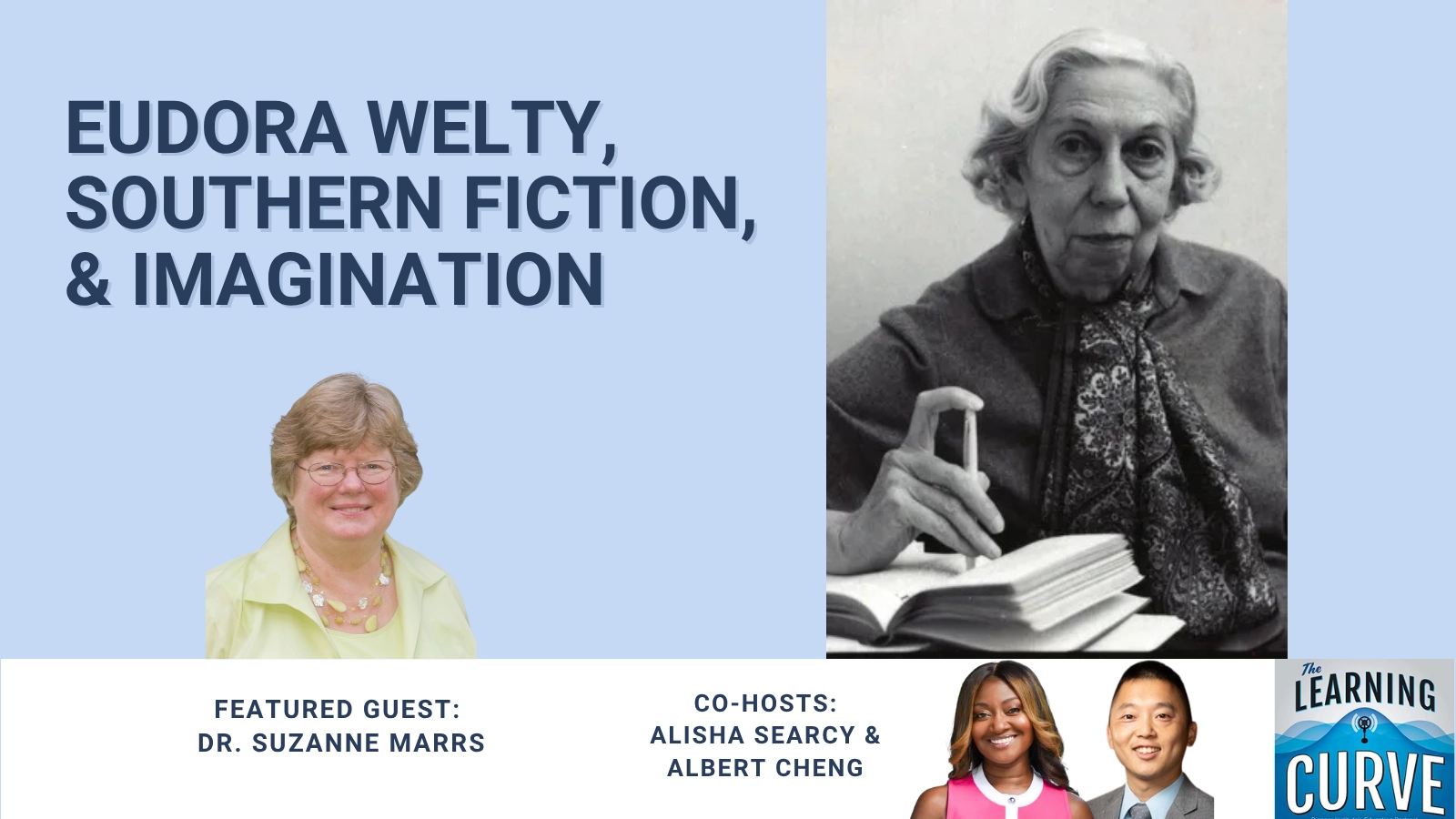
The Learning Curve Suzanne Marrs
Alisha Searcy: Welcome to the Learning Curve podcast. I’m your co-host, Alisha Thomas Searcy, and we’ve got Albert back with us, our other co-host. Welcome back, Albert.
Albert Cheng: Hey, good to be back, Alisha. Nice to hear you and hang out with me to do another show.
Alisha Searcy: Absolutely. And you sound a little different. Has anything changed since the last time we talked to you?
Albert Cheng: Yeah. I am now in Columbus, Ohio. Had to move into our new home here. I, I think we dropped the news a few weeks ago that I’m switching institutions. I’ll be joining the Che Center at Ohio State University this coming fall.
So I might sound different ’cause I’m calling in ’cause, you know, you kinda take internet access for granted until these disruptive things happen, right?
Alisha Searcy: Yes. Well, we are happy to have you, and congratulations to you and your family and excited about your new chapter.
Albert Cheng: Yes. Well, thank you very much. So what do we got today?
Alisha Searcy: We have a few things. So speaking of which, talking about some news articles, we’re gonna, I guess, do things slightly [00:01:00] different this week because we’ve got some cool things happening. I’m going to pull from a local news outlet because I wanna talk about the fact that this is a pretty big week in the country, and I would argue in the world.
Not only is it Juneteenth, and I’ll talk about that in a moment in terms of the federal holiday, but also the Obama Presidential Museum will open up on Juneteenth this week in Chicago.
Albert Cheng: Oh, wow.
Alisha Searcy: Yeah. So I’m pulling from a, a news piece from WTVM, a television station, I believe it is, and an AP article. But essentially talking about the fact that this presidential museum, of course, with the Obamas’ ties to Chicago, that was the reason for the location.
The Obama Presidential Center opens to the general public on Juneteenth after a celebratory dedication in Chicago with dignitaries. And of course, thousands of people have already purchased tickets and will be going there. [00:02:00] Some of the special things about it, President Obama wants you to feel like a president for a day.
It has the very first fully digital museum of its kind. No official papers will be on display. Instead, visitors experience a high-tech and hands-on exhibit spanning the campaign, to key moments of the presidency, and life at the White House. There’s also a replica of the Oval Office, so you get to go in there and see what that looks like and feels like if you’ve never had the ability to do that.
And for those of us who love fashion, many of the fabulous dresses that Michelle Obama wore during their eight-year tenure will also be- Oh … in the museum. So very, very cool for that regard. So it… We’re excited. This is a, an incredible time. We need some good news, some happy news. I think it’s pretty powerful that President Obama chose Juneteenth to officially open the museum.
I just wanna mention finally before I turn it over to you that, of course, Juneteenth is a [00:03:00] permanent federal holiday that we observe on June 19th, and it’s also known as Freedom Day or Juneteenth National Independence Day, and it commemorates the emancipation of enslaved African Americans in the United States.
So very, very important, exciting day for celebrating freedom and justice and endurance and resilience, and also a day to celebrate the presidential tenure of Barack Obama.
Albert Cheng: Yeah. Yeah. Well, thanks for sharing that, and then especially, you know, this year of all years, like, you know, it is … We’ve been doing a several shows on the
commemorating the 250th anniversary of the founding of our country. What an experiment this has been, and, you know, we’ve got some things right and are still figuring out some things, and this is the experiment. And, you know, I think this just underscores the importance for us to pass down our heritage, to remember our history, to wrestle with the hard things, and en- engage civically.
So thanks for sharing that, those words about Juneteenth. I was [00:04:00] gonna ask you, you know, with the Presidential Library for Barack Obama, I was hoping that be president for a day, you know, you get to do all the fun, good stuff, the, the easy light stuff and not have to do the stressful hard stuff, and it sounds like you’ll be able to do that.
Alisha Searcy: Right. I hope to say so. It’s gonna be exciting for a lot of people.
Albert Cheng: Well, Alisha, I wanna flag a bit of news that’s maybe a bit more local for our Massachusetts listeners. So a new development, Bloomberg Philanthropies is giving $12.8 million to Madison Park Technical Vocational High School. In case you’re not familiar, Pioneer does have a connection to Madison Park.
We’ve spent quite a bit of work in the past figuring out how to equip that school to better serve their students. And also look out this Thursday, there’s actually gonna be a video that the Pioneer Institute is going to release about Madison Park Technical Vocational High School. So I just wanna plug that, but also plug this development.
It’s nice to see folks [00:05:00] investing in public education, and hopefully this will pan out well, and the students that go to Madison Park will be better served because of it. Anyway, I just wanna flag that news article.
Alisha Searcy: So important. I’m glad that you did, and I’ll just add to that, that I really appreciate the work that Michael Bloomberg does.
I think it’s very clear that he cares a lot about education. He’s made a lot of investments, and we’ve seen that over the years. We’ve even talked about some of his investments that he’s making now between the HBCU and charter school partnerships. Talk about this work, career and technical education. He cares a lot about the arts.
So just nice to see people with means and lots of it going towards good causes, particularly investing in public education. So kudos to him- Yeah … and the work of his foundation. Very good. Well, we have an exciting show today. We’re going to have with us Suzanne Marz, who’s a professor emeritus of English at Millsaps College, and we look forward to having her a little bit later.
So make sure you stay tuned. [00:06:00] You
Suzanne Marrs is Professor Emerita of English at Millsaps College, where she taught for 27 years. She’s received the 1998 Phoenix Award for Outstanding Welty Scholarship from the Eudora Welty Society, the 2004 Distinguished Professor Award from Millsaps, and she was Mississippi’s Humanities Scholar of the Year in 2009.
Alisha Searcy: Professor Marrs is the author of Eudora Welty: A Biography, One Writer’s Imagination: The Fiction of Eudora Welty, and the editor of What There Is to Say We Have Said: The Correspondence of Eudora Welty and William Maxwell. In 2005, her biography of Welty was named an Editor’s Choice by The New York Times Book Review and a top 10 biography by Booklist.
Her study of Welty’s fiction was a 2002 Choice Outstanding Academic Title, and her edition of the Welty-Maxwell letters was named one of the 2011’s Best Books by the Chicago Tribune. Marrs’ most recent [00:07:00] publication is Meanwhile, There Are Letters: The Correspondence of Eudora Welty and Ross Macdonald, co-edited with Tom Nolan.
She earned her academic degrees from the University of Oklahoma, culminating in a PhD in English and American literature. Professor Marrs, welcome to the show. We’re so happy to have you.
Dr. Suzanne Marrs: Thank you for having me.
Alisha Searcy: You are the definitive biographer of the 20th century Southern fiction writer Eudora Welty.
Would you briefly sketch her life for us and explain to our listeners why the main themes of her fiction are so timelessly important?
Dr. Suzanne Marrs: Eudora Welty was born in 1909 in Jackson, Mississippi, educated at the public schools here in Jackson, at Davis School and at Central High School, and then left and went to college at Mississippi State College for Women.
She was only 16 when she graduated, and her parents wanted to protect her a little bit. They thought she was a little young to go too far afield. [00:08:00] But after two years, she went first to Randolph-Macon, which wouldn’t accept her credits, so her father said, “Well, you’re accepted at the University of Wisconsin.
Go there.” So she got on a train and went to the University of Wisconsin, where she graduated. And then in 1930 and ’31, she spent a year at the Columbia University School of Business studying advertising, but really just wanting to enjoy New York and the literary scene there, the theaters. But she was called home because her father was seriously ill, and in the fall of 1931, he died.
She witnessed his death, and this was a transforming experience for her. She longed to stay in New York, but she stayed home with her mother and she began taking a lot of photographs, working at photography, hoping that maybe photographs would help sell stories that she was trying to write. That proved to be a false hope.
But then in 1936, she did manage to have two [00:09:00] stories accepted at a magazine called Manuscript, and the editor there, John Reed, wrote her and said that one of these stories, Death of a Traveling Salesman, he says, “Is the best story we’ve ever received.” And then he changes it. “Maybe it’s one of the best stories we’ve ever read.”
So that launched her, and she also got a show of her photographs in New York City at the Lugt galleries, and so her career was launched. Her next big break came in late 1939 when an editor from Doubleday came through on a talent scouting expedition and read her stories. She had him out to the house. He looked at her stories.
Her mother served him breakfast, and when he got back to New York, he wrote and said, “I knew it was all gonna be all right after I tasted your mother’s waffles.” And he offered her advice. He said, “You need an agent.” And he put her in touch with a young agent named Dermot Russell who was the son of A.E.,
George William Russell. And Dermot Russell wrote her and said, [00:10:00] “Let me be your agent.” And she wrote back and said, “Great, do it.” And he wrote her back and said, “You don’t know a thing about me. You better check this out.” And that was the beginning of a great friendship and professional relationship. And he managed then to get two of her stories accepted at The Atlantic Monthly.
And when he did that, John Woodburn managed to get her a book contract at Doubleday. And in 1941, her first book was published. It was called A Curtain of Green and Other Stories. And that was followed by The Robber Bridegroom in 1942, The Wide Net in 1943, a novel, her first novel, Delta Wedding in 1946.
The Robber Bridegroom was a novella, but this was her first novel, Delta Wedding. The Golden Apples, a cycle of interrelated stories, came out in 1949. The Bride of the Innisfallen and Other Stories in 1955. And then there’s a gap in her [00:11:00] production of books because her brother Walter’s seriously ill, her mother’s health is failing, and she can’t find consecutive time to write.
But she does manage to produce a children’s book called The Shoebird, and two stories about the civil rights movement, Where Is The Voice Coming From? and The Demonstrators. Her brother Walter died in 1959, and then her mother and her brother Edward died within days of each other in 1966. And she was grief-stricken and still unable to produce a book for a while.
But then in 1967, she did write a book, a long story, called The Optimist’s Daughter, which was accepted at The New Yorker. And they would bring it into print in 1969. They waited till they had a whole issue for the book so it didn’t have to be separated. And then after that, she completed the novel Losing Battles she had been working on since 1955.
[00:12:00] She published a book of photographs 35 years after her first show in New York City. So she published Losing Battles in 1970. One Time, One Place, her book of photographs, in ’71, and then revised and lengthened The Optimist’s Daughter and published it in 1972, and it would win a Pulitzer Prize. Just a few more titles.
The Eye of the Story in 1978, a collection of her critical pieces and essays and reviews, her collected stories in 1980, and a big book of photographs in 1989. Lots of awards. Presidential Medal of Freedom, Pulitzer Prize, National Medal of the Arts, the French Legion of Honor, many, many honorary degrees. So a career that Eudora said, “I’ve just had too many honors.”
And I don’t think she had too many, but she was greatly honored.
Alisha Searcy: So in Eudora Welty’s memoir, One Writer’s Beginning, she opens the chapter entitled [00:13:00] Listening with, I quote, “In our house on North Congress Street in Jackson, Mississippi, where I was born, the oldest of three children. In 1909, we grew up to the striking of clocks.”
End quote. Can you talk to us, Professor, a little bit more about her family? You mentioned some things, but a little bit more her upbringing and something about the wider Mississippi landscape during that era, all of which so powerfully shaped her life and writing.
Dr. Suzanne Marrs: Sure. She grew up in a very loving family.
She had two younger brothers, Edward and Walter, and they were great friends to each other, and she had two very supportive parents. Her father, who I think really introduced her to the love of travel. She went with him on a trip, a business trip that he led for a number of agents of the Lamar Life Insurance Company.
She went with him to California, saw the Grand Canyon, learned that love of travel. And from her mother, she developed, I think, mainly a great love of reading. And her mother really [00:14:00] encouraged her to become a writer. And we’ve only just now found out how much she encouraged her, because some family papers that were sealed for 20 years have now been opened.
So let me just read you her mother’s response to Eudora Welty’s thesis that she wrote as a senior at the University of Wisconsin. It was a, a novel. She said, “Of course, I’ve always known you had it in you. From your babyhood, I have seen genius in you, but not all geniuses are able to produce. From the time you were six years old, I’ve been sure this genius would find expression in creative writing, and I’ve nursed that gift to the best of my ability.
Perhaps the wish was father to the thought in the beginning, for the printed page has held a fascination for me since, as a child of four, I spelled out the headlines on the newspapers. Of course, I had ambitions along that line myself, but I know I never had that spark of divine fire, which is necessary to do anything out of the ordinary.
This spark I recognized [00:15:00] in you long ago.” Her mother really encouraging her writing. Witnessing the death of her father in 1931, she was present. He was being given a blood transfusion. He died on the table. I think gave her a real sense of the power of time and the urgency of time, the importance of acting, of loving, of writing.
Her mother’s response was to be very protective of her children. Her mother was devastated, and I think this created some tension in the family. The mother who wanted to protect her children, the children who wanted to be independent, the tension that existed because of love, not in spite of it. So all of those things, I think, came from family.
But there’s also, looking at the South, the patterns of racial segregation that were in the South, the oppression that she witnessed. But she had been to school away, you know. She had seen more open environments, and she had a different [00:16:00] perspective on that, I think. The sense of class and the power of class.
Those are things that came out in her fiction and that she had observed in what you term the larger Southern landscape.
Alisha Searcy: Hmm. So you brought up Welty’s mother. I wanna ask you a little bit more about her mother. In One Writer’s Beginning, she writes, quote, “My mother read Dickens in the spirit in which she would have eloped with him.
The novels of her girlhood had stayed on in her imagination. Besides those of Dickens and Scott and Robert Louis Stevenson were Jane Eyre, Trilby, The Woman in White, Green Mansions, and King Solomon’s Mines.” End quote. So can you talk to us about Eudora Welty’s formative religious and educational experiences, and how her mother’s reading and love of Dickens influenced the young Eudora?
Dr. Suzanne Marrs: Well, I think Eudora never really loved Dickens as much as her mother did, although she liked Dickens. But she did learn that love of reading from her [00:17:00] mother, and, and she did a lot of early reading. You know, her favorite set of books was called Our Wonder World, and she loved that. And then her parents had a complete set of Mark Twain, and she read her way through that.
But the writers I think that meant more to her were Virginia Woolf, Anton Chekhov, Jane Austen, for instance, and E.M. Forster. She said that reading To the Lighthouse opened a door for her, and she loved Chekhov, and she sensed that his stories were the most powerful example of the short story, the genre she loved most, that his ability to move away from formal plot, to empathize, imagine his, himself into the lives of his characters she admired greatly.
She loved Jane Austen. She read those novels over and over again, and when she visited Jane Austen’s house, she wrote back and said that her house is the opposite of her novels. The house looks big, but is really small, the [00:18:00] opposite of her novels. Those were all important to her. E.M. Forster, she thought A Passage to India was the most powerful indictment of racism that it would be possible to have in fiction, and she really admired Forster for that, that he spoke not in a didactic way, but carried this message through his development of character and plot.
She, of course, grew up in a churchgoing family, has fond memories of going to Sunday school with her little nickel clenched in the palm of her hand for the collection plate, and of singing the hymns at church. But she was never one who was really at ease in organized religion, and as she notes in One Writer’s Beginnings, she had the strongest sense of the holiness and mystery of human life when she traveled later in life and saw the windows at Chartres, or the stone peasant figures in the capitals at Autun, or in the frescoes of [00:19:00] Piero and Giotto, or when she was sitting in the ruins of a little church in the field in Ireland with sheep grazing around her.
That’s where she felt the holiness and mystery of life most strongly.
Alisha Searcy: Hmm, that makes a lot of sense. Because she talks about in One Writer’s Beginnings, quote, “Through travel I first became aware of the outside world. It was through travel that I found my own introspective way in becoming a part of it.”
So can you talk more on some of her travels and the relationship between her travel and the larger American South that also served as the wellspring for the Southern literary renaissance of 1920s and ’30s, which we know included writers like Faulkner and Thomas Wolfe, Margaret Mitchell, Tennessee Williams, Robert Penn Warren, and Zora Neale Hurston, among others?
Dr. Suzanne Marrs: Well, she traveled a lot. You know, she went back and forth to New York very frequently. She spent several months living in San Francisco in 1946 and 1947. She had traveled with friends to [00:20:00] Mexico in 1937. She went to Europe by herself for almost a year in 1949 and ’50, and back a couple of times after that.
So she did travel a lot, and her father had introduced her to the love of travel. And I think a lot of her stories take the form of travel narratives. They’re journeys. So you see, for instance, in the short story, The Bride of the Innisfail, and the journey by boat train from England to Ireland. So it’s a organizing principle.
It’s also, I think, she thought travel gave you a way of looking at yourself differently, of seeing that you are not the focus of things, that something beyond you demanded your attention, your observation, your awareness. And so travel granted her a kind of perspective, a prompt to observation, and I think this was very important in developing the key themes of her novels.
Alisha Searcy: Thank you for that. [00:21:00] My final question before I turn it over to Albert, in the early 1930s, well before her legacy as a Pulitzer Prize-winning fiction writer, Welty traveled extensively across Mississippi’s 82 counties as a junior publicity agent for the Works Progress Administration, or the WPA. The Mississippi Department of Archives and History and the books One Time, One Place and Eudora Welty Photographs serve as repositories of her observantly beautiful and poignant Great Depression era photos.
Can you talk about these images and how Welty’s experience as a photographer shaped her vision as an artist and a writer?
Dr. Suzanne Marrs: She took lots of photos of both Black and white Mississippians of all ages. She took photos of them at home and at work, at state fairs, in parades, and in church, all over the state.
And she recorded the resilience and the dignity, the [00:22:00] joy and the pain of individuals who were facing poverty and facing racial oppression and who were living lives in lots of different occupations: nurses, fortune tellers, bootleggers, store owners, wash women, farmers, religious leaders. And in doing so, she had a real strong sense of the diversity of her home state and of the difficulties that needed desperately to be overcome.
Natasha Trethewey wrote an introduction to her photographs in a reissue of that book fairly recently, and she expressed her admiration and gratitude for the diversity and the authenticity of the images. She said that was a lens she needed to see for her work, and I think it was also a lens Eudora needed to see in her own work.
So you have a picture like a woman of the ’30s, which evokes Phoenix Jackson in A [00:23:00] Worn Path, or you have a picture of a fisherman and his son throwing knives at a tree that has a fictional counterpart in At the Landing, or a style in Raymond, Mississippi, which is like the style in The Wanderers that’s depicted in that short story, The Wanderers.
So these individual images come into the stories. But more than that, I think it’s that she’s transforming these images and using them to serve the purpose of her stories, and she’s grounding the stories in this kind of reality. But then these images become more than just observations. They become part of the fabric of the story’s meaning.
Albert Cheng: Fascinating. Well, her breakout short story, Death of a Traveling Salesman, published in 1936, and according to your biography, you said that this, this was a thrilling moment for Eudora, and when she said, quote, “That was a great day in my life because for the first time something was being looked at critically.
This was from [00:24:00] afar, an objective point of view, and they liked it, and they were going to print it,” end quote. So give us a snapshot of Death of a Traveling Salesman, and what did it mean for Eudora, her career as a fiction writer?
Dr. Suzanne Marrs: Well, a neighbor had told her about a hearing of someone who had gone to borrow some fire, and that expression captured her imagination.
And so she wrote this story about a, a traveling salesman who’s been ill, who’s had the flu, a serious case of influenza, and who gets up from his sick bed and, and begins to try to get back on the road selling his goods. And he crashes his car and runs it, gets lost on the back roads of Mississippi, runs over a vein, gets out of the car in time, and is taken in by a tenant farming family.
The husband saves his car, and then he goes down the road to get a burning brand from the man who owns their farm, so he can have a fire, they can cook food, they can keep warm. [00:25:00] And the salesman, who has avoided human contact, now he’s at first thought that the woman in this household was the mother of Sonny, the man who goes to borrow fire.
But he now realizes she’s his wife. He’s not been seeing clearly. She’s pregnant. And what is here, in their generosity to him and their acceptance of him, is a marriage, a fruitful marriage, and he thinks anyone could have had that. But of course, he hasn’t had it. Oh. He’s avoided that kind of connection.
And after they go to bed that night, he gets up and leaves, devastated, and dies of a heart attack before he gets to his car. So that was the story. But I think that this was the discovery. Eudora said, “I discovered my real subject, which is human relationships.” And she found out that somebody, not her mother, somebody who was looking at that story objectively, thought it was a really good story, [00:26:00] too.
Mm-hmm. Hmm. And that gave her the confidence to go on, and the notion that I can work with human relationships. I can work with my Mississippi setting. I don’t have to do something exotic. Here is my material right at hand
Albert Cheng: Well, let’s maybe talk about another example of this perhaps, another short story, A Worn Path, published in 1941.
It depicts the courage of an old African American woman who correctly makes a long journey on foot, braving hostility and condescension, in order to obtain medicine for her grandson. So tell us about the plot of this story and some of the main themes.
Dr. Suzanne Marrs: Well, the main character in this story is a very old, maybe 90, African American woman named Phoenix Jackson, whose grandson has swallowed lye, and who ever after has to have the healing medicine, as she would say.
And in order to get this medicine, she lives way out in the country, she has to walk into Natchez, a long journey. So [00:27:00] she’s 90 years old, she’s walking uphill and down, she’s walking over log bridges, she’s walking through fields and forests. But those are not the only dangers she faces. She meets up with a hunter, and the hunter points his gun at her as a kind of joke and says to her, “Well, you know, I’d give you some money if I had any.”
But she’s already seen him drop a nickel, and she’s blames herself, but she reaches down and when he’s not looking, and gets that nickel. And so he lies to her. Hmm. He terrorizes her. She faces him bravely. He says, “You need to go on home.” She keeps going. She goes to Natchez, and she goes to the doctor’s office where they call her a charity case, where when she has a little lapse of memory, she is 90, by the way, they are condescending toward her.
But she gets the medicine for her grandson, and she turns around, and at the story’s end, she’s headed back to see him. So it’s an act of courage. Now, some have said, “Is [00:28:00] Phoenix Jackson’s grandson really dead?” And what Eudora Welty said was, “I didn’t think so, and I didn’t intend him to be.” Hmm. But even if he were dead, it doesn’t make any difference, because the point here- Hmm
is that this woman is acting out of the well-worn habit of love. Her actions- Hmm … are courageous, and they’re driven by love, and that’s the important thing in the story.
Albert Cheng: Thank you for that. That’s quite a profound story. You’ve piqued my interest in, in reading it, certainly. Let’s talk about another one, and this one has a little bit of a, some background.
Uh, Medgar Evers was a 37-year-old civil rights pioneer, World War II veteran, and first field secretary for the NAACP in Mississippi. And he was assassinated just after midnight on June 12th, 1963, in the driveway of his very own home in Jackson, Mississippi. And Eudora wrote in the wake of these events, Where Is the Voice Coming From?
Could you discuss that [00:29:00] short story for us? And particular, what, what was the public reception across the country and in Mississippi to this short story?
Dr. Suzanne Marrs: Well, this story was written immediately after the assassination of Medgar Evers, and it was written in horror at the murder, and also in horror at the climate of hatred that dominated the state at the time.
And so she wanted to get that into the story, and she wrote it in the voice, a really daring act of the murderer. And the murderer damns himself with every word he says in the story addressed to us, the readers. And he quotes his wife talking about the local newspapers and the racism inherent in those newspapers.
He quotes his wife talking about some society women who have been making racist jokes that she has heard. He defends his murder, his act of violence, by saying that he thinks that violence is inherent in [00:30:00] African Americans, ignoring his own violence, and having described the non-violent passive resistance, yes, of young schoolchildren who march with flags and make no violent acts but submit to the law.
And so his self-deception, his hatred are all revealed in the course of the story. This was written Before the murderer had been arrested. Mm-hmm. And so it had to be changed before The New Yorker could publish it so that it wouldn’t prejudice the trial. So actual names had- Mm-hmm … to be taken out, place names changed.
But The New Yorker did publish it, and William Shawn, who was the editor of The New Yorker, told the fiction editor, Bill Maxwell, he stopped him in the hall and he said, “Bill, does Eudora know how good this story is? Does she know what a great story it is?” And I don’t know if she did or not, but she certainly, it was the, the story, only story she said she ever wrote in anger.
Now, her friend, Bill [00:31:00] Maxwell, the fiction editor at The New Yorker, was worried that this might cause problems for her, but I don’t think it ever did, and I don’t think there was much notice here or anywhere of the story except by readers of the, of The New Yorker. But later, a reporter in Mississippi named Jerry Mitchell, winner of a MacArthur Foundation genius grant, a reporter whose work was really important in bringing Byron De La Beckwith to a retrial, he, Jerry Mitchell, called me, he called Eudora’s niece, Mary Alice, and he wanted to have The Clarion-Ledger in 2013, on the 50th anniversary of Evers’ assassination, reprint Eudora’s story in its original form with the actual place names and people’s names, and he arranged to have that done.
So there was that recognition from a very important reporter here in our local newspaper
Albert Cheng: Well, we have time to talk about one more. It’s not a short story, but Eudora Welty’s [00:32:00] Pulitzer Prize-winning novel, The Optimist’s Daughter, published in nineteen seventy-two. It’s about a woman who returned to New Orleans as her father faces a detached retina and impending death, and this woman is forced to confront her past, the meaning of memory and family in the South.
Pretty big themes. I wanna mention something you wrote in your biography of Welty. You said that this novel was close to her, and that she held onto it for a couple of years and was uncertain about publishing it alone as a book. Could you summarize and discuss this novel and, and maybe just those behind-the-scenes feelings?
Dr. Suzanne Marrs: She was writing this novel in the wake of the death of her mother and her brother. Well, they died within four days of each other in nineteen sixty-six. Those were the last members of her immediate family who were living, so she had lost all of her family, her father, her two brothers, and her mother. And for a time, she felt that she was without words, but then [00:33:00] she found that she had a story to tell.
And in the story, what makes it really close is that the mother’s experiences in the story, the mother who is long dead before the story begins, but the main character, Laurel, goes back and remembers her mother, that the mother’s experiences are the same experiences or many of the same experiences that Chestina Welty, Eudora’s mother, had had.
So it’s very biographical in that sense. And then Eudora uses some of her own memories of going with her mother to their West Virginia home in developing that. It’s much more tied to personal experience than most of her fiction is, and that was why she wasn’t sure about doing it because she’s always sort of valued that privacy and that distance from self.
But she used it here. And so the present action of the novel, the death of Laurel McElvey Hand’s father, that whole present action is fiction. But when she goes [00:34:00] into the past, there’s a lot of it that does emerge from her life and her mother’s life. So that’s why she felt rather sensitive about it. To me, the most important thing in the book is that Laurel, she goes to New Orleans, she experiences the death of her father.
Her father is accompanied by, her mother has been dead for 11 years, and father is accompanied by a new wife. He’s just been married for a year or so. And she has to deal with the loss of her father and negotiate life after his death, how it will proceed, and how the funeral will proceed, what’s gonna happen with the house, all of that.
She nego- has to negotiate with his new wife, Faye, who’s a very alien spirit to her. But she manages it. What she tries to do is sort of, she knows the house has been left to Faye, and so she’s gonna try to make sure that there’s nothing Faye can do to hurt the memory of her parents. And then ultimately she realizes that [00:35:00] she can’t protect the memory, that memory is nothing you can protect, but, from other people, but you have to cherish it, you know, for yourself.
And that continuity of your love for the people you’ve lost is the whole meaning of life. And that when you remember and memory hurts you, that in fact that can be a blessing because the memory is alive. She says, “The memory may be hurt time and again, but in that may lie its final mercy. As long as it’s vulnerable to the living moment, it lives for us, and while it lives and while we are able, we can give it up its due.”
So she gives up the idea of protecting the past from Faye. There’s a breadboard her husband has made. Laurel is threatening to take it with her. Faye is saying, “You can’t take it. It belongs with the house.” And she, she gives it up. She relinquishes it. Faye doesn’t care about it anyway, and she realizes that’s just an object.
I don’t need that. [00:36:00] I have my memory
Albert Cheng: Well, I think that’s a nice segue to our final question. But I do wanna also preface with the family, you know, what strikes me about Eudora Welty’s work as I hear you discuss it is, I mean, she seemed to have captured the human experience in a very deep, singular way.
Quite appreciating a lot of her work for that. I mean, you’ve done, again, you’ve piqued my interest. But my last question, speaking of humanizing and objects, let’s talk about her house in Jackson, Mississippi, Eudora Welty’s house. It’s a national historic landmark, and it’s open to the public as a museum and shrine to this great Southern storyteller and her family.
Could you tell us about her house? You know, are there some significant family heirlooms or keepsakes? But also take the last word to what should we remember about her literary legacy?
Dr. Suzanne Marrs: Yeah. I would say her literary legacy, you wanna find that she is able to translate… She is able to imagine herself into lives not her own.
She is able to part the [00:37:00] curtain between individuals, between any own barriers that might divide us. She has a profound sense of time’s urgency. That’s a important theme in her novel, and she deals with people who avoid facing it and people who do. She’s interested in issues of love and separateness, as Robert Penn Warren long ago said that as much as we love someone, we are never going to overcome the essential separateness between us.
There’s always going to be that mystery and that difference, and this makes for tension and for fulfillment as well. You know, the political dimensions of the world around her that she is commenting on in terms of race and class and gender. So all of these things that are fiction. Now, if you go to the house You’re gonna see a wonderful museum, but it’s more than a museum.
You’ll see her library of more than 5,000 books. What was she reading? Well, how about all these murder mysteries? What about [00:38:00] the serious fictions there? What about the massive number of books of poetry that you find there? And then I found on the shelf a book she had recommended to people, Sir Arthur Eddington’s Nature of the Physical World, about relativity theory and its philosophical implications.
So this, this really devoted reader and, and a reader of diverse text. You’ll see the typewriter where she worked, and you see examples of her revision process, cut and paste, literal cut and paste. And, uh, she used pens, though, straight pens instead of, of glue. You’ll see photographs of her family members that are on the wall.
You’ll see the works of art that she bought for the house that are on the wall. You see the desk that is such an important desk in The Optimist’s Daughter upstairs in her bedroom, and she’s transformed that into a very important symbol in the novel. And you’ll see that there are no awards displayed.
There’s one w- award displayed. It’s the Raven Award for the Mystery Reader of the Year of [00:39:00] 1985. But the Pulitzer Prize, the Presidential Medal of Freedom, those are not in the house. They were never on display. So you get a real sense of the person who lived in this house and of the world in which she wrote or the environment in which she wrote, in which she produced so many great stories.
Mm-hmm. And something about the source of those stories as well.
Albert Cheng: All right. I’m gonna give you one final bit in the limelight to talk about Eudora Welty. Could you please read a, a passage from a biography?
Dr. Suzanne Marrs: I will. I’m gonna read a passage that is a little anecdote that shows you something of the wit of Eudora Welty, of how much you might enjoy being in her presence.
On March 10th, 1971, Eudora left New York for Washington, DC, where she spent a night with John and Catherine Prince before busing to Norfolk and a speaking engagement. [00:40:00] As she told her friend Mary Lou Aswell, dear cousins of Chastina’s had invited her to read for the Virginia Poetry Society. Quote, “Since I don’t ever do readings anymore, I accept it on the condition they didn’t publicize it and didn’t pay me, but I couldn’t say no with my cousins there.”
Unquote. Reynolds Price had agreed to s- meet Eudora in Norfolk and to drive her back to Jackson, and they spent a pleasant first leg on the road to Asheville. Then it was on across Georgia and half of Alabama, but as Reynolds recalled, “Our planned second night in Birmingham proved problematic. All the motels were filled, forcing our exhausted selves onto the next opportunity, Tuscaloosa.
We found a similar dire situation, no rooms.” Reynolds set about phoning every source of housing he could discover in the Yellow Pages, and at last learned that there was a three-bedroom trailer for rent adjacent to a [00:41:00] motel called the Bel Air. “Could you sleep in a trailer?” Reynolds asked Eudora. “I could sleep in a gunny sack in the back of a pickup truck,” Eudora replied.
So the Bel Air it was. In an address to the American Academy, Reynolds recalled the evening there. Here’s his recollection. “Late in the night, and in vast relief to have found a harbor, I poured us stiff drinks of bourbon and offered a toast to our entirely plastic surroundings, plastic beds, plastic walls and floor, plastic furniture.
Eudora was seated on the long plastic couch. As she raised her plastic glass to join me in the toast, she said in her usual dead level, quiet voice, ‘If this sofa could talk, we’d have to burn it.'”
Albert Cheng: Well, thank you so much for sharing that anecdote. It certainly gives another peek into who Eudora Welty was. It did, yeah.
So Professor Martz, thank you so much for- Yes … for being on the show with us.
Dr. Suzanne Marrs: Thank you. Thank you [00:42:00] both.
Wow, Albert, that was really interesting. Professor Marrs, I think, does a great job of helping us to understand some of these writings and Eudora Welty and her work.
Alisha Searcy: Very, very powerful and interesting, particularly talking about some of the historical stuff.
Albert Cheng: Oh, yeah, you bet. And maybe to reveal my ignorance, I was completely unfamiliar with Welty, so it was very special for me to listen to.
Alisha Searcy: It was, and I love that we get to do this because we do learn about a lot of authors that we may not have heard of before, so.
Albert Cheng: That’s right. That’s right. Yeah, lifelong learning.
Alisha Searcy: Exactly. So very important. Well, before we go, it’s time for us to hear about the tweet of the week.
Albert Cheng: I found one that, well, let me read it first. “The decades-long hiatus from reform means that many of those enmeshed in today’s renaissance were in middle school back when Race to the Top was an object of national fascination.”
It’s a link to an article over at EdNext from Rick Hess, which I wanna flag as, you know, it seems like some school reform efforts are picking up [00:43:00] steam again. And, you know, Rick, I think with this article, points out that, look, many of the folks leading the charge now were just in middle school when the early 2000s reforms were then, it was underway.
So that’s making me feel a little bit old. Um, but there are lessons to be learned, and I think Rick wants to pass some wisdom that, you know, folks like you and I, Alisha, have, have maybe learned in the past for today’s reformers.
Alisha Searcy: Yeah. Interesting. Very good. Well, as always, Albert, thanks for, uh, joining me and hanging out together.
Great show. Of course, make sure you join us next week where we will have Doug Tuthill, who is head of Step Up For Students in Florida. Gonna be another interesting topic. See everybody next [00:44:00] week.
In this week’s episode of The Learning Curve, co-hosts Prof. Albert Cheng of Ohio State University and Alisha Searcy of the Center for Strong Public Schools speak with Dr. Suzanne Marrs, Professor Emerita of English at Millsaps College and acclaimed biographer of Eudora Welty, about the life, works, and enduring legacy of one of America’s greatest Southern writers. Prof. Marrs explores how Welty’s upbringing in Jackson, Mississippi, her family’s love of literature, and her mother’s devotion to Charles Dickens helped shape her imagination and literary voice. She discusses Welty’s travels throughout the South and her work as a Works Progress Administration photographer during the Great Depression, explaining how these experiences informed both her photography and fiction. She highlights celebrated short stories such as Death of a Traveling Salesman, A Worn Path, and Where Is the Voice Coming From?, as well as the Pulitzer Prize-winning The Optimist’s Daughter, examining their themes of memory, race, family, resilience, and love. Prof. Marrs concludes by reflecting on Welty’s National Historic site home in Jackson, Mississippi, and the timeless significance of her literary legacy in 21st-century America. She closes with a reading from Eudora Welty: A Biography.
Stories of the Week: Alisha highlights an article from WTVM on the Juneteenth opening of the Obama museum in Chicago. Albert shares that Boston received a $12.8 million investment from Bloomberg Philanthropies for Madison Park Vocational Technical School.
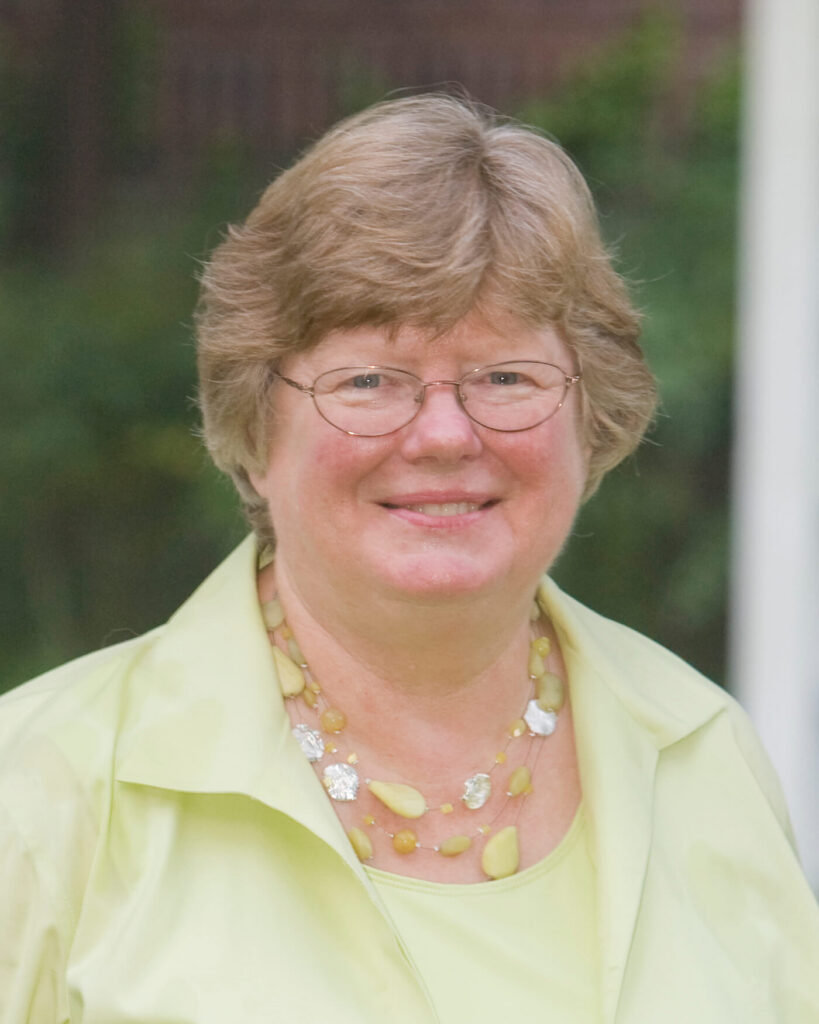
Suzanne Marrs is Professor Emerita of English at Millsaps College where she taught for 27 years. She’s received the 1998 Phoenix Award for Outstanding Welty Scholarship from the Eudora Welty Society; the 2004 Distinguished Professor Award from Millsaps; and she was Mississippi’s Humanities Scholar of the Year in 2009. Prof. Marrs is the author of Eudora Welty: A Biography; One Writer’s Imagination: The Fiction of Eudora Welty; and the editor of What There Is to Say We Have Said: The Correspondence of Eudora Welty and William Maxwell. In 2005, her biography of Welty was named an Editor’s Choice by the New York Times Book Review and a Top Ten Biography by Booklist; her study of Welty’s fiction was a 2002 Choice Outstanding Academic Title; and her edition of the Welty/Maxwell letters was named one of 2011’s best books by the Chicago Tribune. Marrs’ most recent publication is Meanwhile There Are Letters: The Correspondence of Eudora Welty and Ross Macdonald (co-edited with Tom Nolan). She earned her academic degrees from the University of Oklahoma, culminating in a Ph.D. in English and American Literature.