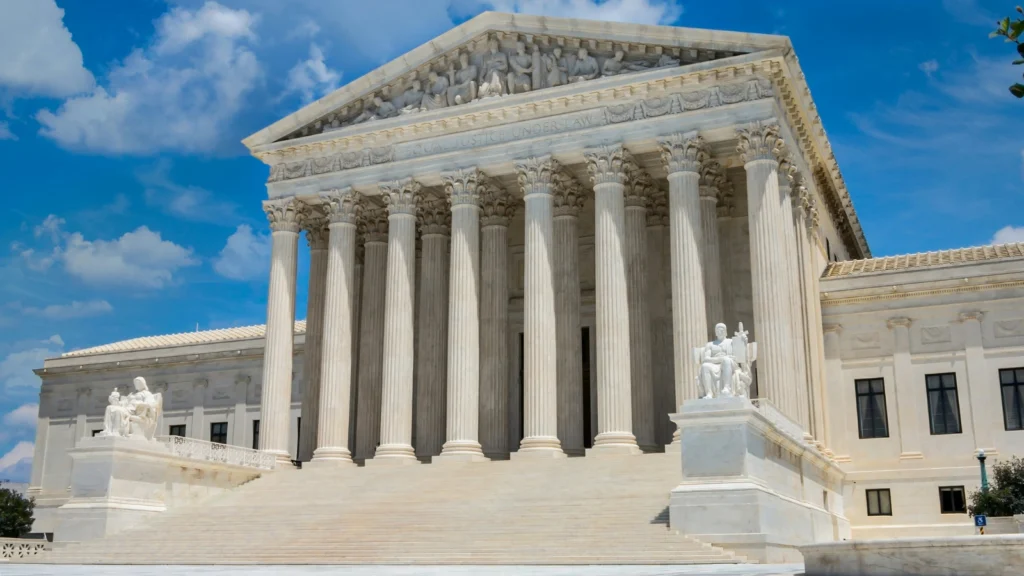



Today, the U.S. Supreme Court will hear arguments in a case with important implications for Massachusetts in which an Illinois public employee is challenging the requirement that he pay an “agency fee” to a union as a condition of employment.
Closer to home, a group of educators has petitioned the Commonwealth’s Supreme Judicial Court (SJC) to hear a case challenging compulsory union payments. The SJC will likely delay any ruling on the petition pending the outcome of Janus v. AFSCME.
“Union membership should never be banned,” said Pioneer Institute Executive Director Jim Stergios. “Nor should it ever be compulsory.”
It is settled law that public employees who choose not to join a union can’t be required to pay fees to fund union political activity. Janus challenges a 1977 Supreme Court ruling that employees who are not union members can be required to pay an agency fee that covers the cost of contract negotiations and workplace grievance procedures.
In January 2016, the Supreme Court heard an almost identical case challenging compulsory agency fees from a group of California teachers. Justice Antonin Scalia died less than a month later and the remaining justices were deadlocked in a four-to-four vote. Neil Gorsuch was confirmed last year to fill Scalia’s former seat, and is widely considered likely to be sympathetic to the case of the plaintiff, Mark Janus.
Last summer, Pioneer Institute, through its public interest law initiative PioneerLegal, signed on to an amicus brief in support of a petition to the Supreme Court to hear the Janus case.
PioneerLegal, as the public-interest law initiative of Pioneer, utilizes a legal-based approach to work to change policies that adversely affect the public interest in Pioneer’s core policy areas. PioneerLegal’s substantive work is consistent with the mission of Pioneer as it clearly develops and promotes its brand as a public-interest law initiative.
Pioneer Institute is an independent, non-partisan, privately funded research organization that seeks to improve the quality of life in Massachusetts through civic discourse and intellectually rigorous, data-driven public policy solutions based on free market principles, individual liberty and responsibility, and the ideal of effective, limited and accountable government.
Related Posts

Court Allows Boston Commercial Taxpayer Lawsuit to Move Forward

Pioneer New England Legal Foundation Files Lawsuit Challenging Cambridge Inclusionary Zoning Ordinance

PNELF Admonishes DOR for Inaction on Unauthorized and Unconstitutional Commercial Tax Overcharges

Pioneer Public Interest Law Center and New England Legal Foundation Unite Under New Banner: Pioneer New England Legal Foundation

Video Statement of Frank J. Bailey (Ret. Honorable), President of Pioneer Public Interest Law Center

New Pioneer Institute Law Center to Focus on Educational Opportunity, Economic Freedom, and Accountable Government

Public Statement: Pioneer Institute Applauds U.S. Supreme Court Ruling in Espinoza School Choice Case

New Report & Legal Analysis Suggests ICER’s Quality Adjusted Life Years Methodology Violates the Americans with Disabilities Act

Pioneer Institute Files Amicus Brief Urging Supreme Court to Hear School Choice Case
Oops! We could not locate your form.