


Dr. John Ferling on Jefferson, Hamilton, & Federalism
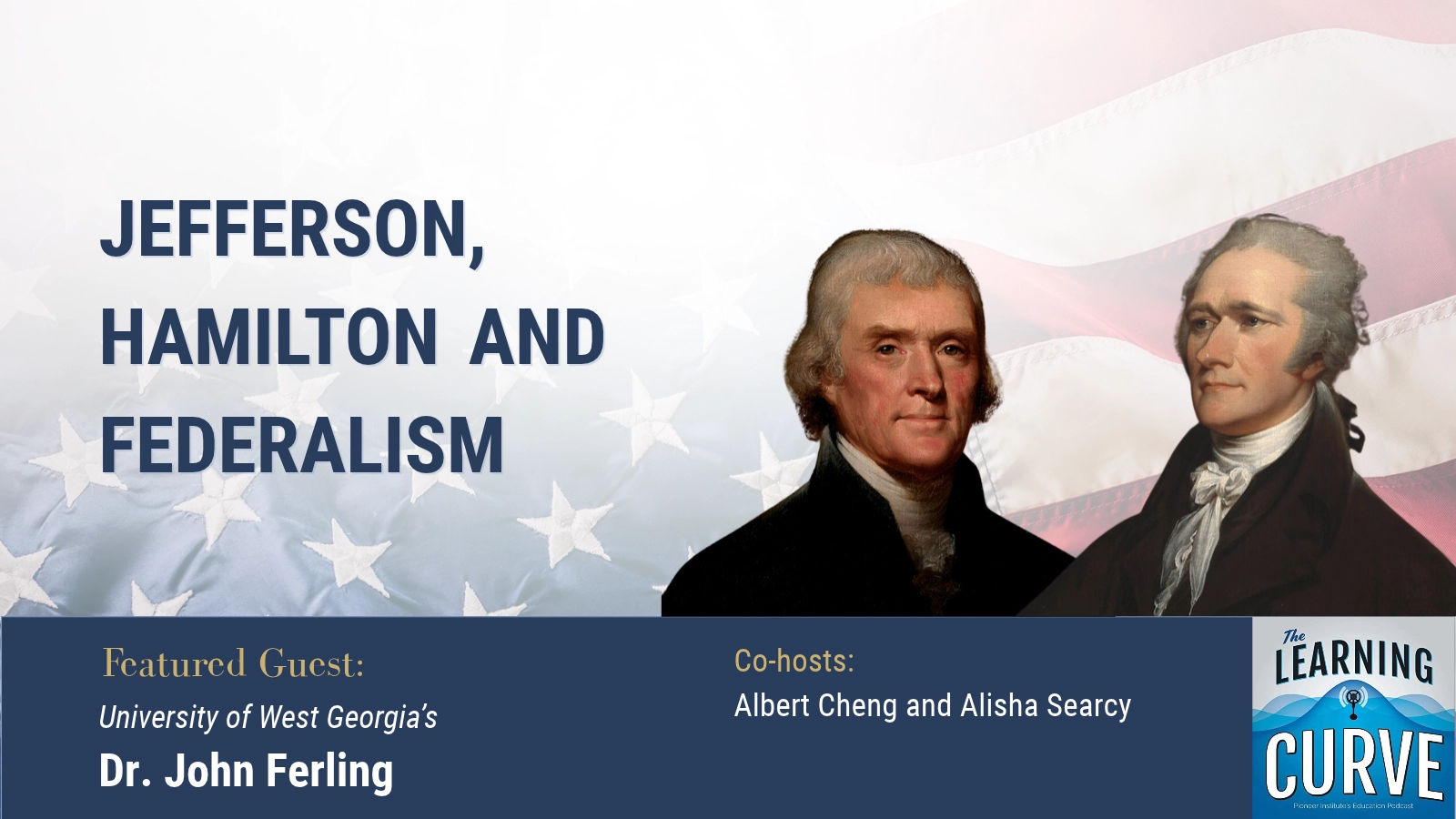
The Learning Curve John Ferling
Alisha Searcy: [00:00:00] Welcome back to the Learning Curve podcast. I’m your co-host, Alisha Thomas Searcy, CEO of Center for Strong Public Schools, and joined by our other co-host, Dr. Albert Cheng, from The Ohio State University. Hey, Albert.
Albert Cheng: Hey, Alisha. Hope you’re doing well today.
Alisha Searcy: I am well. It is the week of the election. I’m excited, and by the time this airs we won’t know the results yet, but I’m excited and hoping that everyone went to vote.
How about that?
Albert Cheng: Yeah. Well, good. I’m wearing my little sticker here.
Alisha Searcy: Very important. We voted early this season, and there are record numbers in Georgia. By the time early voting ended it [00:01:00] was 2.7 million people had already voted.
Albert Cheng: Wow.
Alisha Searcy: Exciting, and I hope that means that they’re even more engaged, right? We talk about civic engagement- Mm-hmm.
Mm-hmm … and democracy and all those good things, and as we celebrate the 250th we want people to vote and participate, so I hope that’s a good sign of all things around the country.
Albert Cheng: Yeah, yeah. Let’s hope. I’m always wanting to push us and hope for the best.
Alisha Searcy: Yes, yes, yes. And so we’ve got a very interesting show this week as we talk about the 250th, but before we get to that it’s time for some news articles.
What are you reading this week?
Albert Cheng: Yeah. Well, Alisha, I guess my story doesn’t have any, much to do with the 250th, you know, we’re going to talk Hamilton, nor the election, but it has to do with space. And it does have to do with education. So it’s a story that caught my eye ’cause I guess I’m a sucker for astronomy.
I, I love this stuff. Apparently there’s a group of seniors, five seniors at one of the voc-tech schools in Franklin, Massachusetts. I know we talk about voc-tech [00:02:00] education here. We’ve had folks that lead these schools in Massachusetts. But guess what? These five seniors are tackling the challenge of how do you grow plants in space?
You know what the issue is?
Alisha Searcy: No.
Albert Cheng: Well, apparently without gravity in space plants can’t take in water the way they do here on Earth. And so that’s a problem, and apparently they have this really creative way to do this, and they are submitting it to some kind of competition with NASA and developing this idea of how to, you know, when you squirt water out in space in no gravity there’s blobs of water.
How do we deal with that? So anyway, they’ve got a creative solution, so check out that article. Sucker for space but glad it’s connected to education.
Alisha Searcy: That is really cool. I thought you were gonna say you were asking about maybe oxygen or something. I, I don’t- … you know, know the makeup of space necessarily.
But that’s a very interesting phenomenon, so yeah, check that article out. I, and I wanna learn a little bit more about that [00:03:00] myself. Very interesting.
Albert Cheng: Yeah, yeah, yeah. And shout out to Ohio here. They’re gonna test their prototype at the Glenn Research Center here. It’s one of NASA’s outfits here.
Alisha Searcy: Very, very cool.
And having grown up in Florida, and being able to be around the space center and all of that is pretty cool. And I would have to say that my article is not necessarily directly relevant to any of the topics that we’ve covered so far, but that’s okay. It is education related, and this one comes from Education Next.
It’s a interview, a sit-down interview with Greg Richmond, who recently stepped down as superintendent of schools of the Archdiocese of Chicago after being in that role for five years, and before that he was with Chicago Public Schools, where he also launched the district’s charter schools office. And so it’s a really interesting interview because they’re asking him a number of questions around leadership, governance, covering everything from mental health.
So the things that I found most fascinating about this [00:04:00] article, Albert, is just his comparing and contrasting between the three sort of- Hmm … institutions, if you will. Yeah. Private school, charter schools, public schools. And so some of the things that I found most interesting, number one, he just talked about how important it is, regardless of the type of school, how important school culture is- Mm-hmm
and how it in itself is a critical driver of student improvement. He also talked about the advantages and disadvantages of each of them. And so for example, one advantage of the district sector is funding, right? And even though districts talk about they need more money, when you compare them to a number of private schools, they’re not the same- Yeah
in terms of access to funding. And certainly not charter schools, even though charter schools have probably more money than some Catholic schools as an example. Still not as much, and we’re fighting for that, of course, to have as much as traditional publics. But he also talked about how although charter schools have less money than [00:05:00] district schools, they also have less politics and regulation.
So they have better conditions for teaching and learning and, but although fewer resources than the district. And then among private schools, they have less politics and regulation than district and charters, and of course, more flexibility and ability to talk about religion and those kinds of things.
Anyway, I thought this was really interesting. I, I would encourage listeners to just read this article. I think it’s so important as we talk about Where kids go to school, and of course, for us, we don’t necessarily care where they go, we just want them to go to great schools. So whether it’s private, public, or public charter, we want them to have great schools.
And so I think talking about leadership, things that work in different sectors like higher levels of parent engagement, for example, that he saw in the private school sector, or how charters have a more clearly defined vision and mission. The last thing that I’ll mention, what I also appreciated was him highlighting that in traditional public schools, they have a greater willingness and [00:06:00] ability to serve all students, particularly those who have special needs and are English language learners.
And so I think it’s just important to learn about, you know, the differences and the things that they have in common, and learn from each other about what works best as we try to deliver a great education to all kids.
Albert Cheng: I appreciated this article as well, and I mean, this topic about, you know, even how leadership looks different across sectors.
But like you said, I think there’s a lot to learn from each other, and I really like the way he closed, saying that, you know, choice is a tailwind that enables good education, but he ends by saying, “But it’s not just choice itself, it’s the adults in the school who do that.” And certainly with our teachers and leaders, they’re there doing their work day in, day out.
And so anyway, just wanna give them a shout-out and root ’em on, ’cause they’re doing good work.
Alisha Searcy: Across all of those sectors, I couldn’t agree with you more. And especially if you’re listening, we appreciate all that you do. How about that? So looking forward to our show today. Again, as we continue to celebrate our 250th, we have coming up Dr.
John [00:07:00] Ferling, who is Professor Emeritus of History at the University of West Georgia, where my daughter attends, and author of numerous books. And so we look forward to having him on and having this discussion.
Dr. John Ferling is a professor emeritus of history at the University of West Georgia. He has written 15 major American history books, including Jefferson and Hamilton: The Rivalry That Forged a Nation, Almost a Miracle: The American Victory in the War of Independence, Whirlwind: The American Revolution and the War That Won It, Setting the World Ablaze: Washington, Adams, Jefferson, and the American Revolution, A Leap in the Dark: The Struggle to Create the American Republic, John Adams: A Life, The Ascent of George Washington, and Adams vs.
Jefferson: The Tumultuous [00:08:00] Election of 1800. As a leading historian of the American Revolution and founding era, he has appeared numerous times in television documentaries on PBS, the History Channel, C-SPAN, Book TV, the Learning Channel, and also received the 2013 Georgia Governor’s Award for the Arts and Humanities.
He earned a BA from Sam Houston State University, an MA from Baylor University, and a PhD from West Virginia University. Dr. Ferling, welcome to the show
Dr. John Ferling: Well, I’m happy to be here. Thank you for having me.
Alisha Searcy: Absolutely. So as we know, you’re the author of Jefferson and Hamilton: The Rivalry that Forged a Nation.
As we celebrate the 250th anniversary of American independence, would you briefly share with our listeners why we should know more about Thomas Jefferson, Alexander Hamilton, and how their rivalry powerfully shaped American political and economic history?
Dr. John Ferling: I think when people consider [00:09:00] the founders during the revolutionary era, they think of scores of people, maybe thousands if they count the people who bore arms during the long, uh, Revolutionary War.
But I tend to think of the big five among the founders, George Washington, Benjamin Franklin, John Adams, Thomas Jefferson, and Alexander Hamilton. And of those five, I guess Washington probably would be the most important from the standpoint that he commanded the army during the war, and the war had to be won for the American Revolution to succeed and for the new nation to be founded.
But beyond Washington, I think Hamilton and Jefferson are the two most important founders in terms of the creation of the nation and what it was going to look like. And in the case of [00:10:00] Jefferson, he was someone who supported democracy and manhood suffrage. He abhorred monarchy, which he equated with authoritarianism and despotism, and he was influential in moving the country toward religious liberty, both the freedom of religion and freedom from religion.
And Hamilton was important from a s- a s- many standpoints, but he soldiered during the Revolution, and obviously, the war had to be won for everything to follow that. He also played an, an important role in the adoption of the Constitution. He was at the Constitutional Convention, but he surprisingly played a f- a very small role there.
But he did play a major role in the ratification of the Constitution, [00:11:00] and then went on, as I’m sure we’ll talk about as we go forward, the establishment of a strong central government and laid the groundwork for industrialization in modern America I think of myself as having been born into the world that both Jefferson and Hamilton created in the sense that in all, all of my life I’ve lived in an America that was a democracy.
But also when I came along, it was an industrial age, and in fact, my father wore a hard hat and worked in industry, and I grew up in a town that was just inundated with petrochemical industry. So I didn’t think about it when I was a kid, but now that I look back, Hamilton laid the groundwork for that. So Jefferson and Hamilton played a much [00:12:00] bigger role than Franklin or John Adams did in shaping what this country would look like
Alisha Searcy: Wow, that’s very important to note.
Thank you. As a member of the Continental Congress, Thomas Jefferson drafted the Declaration of Independence and was a key leader in the American Revolution from the British Empire. Could you briefly talk about Jefferson’s early political experiences and how they shaped his wider views about Great Britain, the future of American Republic, and the role of centralized political power in government?
Dr. John Ferling: Jefferson, of course, was a revolutionary, and he supported the idea of American independence. And in that sense, he was like virtually everybody else who supported the American Revolution. He wanted to break away from England, and he wanted the Americans to be independent and to determine their, their own future.
[00:13:00] So Jefferson saw the revolution as necessary to gain independence and for American self-determination. And he wrote a pamphlet called A Summary View that appeared just before the war began, and in that pamphlet, he talks about being a Virginian, and all of his life he spoke of Virginia, my country, Virginia, as he put it.
And as a Virginian, he felt that his state or his colony was loaded with war debts, and that led Jefferson to write in the Summary View pamphlet about how Britain had dragged America into war after war in the course of the late seventeenth and eighteenth century, wars that may have been in Britain’s interest but weren’t in the interest of the Americans.[00:14:00]
So Jefferson supports independence and becomes a revolutionary in that sense. But there’s another aspect to Jefferson that, unlike a great many of the revolutionaries, Jefferson sought radical domestic change He wanted to get rid of monarchy, as I mentioned earlier. He was a republican in the sense that this is a small R republican who believed that the people were the source of power in any government, and he favored a social revolution.
I think a great many of the revolutionaries, probably including George Washington and John Adams, pretty much wanted to leave American society as it was in 1776, but not Jefferson and not Thomas Paine and some others. So that Jefferson was a real [00:15:00] revolutionary, I think, and the only way to bring about those changes was through gaining independence from Great Britain
Alisha Searcy: Thank you for that.
So as we are comparing and contrasting, and you talked about the role that Hamilton has played in particular, during the Revolution, Hamilton served as lieutenant colonel and aide-de-camp to General George Washington, commander of the Continental Army. So can you talk about how Hamilton’s military experience serving George Washington shaped his wider views about American constitutionalism, which Hamilton later expressed in The Federalist Papers?
Dr. John Ferling: Yes. Hamilton really played only a very small role in the coming of the Revolution. He, he wrote a couple of pamphlets early on that countered what a Tory had written. The Tory had criticized the Continental Congress, which came before the war, as [00:16:00] being illegal, and Hamilton defended calling the Continental Congress.
But beyond that, he was in, actually in college at the time that that was going on, and then, then began his military service, and that sort of added into his entrance into the Continental Army. After a few months in the Continental Army, he became one of Washington’s aide-de-camps, and Washington had about 20 aides during the war, usually about three or four, maybe five at any one time.
So Hamilton, as an aide, was around Washington on almost a daily basis, and he came to understand what Washington was thinking. He learned, obviously, a great deal from Washington. In fact, Washington, after Martha Washington would go home as the campaign season [00:17:00] approached, Washington liked to spend evenings with the aides, and he felt that they were blindly loyal, and he could say what was on his mind, and he didn’t think it would go any further than that.
He loved nuts of various sorts, and he would eat nuts and have a glass of wine. And the aides, of course, would share their ideas with Washington. So from all of this experience, I think Hamilton’s views began to emerge. But also at the camp, a great many public officials would from time to time come to the, visit the Continental Army and perhaps meet with Washington, perhaps even share the midday mess with the officers.
And Hamilton got to know a good many important businessmen and public officials in that regard, and, and he learned from them But over and above everything, I think [00:18:00] this is a long, grim war, maybe longer than most people realize today. It was a tough war in many respects, but tough in the sense that the outcome wasn’t known until seven years into the war and the decisive engagement at Yorktown.
And in fact, the year before Yorktown, Washington writes a letter to the governor of Pennsylvania, and he says in that letter, “I’ve almost given up hope of gaining independence.” And there were many reasons for Washington’s despondency, but certainly one is that he came to think, and Hamilton did, and I think most of the senior officers in the army came to view the states as obstructionists, that they were interested in the provincial interest of their states, but state officials couldn’t conceive of a [00:19:00] national interest.
I mean, they might think about that, but if it came to a question of the national interest versus the state interest, they were gonna line up with the state interest. And Hamilton, I think, came out of this, as did a good many other officers, including Washington, with the notion that the solution had to be a strong central government that would be paramount over the states, and that literally national security for the new American nation hinged on that
Alisha Searcy: Thank you.
During President George Washington’s administration, Hamilton served as the Secretary of Treasury while Jefferson was Secretary of State. Almost immediately, bitter political factions emerged between them which revealed their wider contrasting views of government, commerce, and the ideals of the American Revolution.
So can you talk to us about Hamilton and Jefferson’s feuds within [00:20:00] Washington’s Cabinet, and how this shaped partisan politics in the early republic?
Dr. John Ferling: I think probably Jefferson and Hamilton had never met before they were both part of Washington’s Cabinet. We know that the only time they could have met was if both of them were in Philadelphia at the same time in 1783, half a dozen years before Washington becomes president, and there’s no record that they did meet at that time.
And in fact, Jefferson was out of the country for about five years during the 1780s. He, in the mid-1780s, he went to France as the United States minister to France, so they didn’t know one another. And Washington very quickly appointed Hamilton to be his Secretary of the Treasury. Hamilton was knowledgeable [00:21:00] about money matters.
Washington probably learned that from those evening chats when Hamilton was an aide. But Hamilton was regarded as so knowledgeable, even in his late 20s, when the position of Superintendent of the Finance was created in the last couple of years of the war, Hamilton was considered for that position. He didn’t get it.
Robert Morris became the Superintendent of Finance. So it wasn’t surprising that Washington would turn to Hamilton as his Secretary of the Treasury Jefferson, in the meantime, as I said, was in France. He knew that Washington was gonna become a president under the newly ratified Constitution, but that was all that he knew.
Jefferson, in fact, really only reluctantly came back to the United States in late 1789. He had discovered that he was deeply in debt [00:22:00] and had to come back to Monticello to kind of restructure things and hopefully get himself out of indebtedness. But he’s also, his young daughter, Maria, was talking about entering a convent and becoming a nun, and Jefferson didn’t want that to happen, and he wanted her to marry a Virginian.
So he came back to Virginia with the intention of just remaining for three or four months, getting affairs in order, getting Maria married, and she did marry a Randolph in Virginia, and then he was gonna go back to France. But when he landed in Virginia, he learned that Washington had named him as the Secretary of State And it was a choice that sort of fell in Washington’s lap in the sense that there were only four Americans who had any consequential diplomatic experience.
[00:23:00] Benjamin Franklin, but he was 83 years old. John Jay, but he was on the Supreme Court, and John Adams, and he was Vice President of the United States. So Jefferson was the other person with experience, and Washington chose him. And besides, I think Washington realized from the outset that Hamilton and Jefferson would be the two most important and influential cabinet members.
And Hamilton was from New York, and Washington wanted to balance that with a Southerner, and especially another Virginian. And so he chose Jefferson to be the Secretary of State. And almost immediately, a clash developed. Congress had ordered Hamilton to work on the American problem of indebtedness and to make a report to Congress within just a few weeks, which caused Hamilton to [00:24:00] work endlessly.
He literally burned the midnight oil working until the wee hours doing research and trying to determine the American debt that existed. And, and I think he already knew what he wanted to do, how he was going to respond to that debt, but he had to learn where the debt existed. And essentially what he found was that America was about $80 million in debt.
About 20% of that was owed to foreign governments, primarily France, but also Spain and the Dutch Republic. And he also learned that around a third of the indebtedness was owed by the states and the remainder by the United States, by the federal government And so Hamilton makes his proposal, and it’s a proposal that involves many things.[00:25:00]
He proposed that the solution to the debt be handled through what was called funding or to fund the debt, which wasn’t a new idea with Hamilton. In fact, Superintendent Morris, eight or nine years earlier, had spoken of funding as a solution to the debt. The idea of funding was that a new indebtedness would be created by selling securities, and with the revenue raised from that, and from tariffs which Hamilton proposed, and an excise tax which Hamilton proposed, that revenue would be used to pay off the debt.
And he also proposed, and this had not been discussed and wasn’t discussed during the ratification struggle, that the federal government assume the debts of the state, that the federal government would pay off [00:26:00] the state indebtedness. Some welcomed that. Jefferson didn’t, because Jefferson saw that and much of Hamilton’s program as leading to greater and greater centralization of the United States government.
And remember what we said at the very outset, Jefferson wanted to break away from England, wanted independence from Great Britain because of Britain’s centralized control. So what Hamilton had proposed flew in the face of what Jefferson had regarded as the essence of the American Revolution. And finally, Hamilton proposed a bank of the United States.
Jefferson, I, I don’t think really opposed everything. I m- I, I’ve never really felt that Jefferson opposed funding that much. He did oppose the assumption bill and the bank in particular, [00:27:00] he opposed. But Jefferson lost on all of those scores. Congress supported Hamilton’s proposals. And on the bank issue, Jefferson talked repeatedly with Washington about opposing the bank bill, but Washington supported it, much to Jefferson’s surprise.
He never imagined that Washington would do that. Hamilton then will soon begin to take steps to oppose Hamilton. In fact, once the scales fell from his eyes in the sense that Washington supported Hamilton, Washington talked about Hamilton being a colossus, that was the term that Jefferson used, in gaining virtually everything that he had recommended
Alisha Searcy: Very fascinating So in June of 1790 in New York City, there was a famous, quote, “dinner table bargain” [00:28:00] between Jefferson, Hamilton, and James Madison.
Jefferson and Madison agreed to unblock the federal assumption of $25 million in state Revolutionary War debts, and in exchange, Hamilton agreeing to support placing the permanent US capital along the Potomac River, Washington, DC, as we know it. Would you tell us about this episode of Jefferson and Hamilton compromising for the nation’s wider public good?
Dr. John Ferling: The funding bill and assumption bill and the question of the location of the national capital all sort of came up at the same point. The question of where the capital would be located had been kicked around for a long time, for five or six years or more before Washington became the president, and there was talk of making New York the capital, Philadelphia the capital, somewhere along the Susquehanna River in [00:29:00] Pennsylvania, or somewhere along the Potomac River in Virginia or Maryland as the capital.
All of these political questions are brewing at the same point, and Jefferson very much wanted the capital to be located in Virginia, as did his partner, his acolyte, a young James Madison. And I think Jefferson was moved in that direction because he feared that if the capital wasn’t placed in Virginia, Hamilton would secure it for New York.
And New York was a mercantile state, and it would become not just the political capital, but the economic capital of the United States, and as such, it would really dominate the central government. So Jefferson and, and Madison are hoping to [00:30:00] get a deal worked out where the Potomac, somewhere on the Potomac would become the capital.
And so Jefferson hosts a dinner for Madison and Hamilton. And Jefferson, uh, and this is one case where I think it, y- you probably can’t explicitly believe everything that Jefferson says. He, he says he pretty much stayed out of this and the, all the discussion was between Madison and Hamilton. And in the end, those two came to an agreement, and the agreement was that Virginia would support funding and assumption, and in return, Hamilton would turn his back on his supporters in the North, and he would agree to To somewhere on the Potomac becoming the capital.
A lot of scholars doubt whether this was the [00:31:00] final story in working out a solution to these issues, that they think that there were a number of other players involved in time, at any rate, within the Congress, and that probably even Washington was involved. But this is where I think it really begins. And so that agreement is made, and ultimately Congress agrees to pass what was called the Residence Bill, which was the location of the capital matter.
And that bill gave George Washington the authority to actually pick out the location of the capital on the Potomac, and in return, Hamilton’s funding and assumption would be passed by Congress. And there were a good many people who thought that Washington would pick a site way up in the west on the Potomac, that in, in the event that the United States might ever [00:32:00] be invaded, that the capital would be a long way away.
But those people who thought that didn’t know Washington very well. He picked out a site as close to Mount Vernon, his plantation on the Potomac, as was possible, and that’s of course where the District of Columbia is located today. Jefferson always claimed he was duped in this deal. He thought that he was somehow mistaken, and he later on said it was one of the worst agreements that he ever, ever made.
But I think that that was just for public consumption and to soothe ruffled feathers here and there. And I think Jefferson really saw this as a necessary compromise for the greater public good. The South got something out of it. The North got something out of it. The two partisans that were in opposition each [00:33:00] got something
Albert Cheng: That’s fascinating, Professor Ferling.
You know, as, as you were giving your response to that, I was just thinking about all these hypothetical worlds that could have emerged. You know, what if New York City became the capital, or if George Washington located the White House further inland, would 1812 be a different story, right?
Dr. John Ferling: The matter of 1812 was certainly raised in Jefferson’s lifetime because the British did burn Washington and the White House when they attacked the country.
So the capital would have been safer had it been located further up.
Albert Cheng: Right.
Dr. John Ferling: And if, and if anybody who ever went to Washington and did research in the summertime probably have cursed this agreement because it can be a very unpleasant place to be with that heat and humidity in that Potomac area.
Albert Cheng: Well, you can’t foresee everything, and that’s the nature of compromise.
Dr. John Ferling: That’s right.
Albert Cheng: Well, let’s talk about some other [00:34:00] contrasting positions on policy. I want to talk about the American System, Hamilton’s American System. So this is something he presented in his report on manufacturers to the US House of Representatives in 1791. Could you tell our listeners what was in this American System, and it’s safe to say Jefferson didn’t agree with everything in it.
So what was the nature of that conflict?
Dr. John Ferling: The heart of the American System is this combination of banking, of strong central government, manufacturing, which Hamilton proposed in a- another bill, but that was one that he didn’t get through. And I think Hamilton is foreseeing America take a different shape, and it was a shape that Jefferson abhorred.
And not, not that Jefferson was really opposed to manufacturing per se, but he was alarmed that this whole American System program [00:35:00] of Hamilton’s would lead to greater centralization and would thwart what Jefferson had sought and what he believed most Americans had wanted in the American Revolution, that it would be, he thought, the death knell of republicanism, the death knell of social change, and it would lead to monarchy and to make America very much like Great Britain.
And Hamilton, I think, indeed wanted to make America like Great Britain. That, that was his model, and he had read deeply in what people from Britain and from England and Scotland had written. And he knew that at the beginning of the late 17th century or beginning of the 18th century, England was actually a [00:36:00] fairly small, not terribly powerful place in comparison to countries like France and Austria on the continent.
But in the course of the 19th century, by developing a, a system that was built around banking and strong central government, Britain began to expand and establish colonies in the Caribbean and of course, in North America. And through that, it became a great world power, great enough that it won the Seven Years’ War, the war that immediately preceded the American Revolution, and a war in which Britain defeated France and utterly destroyed the French navy, at least temporarily.
And so Jefferson, I think, understood that that was where Hamilton was going, and that was [00:37:00] indeed where Hamilton was going. And again, Jefferson sees this as just anathema and contrary to everything that he had believed in, in the, the American Revolution
Albert Cheng: Well, let’s move on to talk about another disagreement, this one on foreign policy.
Jefferson and Hamilton are known for having opposing views on the French Revolution, as well as the 1794 Jay Treaty, which was signed between the US and Great Britain to resolve some post-revolutionary loose ends, I guess. Could you talk about these two disagreements with respect to these foreign issues?
Dr. John Ferling: I want to back up just for a second here, and I neglected to mention, and I think it’s an important point when we’re talking about Jefferson’s opposition to Hamilton’s American system. Once he learns that Washington supports the bank and he sees Hamilton as a colossus, [00:38:00] Jefferson thinks the only way to resist this now is he’s got to organize an opposition movement.
Prior to the, the elections of 1792, Jefferson and Madison go on what Jefferson called a botanical tour. They went up to upstate New York, ostensibly, and I think in Jefferson’s case, he really was interested in this. Madison, not so much. They look at the flora and fauna in that area. But then also they went to key locations and talked to important political leaders that they knew were in their corner.
And this is where Jefferson is really beginning to form a political party. He probably didn’t envision it as we envision political parties today, but this is the origin of what became known as [00:39:00] the Democratic Republican Party, Jefferson’s party in the 1790s, and Hamilton in turn counters that By taking steps to organize along with others the Federalist Party, so that by the end of Washington’s first administration, you do have two political parties taking shape, and they’ll, they’ll become more important over the next few years.
And foreign policy certainly would become an important issue that both of those parties dealt with, and the parties took opposite views on many of the foreign policy issues, just as they did on Hamilton’s domestic policy. Early in Washington’s administration, the, the major foreign policy issues had been things like opening the Mississippi River, which Spain was opposing.[00:40:00]
It was essential if the West was going to fill up with farmers, and getting the British to remove their troops from western posts, some of which had been created during the Revolution, some antedated the Revolution. And Hamilton made it clear, he met with the British Minister to the United States even before Jefferson became Secretary of State, and he tells the British ambassador that he prefers a connection with Great Britain, which is hardly what Jefferson would support.
Jefferson was more of an Anglophobe than Hamilton, who was very much an Anglophile. And then comes the French Revolution, and it breaks out actually at almost the moment that Washington is inaugurated in 1789 But initially, the French Revolution was pretty [00:41:00] popular throughout the United States. People like Lafayette, who were heroes in America, supported the revolution at the outset.
It was fairly mild in the first couple of years. But then by about 1792, the French Revolution began to become really radical. There were massacres like the September Massacres that occurred. Lots of people who were on the wrong side go to the guillotine, and the Reign of Terror follows. But there’s also rampant social change in France which alarms the conservatives.
They hadn’t really wanted social change within the United States, and they were afraid now that France, which had been our ally in the Revolutionary War, and without whose help the United States could never have gained its independence, France is going [00:42:00] through this republicanism and radical social change.
And so in America, there begins to be what were called Democratic-Republican clubs that were formed, particularly out west, supporting the French, and the more conservative people supported the British in this war. Although I have to say that both Jefferson and Hamilton favored neutrality. Even though Hamilton may have wanted to help Britain by not helping France, both of them realized that to get into another war so soon after the Revolutionary War would be destructive of the United States.
It probably could not have withstood that. And much of what follows in the 1790s, from 1793 [00:43:00] on, that’s the year that the radicals in France guillotined Louis XVI and threw the, the monarchy out the window completely. From that point on, the war in Europe is a major issue in the United States, and not just philosophically, but because the two are waging war at sea, and both sides are trying to keep the United States from trading with their adversary.
And in fact, within three or four years, the French had seized more than 300 American vessels that were trying to trade principally with colonies in the Caribbean and elsewhere. So the foreign policy issue becomes really kind of a driving force in the partisan fights in the latter 1790s
Albert Cheng: Well, l- let’s build on that story and talk about the Alien and Sedition Acts under President John Adams.
First, [00:44:00] I’ll ask you to speak about the background behind those acts, but Madison and Jefferson drafted the Virginia and Kentucky Resolutions of 1798 in response. And so talk to us about those resolutions and how this all fits with this larger partisan conflict between Jefferson and Hamilton, and ideas about the proper role of government.
Dr. John Ferling: I think there’s a lot of similarities in this, between the 1790s and modern political America today, and nothing more so than in the sense that in the latter 1790s, the Federalist Party kind of divides into two wings, and there’s an extreme right wing within that Federalist Party that is really led by Hamilton, and is in opposition to the President of the United States, who was, [00:45:00] was also a Federalist, John Adams, who’s off in the other wing of the party And this right-wing element which controls the Congress passes the Alien and Sedition Acts, which makes it seditious to write material that would be critical of the US policies and so forth, and some people were arrested under the Sedition Act.
And the Alien Act provided for the deportation of aliens. Many were in fact deported. Most of those aliens turned out to be recent immigrants from Europe who were more likely to vote for Jefferson’s Democratic Republican Party. Hamilton also fosters the idea that is blarney, I think, but is the idea that a French invasion [00:46:00] of the United States was likely.
Adams made the remark that you’re more likely to see a French army in heaven than you were in the, in the United States. And in fact, I don’t think even Hamilton really believed deep down that the French were about to invade the United States. They had their hands full fighting Great Britain. They couldn’t fight a two-front war.
But what was behind Hamilton’s move was he wanted a new army to be created, which became known as the Provisional Army, and he was hoping for a major position in that army. And Adams opposed the creation of the army, but the right wing, as I said, and the Federalist Party controlled the Congress. They enacted the bill which provided for the creation of a provisional army.
And the way it was structured was that Washington was to be the [00:47:00] commander of the army if he was willing And Washington said, yeah, he was willing to be the commander, but that he would not leave Mount Vernon unless the French actually did invade the United States. So that made the number two man in the army the key person, and you can guess who the number two man turned out to be.
It was Alexander Hamilton, given the pressure that was put on Adams. Adams wanted to, to name Henry Knox, the old artillery commander from the Revolutionary War and a fellow New Englander, as the number two man in the army. But Adams was forced by political realities and pressure from Washington to appoint Hamilton.
And so in opposition to what was going on, seeing the provisional army’s creation and the Alien and Sedition Acts, Jefferson and [00:48:00] Madison draft the Kentucky and Virginia Resolutions. Jefferson wrote the Kentucky Resolutions, Madison the Virginia Resolutions, and those resolutions provided for what was called interposition.
That is that the states would have the right to void a federal law, to nullify a federal law within the boundaries of that state. Jefferson told people that this was all a bluff, a ploy to make Congress back down, and I think it probably was, because I, I think he realized that pushed to the limit, this might absolutely break up the Union.
And in fact, there was talk of civil war or breaking up the Union in the 1790s. And I thought one of the most interesting things that came out of this was [00:49:00] George Washington told an acquaintance in Virginia, Edmund Randolph, that if it came to that, if Virginia seceded from the Union, he would leave Virginia and move to a northern state.
I never thought that Washington would say something like that. But at any rate, the issue is finally resolved because Adams stuck to his guns. He knew that the country was on the wrong course. He feared a war with France, and he sends peace commissioners to France, and that resolves the issue, and it leads to dissolving the provisional army and to a considerable degree, really sinks Hamilton’s political ambitions
Albert Cheng: Fascinating.
Well, speaking of Hamilton’s ambitions, let’s fast-forward a little bit to the Revolution of 1800. That’s, of course, when Jefferson wins the election, becomes President-elect, and his running mate, Aaron Burr, [00:50:00] of course, is famously known for killing Hamilton in a duel in the summer of 1804. What were the dynamics between Jefferson, Hamilton, and then Burr following the election of 1800?
Dr. John Ferling: Jefferson and Burr had once been fairly close. They had been lawyers together in, in New York, argued cases together in a couple of instances, but they became political adversaries. They were in different political parties, and when the presidential election of 1800 gets hung up in the House of Representatives, no one received a majority of the electoral votes, and it had to be resolved in the House, and they couldn’t get a majority together there for a long time, and weeks went by before the House finally resolved it.
So during that time, the issue is who’s gonna be elected president? Will it be [00:51:00] Jefferson or will it be his running mate, Burr? And clearly the party wanted Jefferson, but Burr made an issue of it, and this was a fatal mistake by Burr. He was a fairly young man. He, he should have just accepted Jefferson’s presidency and he would’ve followed Jefferson, but he resisted.
He opposed Jefferson, so he makes an enemy of Jefferson. And when the Federalists are trying to decide, they’re gonna have the swing vote in the House who to support. Will it be Jefferson or will it be Burr? Hamilton throws his weight behind Jefferson. Jefferson is a bad choice, but Burr is a worse choice in Hamilton’s mind, and so he alienates Burr there, and of course, Jefferson winds up winning the election.
And then later on, Burr runs for governor of New York in 1804, and Hamilton [00:52:00] opposes him, writes some nasty things, but Burr is outraged by this, and he challenges Hamilton to a duel. And foolishly, Hamilton accepts the invitation to a duel, and it’s difficult to know what went on in Hamilton’s mind. I know that about four or five years earlier, Hamilton had challenged James Monroe to a duel.
I think he thought Monroe would back down, and Monroe is a steely Virginian who had fought in the Revolutionary War and been wounded seriously during that war. And when he was challenged to a duel by Hamilton, literally Monroe’s response was, “I’m ready. Get your pistols.” And Hamilton then backed down, and I think he had probably perhaps lost some face in backing down to [00:53:00] Monroe, and maybe he just thought that it would be toxic for him to back down again.
And so he goes through with the duel in July of 1804, and we know what happens. They crossed over to New Jersey, and Burr shot Hamilton, and Hamilton died a couple of days later.
Albert Cheng: Oh, yeah. Not worth it.
Dr. John Ferling: That’s right.
Albert Cheng: Anyway, so, you know, actually I learned something new today where Jefferson had a marble bust of Hamilton opposite the bust of himself at his home, and Jefferson wrote that they would remain, quote, “Opposed in death as in life,” end quote.
So in closing, could you summarize briefly all these battles between Jefferson and Hamilton? How did that shape American politics moving ahead throughout the centuries?
Dr. John Ferling: It shaped it, I think, in the sense that Jefferson, on the one hand, is pushing for an end to the [00:54:00] danger of monarchy, of republicanism, that is that the people would be the voice of the government, the final decision-maker.
And Hamilton, on the other hand, is pushing for a strong government and a government that is armed with the American system that he had supported. So as I mentioned earlier on, we have the world and have had the world for the past more than 200 years that both Jefferson and Hamilton created. We have a world of democracy.
We’re not a monarchy. People are able to vote. The people are the ultimate source of power. We have religious freedom, and Jefferson’s ringing assertion that all men are created equal and endowed by [00:55:00] their creator with certain natural rights, among which are life, liberty, and pursuit of happiness, is the national credo that has inspired people from generations that followed over the past 250 years, and that’s part of the America that we live in today.
But Hamilton wanted a strong central government, and he got that, and we obviously have a very strong central government. The idea of manufacturing and industrialization did materialize in the course of the 19th century. Hamilton, where Jefferson talked about democracy and the people, Hamilton talked about society as being a matter of a battle between the few and the many.
And Hamilton wanted the [00:56:00] few to govern. The wealthiest, best educated people should be the ones that would make the primary decisions. And he tried in the Constitution to build in safeguards against the many, and he s- succeeded. I think it is very, very difficult to bring about change in the United States.
The great changes that you can think of, eliminating slavery, didn’t occur through the ballot box. It occurred on the battlefields of the Civil War. And workers gained rights through striking, and women gained rights through organizing in the women’s liberation movement in the recent decades. And the modern civil rights movement is a matter of people who [00:57:00] have embraced the idea of all men are created equal, as Jefferson articulated.
But it took generations and generations to bring about those changes, so that that is in a sense Hamilton’s legacy.
Albert Cheng: Dr. Ferling, I want to ask you to close us out by reading a passage from your book.
Dr. John Ferling: I attempted to just gather some quotes from Jefferson because he could say things probably better than I could, but I will read something that comes in the book toward the end right after the resolution of the election of 1800.
Jefferson had spoken of a revolution of 1800, and politically and socially, Jeffersonianism was truly revolutionary. After 1800, suffrage rights were broadened, property qualifications were gradually [00:58:00] phased out, and universal manhood suffrage, the right of all adult white males to vote, took hold. Changes in voting rights were accompanied by the nearly complete end to the requirement for meeting property qualifications in order to hold office.
A breathtaking egalitarianism burst forth as well. The deference patterns of colonial times and of eons in Europe before American colonization commenced were largely gone before the 19th century was very old. Men stopped bowing to their social betters and began shaking their hands, and badges of social distinction, such as silk stockings and silver buckled shoes, faded from view.
As a British traveler in America noted during Jefferson’s presidency, Americans have a [00:59:00] spirit of independence and will brook no superiority. Every man is conscious of his own political importance and will suffer none to treat him with disrespect. Hamilton had not lived to witness this sweeping transformation in America’s political and social fabric, but he lived long enough to understand that crucial aspects of the world that he had inhabited were disappearing, and he understood the cause of the sea change all about him.
In his last letter, written on the day before he fought Burr in the duel, Hamilton wrote, “Our real disease is democracy.” He called it a poison and presciently foresaw it as certain to grow in America.
Albert Cheng: Dr. Ferling, thanks for your time. Thanks for all your insights to help us better understand our civic [01:00:00] inheritance.
So thank you.
Dr. John Ferling: Thank you for having me.
Alisha Searcy: That was really fascinating, Albert. I always love learning about our history and sort of the moment of negotiation that have taken us to where we are today. Really interesting.
Albert Cheng: Yeah. You know, Alisha, I’m getting ready to teach a class here at the Chase Center on the Declaration of Independence, and so I’ve been kind of doing my homework and relearning a lot of it.
And so this show really added to, you know, what I’m learning these days and reviewing. So appreciate it.
Alisha Searcy: I love that. And I’m very curious, we’ll have to talk later about now that you are refreshing yourself on it, what new discoveries or observations you’ve made.
Albert Cheng: Oh, yeah, plenty. That’s another show.
Alisha Searcy: I’m sure.
I am sure. Before we go, I wanna give our tweet of the week. It comes from [01:01:00] Chalkbeat. “One Harlem middle school has just sixth-graders. Now, New York City wants to close it as the city confronts a growing crisis of under-enrolled students.” And of course, this is a very timely article because there are a number of districts, whether it’s in Boston, in Atlanta where I am, there are a number in the metro area here in Georgia, where schools are facing closures because of under-enrollment.
And so it’s a very challenging problem to have and to contend with. I’m a former superintendent, it’s, I think, the hardest thing you have to do is when you have to close schools. And so check out this article. These conversations will be ongoing. As always, looking forward to next week’s show, where we will have on with us Dr.
Candice Sumner, who is president and CEO of METCO Inc. And so with that, Albert, always great to hang out with you. Great show today, and, uh, look forward to seeing you and everybody else next week.
Albert Cheng: Yep. See everybody [01:02:00] later.
This week, on The Learning Curve, co-hosts Alisha Searcy of the Center for Strong Public Schools and Prof. Albert Cheng of The Ohio State University speak with Dr. John Ferling, Professor Emeritus of History at the University of West Georgia. Prof. Ferling explains how Jefferson and Hamilton’s sharply different political and economic convictions shaped the early American republic. He explores Jefferson’s American Revolutionary politics, mistrust of centralized power, and more states-driven vision for the nation. Ferling also discusses how Hamilton’s military service under George Washington shaped his case for an energetic national government and political economy grounded in commerce, banking, and manufacturing. He examines the two statesmen’s cabinet clashes, their 1790 compromise, and competing views on constitutionalism, debt, tariffs, and foreign policy. Ferling also considers their responses to the French Revolution, the Jay Treaty, and the Alien and Sedition Acts. He explores Jefferson’s victory in the election of 1800, Hamilton’s mortal conflict with Aaron Burr, and how the enduring legacy of Jefferson and Hamilton’s rivalry still influences American political life and policy today. Prof. Ferling closes with a reading from his book, Jefferson and Hamilton: The Rivalry That Forged a Nation.
Stories of the Week: Albert shares an article from WCVB 5 on how Tri-County Voc Tech Massachusetts students have been working with NASA to help plants grow in space. Alisha discusses an article from Education Next on how leadership is what matters most in K-12 schools.
Dr. John Ferling is a Professor Emeritus of History at the University of West Georgia. He has written 15 major American history books, including Jefferson and Hamilton: The Rivalry That Forged a Nation; Almost a Miracle: The American Victory in the War of Independence; Whirlwind: The American Revolution and the War That Won It (a Kirkus Prize finalist); Setting the World Ablaze: Washington, Adams, Jefferson, and the American Revolution; A Leap in the Dark: The Struggle to Create the American Republic; John Adams: A Life; The Ascent of George Washington; and Adams vs. Jefferson: The Tumultuous Election of 1800. As a leading historian of the American Revolution and Founding era, he has appeared numerous times in television documentaries on PBS, the History Channel, C-SPAN Book TV, the Learning Channel, and also received the 2013 Georgia Governor’s Award for the Arts and Humanities. He earned a B.A. from Sam Houston State University, an M.A. from Baylor University, and a Ph.D. from West Virginia University.