

Hoover at Stanford's Peter Berkowitz on Reclaiming Liberal Education in America
The Learning Curve Peter Berkowitz
Albert Cheng: [00:00:00] Hello, everybody. You are listening to The Learning Curve. I’m one of your co-hosts this week, Albert Cheng, and co-hosting with me this week is our friend Steve Wilson. Steve, good to have you back on the show.
Steven Wilson: Great to be with you, Albert.
Albert Cheng: Yeah. Well, it’s been a while since we’ve had you on, and I know listeners probably caught the episode where we interviewed you about your recent book, but reintroduce yourself just in case folks missed that.
Steven Wilson: Sure, yeah. Well, my most recent book is called The Lost Decade, and it really looks at a 10-year period of decline and a loss of way in reforming the K-12 system, and specifically the rise of [00:01:00] social justice education and its displacement of an academic focus in schools. I think it’s quite timely in light of specifically things that have come up in recent weeks, which we will no doubt touch on.
Yeah. But I worked in school reform for 30 years or so. Most recently, I ran a network of charter schools in Brooklyn called Ascent Learning.
Albert Cheng: Yeah, yeah. Well, you know, time flies when you’re in ed reform, I guess. Uh, even if we might not be having fun or, but I think we do. But, uh, hey, as you say, your book certainly is related to our topic for today.
We’re gonna have Peter Berkowitz from Stanford talk about actually a new book that he’s written. It’s really a compilation of articles that he’s written before. The book’s entitled Reclaiming Liberal Education in America. So we’re gonna get into talking about academic standards and expectations and that sort of thing.
But before we get to him, Stephen, why don’t we talk about news, as we usually do on this show? So what got your attention this week?
Steven Wilson: Well, I was seeing a piece by Trecia Ward in [00:02:00] The 74, which is, of course, a education publication or website of real significance. And she writes a piece about Nikole Hannah-Jones’s much-noted essay in New York Times Magazine of a few weeks ago.
And her point, which is, I think, rather different from those of others, a flurry of pieces, by my count something like 60 or more essays in response, right? Her point is that, in fact, Nikole Hannah-Jones could have found a integrated high-performing school in the city, and in a sense she gave the impression that this didn’t exist.
And so as the CEO of Brooklyn Prospect, which is a network of integrated-by-design, if you will, schools, charter schools, she’s doing exactly that. She’s running a high-performing network that educates all students in the city from across race and income. I think it’s an important [00:03:00] contribution to this debate.
Everyone should see it. But I think it’s part of a larger phenomenon of the last several weeks, which is a resurgence of interest in school reform after a long dormancy. So I think the real contribution of Nikole Hannah-Jones, maybe not intended, is to awaken us from our slumber on the dismal performance of K-12, and in particular, urban education.
And the kind of discussion that her piece has given rise to is absolutely vital, and I think it’s an incredibly important contribution.
Albert Cheng: And I, too, have seen the flurry of pieces in the wake of Nikole Hannah-Jones’s article. And, yeah, this one’s a bit different, but it raises a, a valid point that we need to put on the table as well.
So thanks for sharing that article.
Steven Wilson: Absolutely.
Albert Cheng: I found another article that, speaking of galvanizing or awakening us, I forget what verb you used, to school reform, this one caught my eye. It’s a piece that I found on Forbes entitled Are [00:04:00] AP Courses Still College Level? This is actually a summary of a report written by John Muscatiello called The Decline and Fall of Rigor and Advanced Placement.
And, you know, this report, I mean, that’s the argument, that AP standards have been watered down. Really, the central claim is that students, in order to perform well, need to know less. They read shorter texts, they answer more basic questions, and the rubrics used to assess writing are easier. And so I think the case here is laid out pretty clearly, and, and I appreciate the article also giving College Board a chance to respond to some of these claims.
I’ll let the reader decide, but seeing the, the whole argument laid out about how AP has changed, I tend to agree, and, and I’m a little bit concerned
Steven Wilson: It’s all connected, right? Yeah. So our guest is going to talk to us about illiberalism on campus and the decline of the [00:05:00] commitment to a liberal education.
And in K-12, that has taken the form of this turn away from academics and a number of related developments, one of which you are touching on, which is the erosion of academic standards in the name of anti-racism or social justice, but in fact having the opposite effect. And this also ties in very neatly to the essay by Nicole Hannah-Jones.
‘Cause, of course, what she observes in her own child’s schools was precisely this, which is lower standards. She finds her daughter arrives in high school thinking that she has mastered algebra because she got As in middle school, and then her mother finds that she has an extraordinarily weak understanding of algebra and has to do a huge amount of work to catch up.
So this dumbing down and reduction in grading standards and academic standards was advanced intentionally, this is the extraordinary thing, as something that would do good for students, and it’s [00:06:00] had the opposite effect. So these trends that we’re talking about really are all very much related, I think.
Albert Cheng: Yeah, indeed. There’s a quote in the article that might as well have been lifted from your book or something you’ve said in the past. I’ll just leave it at this for our listeners. Quote, “It was always wise to remove irrelevant barriers and expand access to the program,” referring to AP, “but equity does not require students to know less content, read less complex texts, or produce less sophisticated arguments.”
End quote. So anyway, I think that sums up some of the arguments you’ve been making,
Steven Wilson: Steve. Absolutely, and we see it, the effects are disastrous, right? We have students that are unable to sustain their reading attention beyond 400-word lengths. We see students arriving to college unable to write a coherent paragraph with a clear thesis.
We see students resisting their professors’ calls to read whole books, even at places like Harvard and Yale. I mean, that’s an astonishing development. So yeah, we very much need to change [00:07:00] course, and I think Peter will be a very strong advocate of that.
Albert Cheng: Yeah, well, speaking of Peter, let’s bring him on. He’s gonna join us on the other side of this break.
Peter Berkowitz is a senior fellow at the Hoover Institution at Stanford University. At Hoover, he chairs the Caret Taub Task Force on National Security and Law and co-chairs the Boyd and Jill Smith Task Force on Virtues of a Free Society. Dr. Berkowitz is the author of Reclaiming Liberal Education in America, Explaining Israel: The Jewish State, the Middle East, and America Constitutional Conservatism: Liberty, Self-Government and Political Moderation, and Virtue and the Making of Modern Liberalism.
He has written hundreds of essays, articles, and reviews on many subjects for a variety of publications, including The Atlantic, The Boston Globe, The Chronicle of Higher Education, [00:08:00] Commentary, Haaretz, The Jerusalem Post, The London Review of Books, The New Republic, Real Clear Politics, The Times Literary Supplement, The Wall Street Journal, and The Washington Post.
He holds a BA in English literature from Swarthmore College, an MA in philosophy from the Hebrew University of Jerusalem, and a JD and a PhD in political science from Yale University. Dieter, thanks for taking some time to be with us on The Learning Curve. Welcome to the show.
Peter Berkowitz: It’s good to be with you.
Thank you.
Albert Cheng: Well, so for a long time, you know, I’ve been doing quite a bit of work on liberal education and its central role for self-knowledge, self-government, and could we say that, you know, your latest book here, Reclaiming Liberal Education in America, is the latest summary of all that? Could you maybe share first off just some of your background, formative educational experiences?
How did this all lead to this new book?
Peter Berkowitz: Happy to share, and thank you for the question. [00:09:00] I graduated from a small liberal arts college near Philadelphia called Swarthmore College, and I graduated before I think many of our colleges and universities fell off a cliff. And I really did leave Swarthmore as an English literature major who had moved across several different majors.
I began in economics and moved to psychology, political science, and philosophy for a while. I really did leave Swarthmore College with one huge impression, and the impression was that I was a rather ignorant young man, and there was a great deal I needed to know about the country in which I lived, the civilization of which that country was part, and the broader world.
In other words, Swarthmore College, back in those days, I think achieved a worthy goal. Yes, it transmitted information to me. Yes, it helped me think for myself better. And it really impressed [00:10:00] upon me as a combination of those two achievements, both how little I actually knew about what is important to know and how important it was to me as a human being and a, as a citizen of a free republic.
So that’s how I graduated from Swarthmore College. I went on to study philosophy at Hebrew University in Jerusalem, then political science, really political philosophy at Yale University, and law at Yale Law School. In other words, I took seriously that I was just beginning my education. I wrote a dissertation in the Yale political science department on Nietzsche, which became a book called The Nietzsche, The Ethics of an Immoralist.
I taught for the better part of the 1990s in the Department of Government at Harvard University, which gave me an extraordinary opportunity to continue to study the history of political philosophy by preparing lectures for talented undergraduates on ancient, medieval, and modern political philosophy. I had the [00:11:00] chance to learn from by serving as a colleague of the great Harvey Mansfield.
I also learned from others like Judith Shklar while I was at Harvard. I went on to teach law at George Mason University School of Law for several years, and for the last 20 years, I have been a full-time senior fellow at the Hoover Institution. The Hoover Institution, as many of you know, is part of Stanford University.
That means it’s not really, as it’s sometimes characterized, a think tank. It’s a research center within the university, and it has, for a long time at least, provided me a home that allows me to take what I’ve learned from my studies of the history of political philosophy and of law and to write better for the public about what I regard as the great issues of the day.
And really, for about 20 years now, I’ve been writing mostly for the public, and my writings fall into three large areas. One area is American political ideas and institutions, especially [00:12:00] controversies between right and left, and most recently, controversies between right and right. A second broad area that I write about is Israel and Middle East politics, and a third area, as exemplified by my new book that you were kind enough to mention, is liberal education, the sorry state into which it has fallen, and the steps we ought to take to reclaim liberal education in America
Albert Cheng: Well, let’s discuss liberal education and the content of your book.
I think maybe our, our listeners are familiar with the old Greek maxim or proverb, “Know thyself,” inscribed on the Temple of Apollo in, at Delphi. And look, I mean, I think this quote’s probably been quoted and maybe even misused . But could you discuss this ancient Greek maxim and what it has to do with how we understand what liberal education is?
Peter Berkowitz: Yes, it’s very important, and we moderns especially tend to misunderstand this [00:13:00] command, “Know thyself.” The modern way of understanding it tends to be, let me delve into my own experiences, my emotions, my passions, my appetites, my fears and apprehensions, my aspirations, my lusts, and the aim is to get to know all the distinctive features that make up my psyche.
The Greek way of understanding was very different. Know thyself meant understand what it is to be a human being. Socrates’ conversations, as recorded in the Platonic dialogues, do not delve into the specific personalities of his interlocutors. Although, of course, as we know, the personalities of his interlocutors do shape his rhetoric Socrates wants to know what is courage, what is justice, what is piety, what is love.
In other words, universal features of the human [00:14:00] experience. Ultimately, he wants to understand the structure of the human soul. He wants to understand the structure of the human soul, how it is organized, how the different parts rank, how they operate together, how they dysfunction, in order that we can live lives more in accordance with our natures, more in accordance with virtue.
Socrates says in the Apology, on several occasions in the Apology, in his trial before the citizenry of Athens, that he spent much of his life engaging Athenian citizens, often young men, about the virtues, the virtues of citizenship and the virtues of a human being. One interesting observation there is they’re not the same set of virtues.
Hmm. But in any case, it’s a puzzle Socrates recognizes. It’s not intuitively clear what it means to live a good life. This requires investigation. It requires [00:15:00] determined investigation. It depends upon conversation with others. It depends upon a disposition to question, an ability to listen, a capacity to reason carefully.
And often it means a courage to stand against the crowd because as one raises questions about what is courage, what is piety, what is justice, what is love, as one raises these questions and pursues answers, one often finds oneself in questioning established ways and in questioning the authorities. And it turns out that the authorities often don’t like to be questioned.
So this is the, the beginning of the understanding of what it is to know thyself. For the Greeks, it meant learn what it is to be a human being, learn what it is to be an excellent human being.
Albert Cheng: Well, Peter, let me pick up on this, a- and maybe just to bring some Plato into this. So Plato’s famously known for using midwifery as a metaphor for [00:16:00] education.
He says, the quote here, “My art of midwifery is in most respects like theirs, but differs in that I attend men and not women.” And of course, he’s speaking at a time where, where education was primarily for men. And Plato says, uh, you know, he goes on to look after their souls when they are in labor and not after their bodies.
So again, soul versus body, and he finishes by saying, “The triumph of my art, education, is in thoroughly examining whether the thought which the mind of the young man brings forth is a false idol or a noble and true birth.” There’s some contrasts here I think that are worth underscoring here. Soul, body, false idol versus noble and true birth.
I think you’re hitting on some of these points. Could you maybe unpack that metaphor for us?
Peter Berkowitz: I’m happy to do so, and, and in the process, I also want to highlight one important difference between Socratic education and liberal education in America. First, let’s discuss Socrates, [00:17:00] and I think the best way to begin to understand Socratic education is to look at the case of Socrates himself.
In the apology, in his trial, in front of a jury of his peers, defending himself against the charges of impiety and corrupting the young, Socrates explains how a life devoted to questioning and philosophizing began. The Oracle of Delphi had pronounced that none was wiser than Socrates. Now, some people might react by saying, “What an honor Thank you very much, and go about their daily life.
But not Socrates on his own account. He said, “This must be a very high compliment, but what could it mean? I don’t feel wiser than everybody else. In fact, I know how little I know.” And so then he set out to disprove the Oracle. And, you know, he questioned statesmen, questioned [00:18:00] generals, and questioned artisans.
In each case, he discovered that the experts in the field thought that their expertise in one matter, making sandals, commanding a ship, more made them experts in all areas. And Socrates even discovered they could not give an account of their own expertise. So Socrates concluded that his wisdom consisted in knowing better than the other experts did, the limits of their knowledge.
And this launched him on a lifetime journey of questioning and exploration. And he shares that with young men. And you see in the dialogues… And, and not only young men, he ta- also talked with sophists, he talked with political leaders. And often what one sees in the Platonic dialogues is these various figures so confident in their understanding are incapable of giving a full and coherent account of the thing they think they know, [00:19:00] the thing they think they know best.
This launches, especially young men, Socrates hopes, onto a life of inquiry. Now, it’s also can be dangerous because if not elevated by a respect for our humanity, this can lead to relativism, this can lead to nihilism, this can lead to an Alcibiades who thinks that he deserves to rule just because the others are so incompetent and so ignorant.
So there are dangers in this kind of inquiry. But the main idea is that, yes, Socrates urges all who come within his circle to examine carefully their ideas, even sometimes their heartfelt convictions. But his goal is to lead them to a life that exemplifies the virtues
Albert Cheng: Yeah, I mean, it strikes me that the end goal here is ordered, right?
That there is such a thing that you’re pursuing, that it’s constrained. It’s not just whatever you want it to [00:20:00] be, which I think is the contrast between some of these more nihilistic, relativistic views that just lead to will to power. I mean, I have that correct, I think?
Peter Berkowitz: Socrates is a teacher of the virtues.
Socrates himself lives a life in many ways of restraint. Though radical often in thought, his own life exemplifies the moral virtues. Moreover, his own life exemplifies an obedience to the law to the extent that after he’s sentenced to death by a jury of his peers, he rejects his students’ efforts to spring him from jail and save his life, and explains in the Crito how actually he has implicitly consented to live under the laws and accept their pronouncements when they benefit him and when they don’t, in part because he has overall benefited from being a citizen of Athens.
One certainly finds in the Platonic dialogues a simultaneous, you could even call it [00:21:00] a dialectical questioning of all things and respect for established laws and the teaching that to maintain these two postures, the ability to question radically and also to live among your fellow human beings and respect the law, one must exercise a variety of virtues, not least courage, temperance, justice, and wisdom
Albert Cheng: Peter, you’re making lots of distinctions that I think are bringing clarity to helping us understand just what’s going on, and we just celebrated the 250th this year.
And as we know our, uh, certainly the- our founders, one of the things that unites them is all of them, to some extent, got a liberal education, and somehow that education made them statesmen. Now, of course, I don’t wanna overstate and over-idealize them, obviously, but what was it about, you know, Cicero or [00:22:00] our founders or some of these other folks throughout history, their encounter with liberal education that enabled them to be politically engaged and become statesmen, to become the kind of leaders, I guess we’re all hoping our students come to be in the future?
Peter Berkowitz: Liberal education is humanizing education. Liberal education is education for freedom. It’s an education that equips men and women to shoulder the responsibilities and effectively exercise the rights of freedom. In order to do that, it is very useful to understand what a human being is. That goes, as we’ve discussed, all the way back to Socrates.
It’s also very useful and humanly enriching to understand, to use a Roman phrase, the variety of ways of being human. This promotes toleration. It promotes a respect for the dignity of the individual. It also promotes an understanding of the limits of politics. [00:23:00] Human beings can achieve great things, and we human beings are capable of awful and depraved actions.
Liberal education helps us understand where we’ve come from. A liberal education helps us raise questions. Liberal education helps us answer them in reasonable ways. The figures you’ve mentioned all acquired educations of which we can barely dream these days. Now, liberal education is also a matter of the natures of the students.
It doesn’t take hold well on everybody. But no surprise that some of our greatest statesmen have been recipients of this sort of education, and if we’re going to preserve freedom and democracy in America, we’re going to need to restore such an education.
Albert Cheng: Could you maybe speak to some specific proposals?
How do we recover this? What are maybe some classroom practices or ways we might reimagine how we order a student’s course of study? You mentioned the Civil [00:24:00] Rights Era as one of these examples of where political change was done, I mean, should I just say relatively well? And so we’d be remiss to mention, of course, Martin Luther King and Frederick Douglass, although he’s stretching much further back than the Civil Rights Era.
Yeah. And to point out that they too got a liberal education. They were certainly in dialogue with lots of the texts and the ideas that you brought up. So what might we learn from some of these Civil Rights leaders like Martin Luther King, or going further back, Frederick Douglass, about how we might actually pursue political change of that magnitude in a way that preserves perhaps the ideals of our free society and our republican form of government?
Peter Berkowitz: I think it’s an excellent question, and they are both exemplary figures, and they represent a stunning contrast to so much of the protest and criticism we hear on campuses. Again, I wanna emphasize this. We should expect, we should [00:25:00] want in our young people to eagerly oppose injustice, not be satisfied or complacent as older people can grow.
Who faced greater, uh, outrages than Frederick Douglass, who had been enslaved, obtained his freedom, acquired an extraordinary education, as he’s fighting in the 1850s to emancipate fellow Black persons in America? Martin Luther King, fighting the noble fight for equality under law for African Americans in the 1950s and the 1960s.
It would have been easy for Douglass or Martin Luther King to decry the United States of America and all it stood for. But both unequivocally argue for reform, for dramatic reform based on American principles. In his great Fourth of July [00:26:00] speech in the 1850s, Frederick Douglass calls the Constitution a great liberty document.
He doesn’t want to overturn the United States. He demands that the United States live up to its founding principles, which are its essential principles. In 1963, on the steps of the Lincoln Memorial, where progress has been made, but still a lot of progress remains to be made to transform the United States into a country that honors its promises of freedom and equality for all citizens, King refers to the Declaration of Independence and to the Constitution as promissory notes, as something that the country owes its Black citizens.
He was right. He spoke with great reverence about these promises because he understood that those promises made the United States an extraordinary nation. As Abraham Lincoln said, “The [00:27:00] first nation ever anywhere on this planet to come into existence in dedication to a universal principle that human beings are by nature free and equal, and that they are endowed with unalienable rights, among them life, liberty, and the pursuit of happiness.”
So the lesson we can learn from Douglass and King is to study our history, cherish its dedication to freedom, individual freedom and equality under law. Yes, please demand of the United States that it live up to its principles, but understand the glory of these principles, how much has been achieved by these principles.
If you do, you will not be haters of America. You will be both grateful citizens because of the blessings that you’ve inherited, and you’ll be citizens with… You’ll understand yourselves as citizens with high responsibility because the work of the American experiment remains unfinished [00:28:00]
Albert Cheng: Thanks, Peter, for that response.
And perhaps in closing, we’d like to invite you to have the last word by reading a selection from your recent book.
Peter Berkowitz: I’ve said a lot already and drawn from it. I think I’ll just read the closing lines, which end with a kind of exhortation. The book is a collection of 40 columns. The most recent column, including the book, is from last year, and I write, “The multi-front effort to reform higher education in America is anything but a niche undertaking.
The reclaiming of liberal education in America is a precondition for forming and sustaining a citizenry capable of respecting, maintaining, and improving freedom and democracy in America.”
Albert Cheng: Well, Dr. Peter Berkowitz, thank you for your time and lending your wisdom and expertise on The Learning Curve.
Peter Berkowitz: Thank you for the questions and for the conversation.[00:29:00]
Albert Cheng: Yeah, Stephen, we spent the beginning of the show reflecting on trends we’ve seen in ed policy and how we organize and run our schools, both at K-12 and higher ed, and I guess I really appreciate Peter coming on to bring even more clarity to this.
Steven Wilson: Absolutely. Terrific conversation. So much needed. We are entering a new period where we can talk candidly about these trends and what to do about them, so I think it’s absolutely wonderful.
Albert Cheng: All right. Well, Stephen, I wanna thank you too for joining us. Don’t be gone too long. Maybe we’ll, you know, we ought to have you back sooner than later.
Steven Wilson: My pleasure, Albert. Thank you.
Albert Cheng: And with everybody else, I wanna leave them with the tweet of the week. This one comes from Education Next. Quote, “In the nearly four years since ChatGPT was commercially deployed, however, we have suffered from a lack of high-quality empirical research on the impact of students [00:30:00] using generative AI.”
That references an article entitled “The Penalty Students Pay for Using AI.” So certainly another highly salient topic in education, and so I want to refer folks to that. Join us next week for another episode. We’re gonna have Dr. Melody Wittenbach, who is the executive director of the Roche Center for Catholic Education with Lynch School of Education at Boston College.
So should be another exciting episode. I hope to see you then. Until then, be well, everybody.
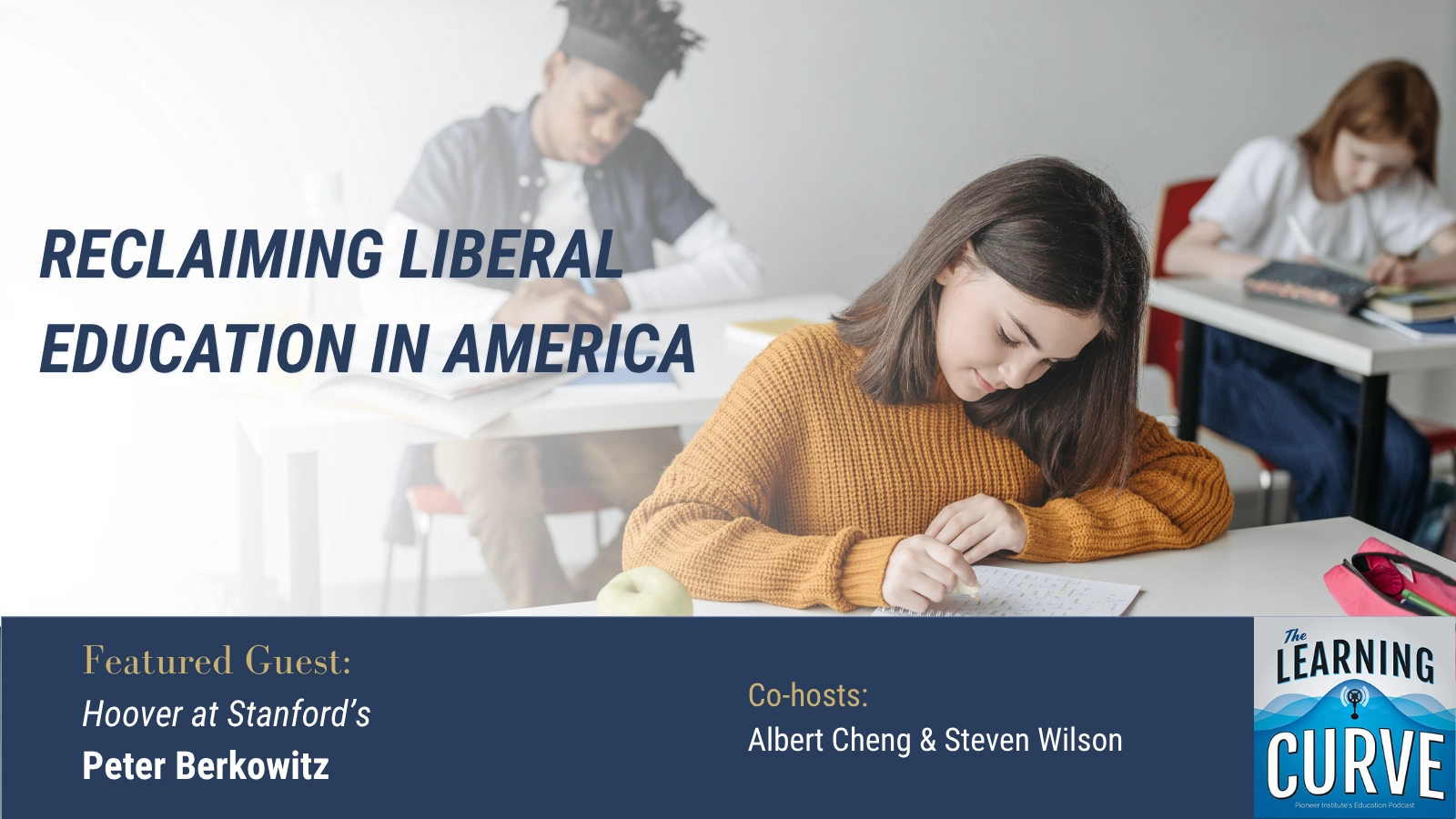
In this episode of The Learning Curve, co-hosts Prof. Albert Cheng of The Ohio State University and Pioneer Senior Fellow Steven Wilson, speak with Dr. Peter Berkowitz, a senior fellow at the Hoover Institution at Stanford University and author of Reclaiming Liberal Education in America. Berkowitz reflects on the education that led him from Swarthmore College to the study of philosophy, political science, and law. He explains the ancient Greek meaning of “know thyself” and how Socratic inquiry seeks to understand universal questions about human nature, virtue, justice, and the good life. He distinguishes liberal education from a relativistic one, arguing that students should learn to question authority while cultivating moral virtues and respect for the law. Drawing on the examples of Frederick Douglass and the Rev. Dr. Martin Luther King, Jr., he discusses how Americans can pursue civic reforms through the nation’s Founding principles and upholding constitutionalism. Finally, Dr. Berkowitz reads a passage from his book Reclaiming Liberal Education in America.
Stories of the Week: Albert shares an article from Forbes questioning is AP courses are still college level. Steven discussed an article from The 74 Million on how New York City should renew their partnership with charter schools that are showcasing how integration and excellence can coexist.
Peter Berkowitz is a Senior Fellow at the Hoover Institution at Stanford University. At Hoover, he chairs the Koret-Taube Task Force on National Security and Law and cochairs the Boyd and Jill Smith Task Force on Virtues of a Free Society. Dr. Berkowitz is the author of Reclaiming Liberal Education in America; Explaining Israel: The Jewish State, the Middle East, and America; Constitutional Conservatism: Liberty, Self-Government, and Political Moderation; and Virtue and the Making of Modern Liberalism. He has written hundreds of essays, articles, and reviews on many subjects for a variety of publications, including the Atlantic, the Boston Globe, the Chronicle of Higher Education, Commentary, Haaretz, the Jerusalem Post, the London Review of Books, the New Republic, Real Clear Politics, the Times Literary Supplement, the Wall Street Journal, and the Washington Post. He holds a B.A. in English literature from Swarthmore College, an M.A. in philosophy from the Hebrew University of Jerusalem, and a J.D. and a Ph.D. in political science from Yale University.