


Dr. Jocelyn Chadwick on Teaching Mark Twain, Huck Finn, & Jim
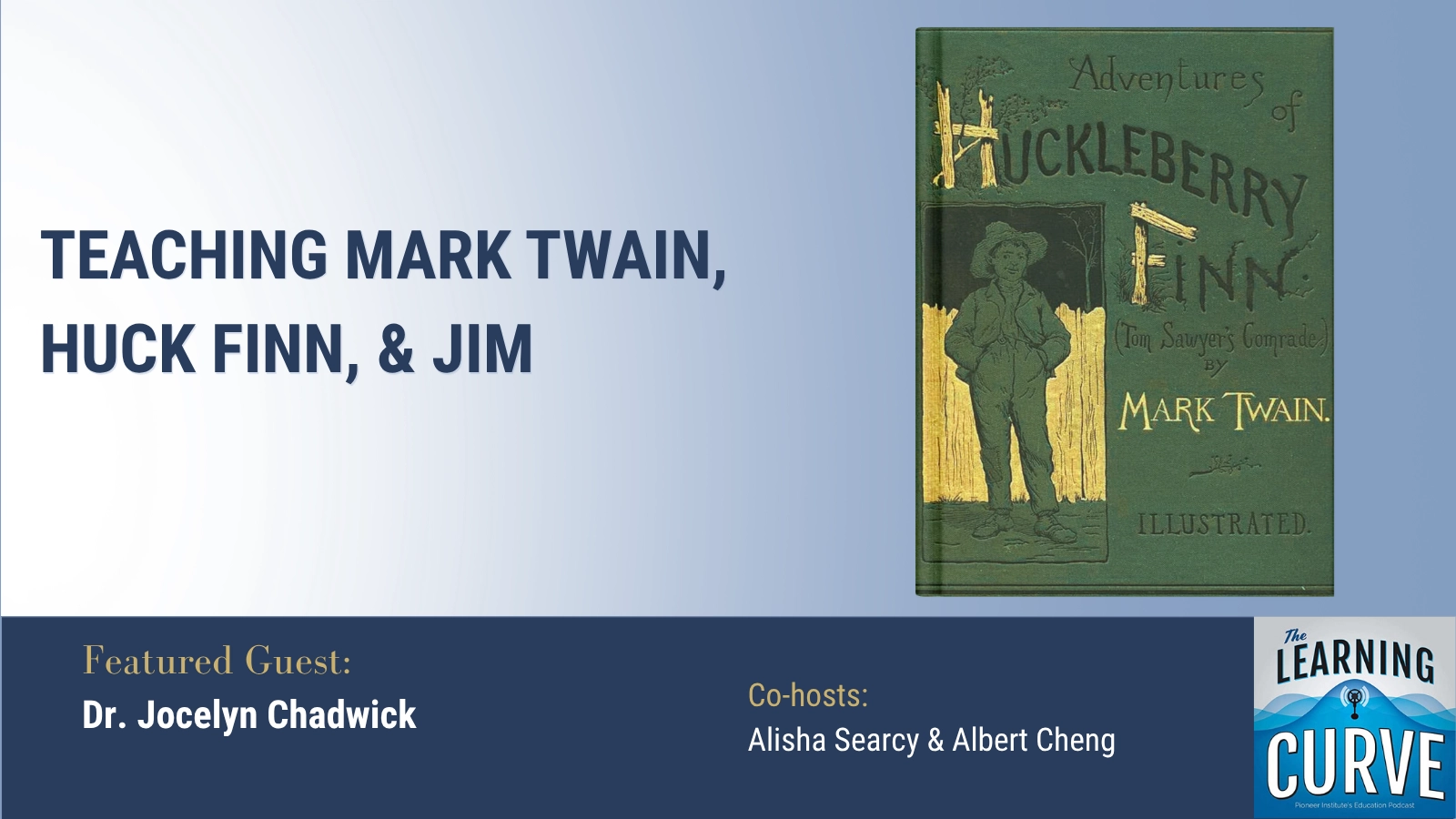
The Learning Curve Jocelyn Chadwick
Albert Cheng: [00:00:00] Everybody, this is Albert Cheng coming at you with a brand new episode of the Learning Curve podcast. And I’m coming at you with none other than Alisha Searcy. Hey, Alisha. What’s up?
Alisha Searcy: Hey, Albert. I’m great, and I love that introduction today. I love it. I love the energy.
Albert Cheng: Oh, cool. I just thought I’d introduce the show.
But, uh, I don’t know if I drank extra coffee or something, but hey, I guess I’m excited to be here, and I hope everyone is too.
Alisha Searcy: Yes. And you know, excited to be alive. Sometimes you just have to be grateful for the small but big things, you know? So yes, I am grateful to be here too and looking forward to hanging out with you today.
Albert Cheng: Yeah. That’s right, and we got [00:01:00] a great conversation on tap here with Dr. Jocelyn Chadwick. She’s gonna join us to talk about Huck Finn, American classic. Not without controversy of course, I think many of our listeners know, but anyway, looking forward to the interview to learn more about that book.
Alisha Searcy: Absolutely.
Albert Cheng: Well, before we get to that interview, let’s talk education news. Alisha, what’d you find?
Alisha Searcy: I came across a very interesting article that caught my attention from The 74, How To Fix Michigan’s Literacy Crisis: Property and Housing Solutions, Experts Say. This caught my attention of course because I have struggled as a former superintendent, you know, school leader, understanding that you are responsible for what happens when kids…
And I’ve, I’ve always said this to our principals and teachers, whatever happens outside of those doors, when the kids walk in at 7:30 or whatever the time is, we are responsible for what happens in those eight hours. And it sounds good [00:02:00] But then you would be very shortsighted to not realize that some kids are really, really struggling.
Their families are really struggling. And so this article is about, in Michigan, and of course it talks about Detroit and some other places, how poverty and housing issues are contributing to the challenges that kids are facing in schools, and it really begs the question about the role that schools need to play in this.
So we’ve seen all over the country, certainly in urban areas or rural areas as well, where schools and school districts have food pantries and clothing closets where kids can get clothes. I know at our schools, kids who didn’t have uniforms, we would make sure that we had extra uniforms. I remember, Albert, that there were two sisters that went to our elementary school who were homeless, and they would literally come in in the mornings and take a bath in the sink and put [00:03:00] on their uniform.
But no one else knew except for the administration in that particular school that these babies were living either in their mom’s car, sometimes in a hotel. And so I just think about the level of endurance, perseverance that kids are dealing with who go to school every day, who when they leave are facing abject poverty.
And so the question that we have to ask ourselves is what’s the role of the school? And I’m not arguing that schools need to be social workers and cover all of the needs of children, but I do think we have to acknowledge, and we’ve all heard people say, you know, if kids are hungry, they can’t learn. So it’s just an interesting article to see what’s happening.
For example, Detroit Public Schools has this attendance plan that wants to decrease chronic absenteeism to below 43% and raise average daily attendance to 90%. And we talk about absenteeism, but do we talk about the issues that cause absenteeism? So again, just a very [00:04:00] interesting article, and always a good opportunity to have conversations about how some of these social issues that kids and families are dealing with and come to school with, what the role of the schools are, and how we also have to care and have a sense of humanity about what kids and families are experiencing in American schools.
Albert Cheng: Yeah. Yeah. Well, you know, I think that last point, you really hit the nail on the head, you know, how do we make education humane again? Mm-hmm. You know, not treating students like just some ID number or a thing that kinda goes through the conveyor belt of our education system, you know? But yeah, you know, I, every, every time I, I come across articles on this topic of dealing with stuff outside of school, I find myself coming to a moment of sobriety to, one, recognize that these things matter and our kids come with lots of oftentimes baggage that, that we all have to deal with.
And, you know, as much as we wanna try to shut that out of the classroom door, it always, you know, rears its head. And by the way, a- actually, when you were talking, it kind of [00:05:00] reminded me, I think, of an article we talked about a few months ago about Mississippi, about how one school district went above and beyond trying to track down students that stopped showing up, you know.
So they were actively, in addition to improving literacy rates and with good instruction, doing that kind of human work. So I wanna acknowledge To your point that this is an important issue. And, you know, I think I just wanna maybe underscore just a slight counterpoint, and I, I mean, I don’t think you’d disagree with this, but we also would wanna avoid going too far to, to make an excuse, right?
We have seen schools show that, hey, we can overcome these odds of poverty, and these kids, it’s hard, they’ll have to struggle through it, and they need committed adults, but- Mm-hmm … there’s no reason to hold them to lower expectations just because of the challenges- Oh, absolutely … they face. So, and again, I understand there’s a balance there, and so appreciate you bringing up that article, Alisha.
Alisha Searcy: Sure. And I appreciate you saying that, Albert, and you’re right, I do agree with you. I think you acknowledge that these issues exist. You do what you can. You gotta put the supports [00:06:00] around, and you have high expectations. And I will brag for a moment and say, that same elementary school, when I got there, had a 43 on the state score, and by the time I left, had an 85.
Albert Cheng: Mm.
Alisha Searcy: It was a, a 90% free and reduced lunch population, and so obviously there was significant growth over those three years. And so it shows, right, that even when kids are coming from those kinds of communities and environments, that they absolutely can still learn at high levels. And to your point, you gotta have trusting adults who have high expectations of all kids around them, and that’s how you do it.
Albert Cheng: Yeah. Well, it’s no easy task- No … but hopefully that’s encouraging and gets us to think about the practice of education for a little bit. Anyway, I wanna move on to my article, and I’ll be- Mm-hmm … brief here ’cause I do wanna get to our guest. This is maybe, like, a public service announcement, I think, you know.
We’ve been talking about the Federal Education Tax Credit quite a bit on this show, and over the weekend, or actually, I don’t know if it’s the weekend, maybe it’s, actually call it last week, the Treasury Department [00:07:00] released some rules. In case you missed that memo, take a look at the couple articles that are out there about the release of these new rules.
I think I’ll highlight one thing that really caught my eye, and I think it’s probably catching the eye of a lot of people who are in on this. You know that $1,700 tax credit, the rules have been interpreted such that married couples can qualify for a tax credit up to 3,400. So I think there’s a lot of other rules that people need to look into, including eligibility and what you can spend the money on, you know, how do public school students, homeschool students all qualify.
So. Mm-hmm.
Alisha Searcy: And that’s good to know because I know there’s been a lot of discussion about the rules and asking for feedback and all of that. I think I’m particularly interested to hear what it’s gonna look like for public schools. So thank you for sharing that. Now it, that means I need to do my homework.
Albert Cheng: Yeah. Well, anyway, thanks for sharing the news, Alisha. Love chatting about it, as usual, and let’s move on to Dr. Jocelyn Chadwick and Huckleberry Finn.[00:08:00]
Dr. Jocelyn Chadwick has been an English teacher for over 40 years, starting at Irving High School in Texas, then at the community college and university levels, and for nine years at the Harvard Graduate School of Education. As a nationally recognized Mark Twain scholar, Dr. Chadwick is the author of The Jim Dilemma: Reading Race in Huckleberry Finn.
This academic work has taken Chadwick to the White House, to participating at the Mark Twain House, and in television features and documentaries, including NBC’s Dateline, PBS’s Born to Trouble: Adventures of Huckleberry Finn, and Ken Burns’ Mark Twain. In 2015, Chadwick was elected vice president for the National Council of Teachers of English.
She earned a BA from the Houston Baptist University, her MA and PhD in American and British literature and classical and modern rhetoric from [00:09:00] Texas Woman’s University, and completed a PhD residency at the University of London. Dr. Chadwick, welcome back to the show.
Jocelyn Chadwick: Well, I’m excited. I’m always happy to help.
Albert Cheng: Let’s start maybe with a bit of your own background. You’re an accomplished English teacher. You teach classes at Harvard, celebrated Mark Twain scholar. Tell us a bit about your background, maybe some formative educational experiences. And really what we’re interested is how did you come to love Mark Twain’s classic novel, The Adventures of Huckleberry Finn?
Jocelyn Chadwick: Well, both of my parents were teachers, my father math, my mother elementary, and I was surrounded by books all my life. And my weekends were also scripted, library time, playing the piano, learning how to play the piano, which I didn’t really want to do, but that’s neither here nor there, and being surrounded by books all the time.
And I loved reading, and my father loved Mark Twain, and he first read it to me [00:10:00] when I was, literally out loud, on his knee when I was seven. And so I have been with Mark Twain just basically all my life because of my parents. I have read just about everything he ever wrote, including his letters that he wrote to other writers, and I have found his work to be very interesting.
And as I grow older, I understand that it is even more prescient now- Mm … than it was when my father read it to me, which I still, to this day, I am so grateful.
Albert Cheng: Well, thanks for sharing that. I mean, you, you remind me of, I think it was a conversation we had at some point when we were talking about what we might learn from books, what we might learn about ourselves from books.
And so I think this book is no exception, so let’s get into it. Let’s talk about Mark Twain first, or maybe we should say Samuel L. Clemens, how Mark Twain’s the pen name. But Mark Twain, considered one of America’s greatest novelists and humorists, the father of American literature is what William Faulkner called [00:11:00] Twain, for authoring The Adventures of Tom Sawyer and the sequel, Adventures of Huckleberry Finn.
So what should we know about Twain’s own biography and maybe the story of Tom Sawyer to help us better appreciate Huckleberry Finn?
Jocelyn Chadwick: Sam Clemens grew up in a, his family were poor. They had better off relatives, so to speak, but his immediate family were poor, but a good family. They loved each other. Sam grew up to be a newspaper reporter.
He sailed on the riverboats and then started writing. He fell in love with Olivia Langdon and her family. He married Olivia Langdon, and she was his spirit. Every time I think about Sam Clemens and Olivia, they remained so much in love and dedicated to each other that her death really discombobulated him a bit, like losing a portion of [00:12:00] himself.
And he loved his children. He was a devout and devoted father. He loved a good laugh. He was a brilliant writer, and Olivia pushed him. She was not only the love of his life, but she was also his inspiration of really getting into writing. She knew that there was more to him than just laughter and a joke or two, so he did knuckle down and start writing, and he wanted to know more about people in general.
He grew up around slavery. At the time of slavery, he saw slaves. He talked to the slaves when he should not have been. So he was a curious boy, he was a curious man, and he remained curious about life in general. The Tom Sawyer book, The Adventures of Tom Sawyer, is really a primer, and to be honest with you, it’s something I haven’t shared much with many people, I used to hate The [00:13:00] Adventures of Tom Sawyer because I thought-
what is this about? It makes no sense to me. And several more years ago, I reread it And I realized for the first time, because I actually wanted to take it seriously, ’cause I thought I was being duplicitous by saying I’m a Twain scholar and I actually hate Adventures of Tom Sawyer. So, and going back and rereading it, I realized that, yeah, it’s The Adventures of Tom Sawyer, but the book is really about Huck Finn.
And if you read the end of that book, the end of Tom Sawyer, when Huck and Tom are talking about the reward money and so forth, Huck says to Tom, “I don’t care about the money. I don’t care about all of these things. I just want to live. I just want to be.” And I’m thinking, gosh, this whole book has been about Huck Finn under the guise of Tom Sawyer.
That is just so interesting. And so if you own a copy of The Adventures of Tom [00:14:00] Sawyer, go to the last chapter and just read that section where Huck and Tom are talking, and Huck just takes out this singular moment that goes right over Tom Sawyer’s head in saying, “I can’t do it. I can’t go with this life of trying to make people do what they want me to do.
I’m just me. I’m just Huck. I don’t need the money. I don’t need the attention. I just wanna be myself.” It’s amazing.
Albert Cheng: Yeah.
Jocelyn Chadwick: Yeah.
Albert Cheng: And so it launches right into, I mean, l- as you’re explaining that, I just can’t help but think about all the post-credit scenes in these Marvel movies that try to preview the next episode to connect the movies together.
But anyway, maybe that’s a discussion for another time. Let’s talk about the book a bit. Yeah. Ernest Hemingway famously wrote, quote, “All modern American literature comes from one book by Mark Twain called Huckleberry Finn,” end quote. So I mean, that’s quite the statement. Why don’t we start with having you give us a brief plot overview for The Adventures of Huckleberry Finn?
Jocelyn Chadwick: [00:15:00] After Twain writes Tom Sawyer’s book, he goes right into writing a book that would take him a totality of seven years to complete. So just think about that for a moment because not only did he have servants in his home who were, who, George, who was Black, but he also had another friend whom he met, and we’ll talk about him a little bit later, but he was experiencing Black people all the time, and he was around Olivia and her family, who were sympathetic to emancipating slaves and so forth.
And so with Huckleberry Finn, when you begin to read this book, you find that it is a book that projects a mirror of what the North, the South, Black people, white people, poor, rich, literate, illiterate, slaves, free people, all of these voices and non-voices are in this one book. We meet them all. We meet people who are family by [00:16:00] blood, like the Grangerfords and the Shepherdsons, or we meet people who are family by the connections, like Huck and Jim.
We see friendship, we see betrayal in this novel, and we see, most importantly, the power of words. That’s great. How words can hurt, how words can anger, how words can endure, how words can bring people together, and I can see why it would take seven years to write it.
Albert Cheng: Well, let’s dig in some more, and I wanna ask a question about the character of Huckleberry Finn.
The beginning of the book, as you know, goes like this, quote, “You don’t know about me. Without you I’ve read a book by the name of The Adventures of Tom Sawyer but that ain’t no matter.” “That book was made by Mark Twain and he told the truth, mainly.” That’s how it starts, and Huck is basically narrating, if I’m not mistaken, so- Yes
so tell us about Huckleberry Finn. What’s his background, his personality, and also why don’t [00:17:00] you discuss the regional vernacular and dialects that are used- Sure … in the story.
Jocelyn Chadwick: Well, let’s talk about the people that you mentioned. We have a little boy, a teenager, who’s just, he has no family. He has two unmarried women, and of course, 19th century, that was a big deal, who had adopted him.
But he did have a father. He had a biological father who wasn’t a father. And we look at Huck, and we find that he is, in a sense, an emancipated teenager who’s just a nice kid, and the vernacular is Southern. And I am from the South, so I know about the stereotypes that people give Southerners, and that we Southerners ourselves sort of hang on to.
Drives me crazy, but it exists. And so the dialect you see or that you read is the dialect that you would hear if you were anywhere in the South. In Texas, my [00:18:00] home state, if you go to East Texas or West Texas, the dialect is even harder to discern than it is in Adventures of Huckleberry Finn. It’s a Southern dialect.
And again, if you’re gonna write about characters who live in the South, they have to sound Southern. Just like here in Massachusetts, there’s a distinctive Massachusetts dialect that you can hear. You know the people who were born here because you can hear it. And those of us who were not born here, you can hear that, too.
He also includes in this book the different kind of vernacular, the one character that I always say people forget, the free professor from the North. That professor’s the very first person of color we see in the novel, and it’s important that he’s there because he talks. Hmm. He has a voice. He tells people that he votes, that he is free.
He is walking down the Southern street in the broad daylight. I often ask students, “If we were slaves back in the day, [00:19:00] how many of us would walk down the street when we knew that people didn’t like the way we look?” And could do anything they wanted to us. But here is a guy from the North who’s walking and talking and lets people know that he can vote in the North where he lives.
Hmm. So Twain puts that character there. And one has to ask, why would you do that? He doesn’t come in anywhere else. He’s there at the beginning and that’s it. And that’s a very important character juxtaposed to Jim, who is the slave and who is trying to do what not many slaves were able to do, run away, because of the consequences of running away.
So we have a free African American from the North, we have an enslaved African American in the South who’s trying to get the heck out of dodge. So you want the vernacular. The professor is the juxtaposition because we hear someone speaking correct, edited English, and he is of color. Right. And then we go into the Southern [00:20:00] portion of it and we understand that vernacular.
Hmm. And that is the regional vernacular. Colonel Sherman is another example of a Southerner who is not quite as Southern in dialect when he’s talking to the crowd. He’s very crisp and he’s very clear. And so there, again, is another diversion of not all of us speak the same way in the South. And so the dialects vary throughout the South
Albert Cheng: Speaking of dialects, and you’ve started to bring up Jim, so let’s talk about Jim, and here’s how he’s introduced in chapter two.
“Say, who is you? Whar is you? Dog my cats if I didn’t hear something. Well, I know what I’s gonna do. I’s gonna set down here and listen till I hears it again.” That’s how Jim comes in , shows up in the book. Yeah,
Jocelyn Chadwick: yeah.
Albert Cheng: So tell us about Jim. What is Twain showing us about antebellum America, particularly slavery?
And you mentioned George earlier. Talk about who he is and his relation [00:21:00] to Jim as well.
Jocelyn Chadwick: Well, as I mentioned earlier, the Langdons were abolitionists, and Twain became an, an astute abolitionist as well, even though his primary family didn’t have slaves, but they supported the concept. You know, they went along with it.
But as Twain is with his wife and his family, he does meet a number of African Americans. And when he visited his uncle as a child, just like Huck, Twain would go to the slave quarters and talk to the slaves and listen to their stories. So that, of course, means that he, he was always intuitive and curious about everything.
As he was married to Olivia, he had a servant, a butler by the name of George Griffin, and he and George were more than just the owner of the home and the butler. They were friends. They were confidants. George was a part of the family. And also [00:22:00] John Lewis. And John Lewis is one of my favorite people, because one afternoon, Twain is sitting out on the porch of his home.
He sees his sister-in-law get into a carriage, and the horse just bucks, and it goes running. Just got away. And Twain goes after the carriage on foot, running, trying to stop the runaway carriage. And as Twain goes down the hill and turns the corner, he sees the carriage, his fainted sister-in-law, and a Black man standing holding the reins of the horse, making the carriage, the horse all stop, and everyone is safe.
And his name is John Lewis. And Twain talks about running around the corner and seeing this man holding the reins of the horse, and his sister-in-law just fainting, and the driver just being discombobulated. And Twain [00:23:00] and George and John Lewis make a forever friendship. They become friends. And after Twain thanks Mr.
Lewis, every time he publishes a book, he gives John Lewis a copy, a signed copy of the book And I just think that that whole scenario of how Mark Twain and John Lewis become fast friends is just amazing. And those are just two people whom he met who had an impact on his writing, on his thinking about African Americans.
He knew Frederick Douglass, the Jubilee Singers, so he was around people of color quite a bit, more often than many people are aware.
Alisha Searcy: That explains a lot. Dr. Chadwick, Huck Finn’s relationship with Jim evolves from viewing him as a slave to recognizing him as a true friend, a protector, and an equal. And it says, quote, “Jim, this is nice.
I wouldn’t wanna be nowhere else but here,” [00:24:00] end quote, Huck says to Jim in chapter nine. Would you discuss Huck and Jim’s relationship early on? You’ve mentioned a few of these things. The fog dream trick episode in chapter 15 and the significance of their time together on the Mississippi River in raft compared to life on the land.
Jocelyn Chadwick: I’m glad you mentioned that section because it’s a very important section. When some folks, teachers, people, and they just come up to me and say, “You know, I don’t like the way Jim is portrayed in the novel.” My take on that is I say to them, the Chadwick side of my family is a mix match of slave owners, Native Americans, and Africans And so it’s this idea of how does one get one’s voice out?
What does it mean when a part of you, African Americans in the 19th, slaves in the South, had no [00:25:00] voice? And what were they really thinking? Were they thinking? Could they think? And what you mentioned, the chapter that you talked about, the dream, the fog dream section is so important because as you read the novel earlier on when Huck goes off the boat and he goes to sort of see if there’s anyone in the wreck, and Jim says, “There goes old Huck, my only friend.
I trust you, Huck. You just be careful.” And it’s rhetoric that Jim is using very smartly to make Huck feel responsible. Huck doesn’t really want to feel responsible, but Jim makes him feel responsible. And the section that you talked about is so important because when Huck plays that trick on Jim, Jim has the voice and he comes back and Jim says, “What did they stand for?
I’s gonna tell you. When I got all wore out [00:26:00] with work and with the calling for you and went to sleep, my heart was most broke because you was lost, and I didn’t care no more what become of me and the raft. And when I wake up and find you back again, all safe and sound, the tears come, and I could’ve got down on my knees and kiss your foot.
I’s so thankful. And all you was thinking about was how you could make a fool out of old Jim with a lie. That truck there is trash, and trash is what people is that puts dirt on the head of their friends and makes them feel ashamed.” And if you look at the real text of the novel itself, trash is italicized.
So he calls Huck trash, and it is in italics, and this is the real voice of this slave coming out, and it is amazing. I mean, that is such a powerful point, and I don’t know that readers who [00:27:00] want to see this book as a racist book have read the book in its entirety, because you can’t see a passage like that and say that Jim is weak
Alisha Searcy: Wow, that’s very powerful.
So speaking of race and controversy, I wanna ask you a couple of questions around that. Quote, “Much debate has surrounded Mark Twain’s Adventures of Huckleberry Finn since its publication in 1885.” End quote. You write in The Jim Dilemma: Reading Race in Huckleberry Finn. But none has been more pervasive, explosive, and divisive than that surrounding the issue of race.
The use of the racial slur, the N-word, which appears 219 times, makes it one of the most debated books in the history of American literature. So I have two questions around this. Number one, can you talk about your thoughts and perspective on saying the word, using the word when it’s in literature, and how that should be treated?
[00:28:00] In our case, we are just going to say the N-word. But I’d like for you to talk about that. And then the second part of this question is if you could also talk about some of the main controversies surrounding Twain’s novel and race.
Jocelyn Chadwick: Sure. Let’s deal with the racial slur to begin with. When I teach this novel and when I write about the novel, I finished an article just a couple of months ago, I always say, “Use what the author puts on paper.”
The word, the racial slur, it was meant from its very beginning, from its start, to be negative, to be hurtful, to be almost like an erasure of identity. So if it was all of that And it was for a very long time. It is a part of our American history. It is a part of the fabric of who we are, White, Black, brown, whatever.
It’s all there. And [00:29:00] so trying to pretend that such a word, an awful word, doesn’t exist, doesn’t help any of us. So I always insist to teachers, if you cannot read the novel the way it is, don’t redact it, don’t teach it, stay away from it. That is right. Because the point in doing it, the whole point in novels is for us to learn more about ourselves and to allow our students, in a safe environment and space, to talk about these topics which they may not be able to talk about at home, or they may not be able to talk about it at church or wherever they go.
But the classroom is where they should be able to talk about controversy and vocabulary. So I do support, and I tell teachers, “If you want me to come in and talk about the work, whether it’s Toni Morrison or Mark Twain, I’m gonna use the very words that they use. If you have a problem with that, then we need to talk about that.”
And I also [00:30:00] tell students, “You can ask me anything. If I know the answer, I will tell you. If I don’t, I will go back, try to find it, and give it to you. But I will tell you exactly what’s going on in the piece.” Twain’s use of those words, particularly the one word, the racial slur, it was in slave narratives by slaves themselves who used them to tell their stories.
It’s in Adventures of Tom Sawyer, it’s in, of course, Huck Finn. You have those same words in The Tragedy of Pudd’nhead Wilson, and in A True Story Repeated Word for Word. And for example, in A True Story Repeated Word for Word, he uses the word colored. And I was teaching that short story to a group of elementary students, and one student, and she was of color, said, “Would you mind telling the class that colored is a bad word?”
And I said, “That is [00:31:00] fantastic.” I hadn’t really thought about it, and I said, “Yes, I understand that colored is a word that is no longer used.” And in that one moment with that sixth grader, we were able to talk about how language changes- Mm-hmm … according to decades, according to generations, that at one time, colored wasn’t a good word next to what the racial slur is.
So it was a learning moment for the principal who was in the class, the young lady who asked the question, her colleagues, her friends in the class, and the teacher and myself
Alisha Searcy: Wow, that’s a powerful moment.
Jocelyn Chadwick: It was.
Alisha Searcy: Yeah. And I agree. What a place to be able to learn and having those kinds of conversations with a trusted adult.
Jocelyn Chadwick: That’s one of the reasons I still stay in the classrooms, and I’ve never said no to librarians or teachers.
Alisha Searcy: Wow. I love that. So in chapter 19, it says, quote, “I am the lineal descendant of that infant. I am the [00:32:00] rightful Duke of Bridgewater, and here am I, forlorn, torn from high estate, hunted of men, despised by the cold world,” end quote.
And goes on to say, “Yes, gentlemen, you see before you in blue jeans and misery the wandering, exiled, trampled-on, and suffering rightful King of France.” And the King says… Would you tell us about The Duke and the King and the Royal Nonesuch episodes, and what Twain is trying to tell us about con artists, grifters, and frauds found in American life?
Jocelyn Chadwick: You know, as I said earlier, this novel is a reflection of who we were and who we still are as Americans. And this is another reflection of how we are so often, we succumb to the idea of wealth, of extreme, of extravagance. We succumb to the idea or concept of royalty. And when I say royalty, I’m [00:33:00] not talking about the Brits.
We kind of put our sports people in a category of royalty. Film people, television, you know, music artists. We put them in a glow of something that we just admire. We love them. We want to be like them. When I say we, I’m definitely not including myself, but I’ll say we. We never really know the real truth about these people.
We see what we think we want to see. Mm-hmm. And we want to be like them or have what they have, and that’s what The Royal Nonesuch is about. It’s about how two grifters could pretend to be royalty, using incorrect English along the way, being absolutely awful selling Jim later in the novel. They’re awful guys.
But how we can succumb to what we think is shiny and different and above us, instead of just being happy with who we are. Again, I keep coming back [00:34:00] to something that Huck keeps saying in both The Adventures of Tom Sawyer and Huck Finn, “I just want to be myself. I’m happy with myself.”
Alisha Searcy: Wow. Thank you for that.
So, quote, “I was a-trembling because I’d got to decide forever betwixt two things, and I knowed it. I studied a minute, sort of holding my breath, and then says to myself, ‘All right, then, I’ll go to hell,’ and tore it up,” Huck says in Chapter 31. Mm-hmm. He goes on to say, “And for a starter, I would go to work and steal Jim out of slavery again.
And if I could think up anything worse, I would do that, too. Because as long as I was in, and in for good, I might as well go the whole hog.” End quote. Could you discuss the moral climax of the novel and Huck’s internal conflict about helping Jim, his friend and a runaway slave?
Jocelyn Chadwick: Yeah. Both Jim and Huck confront individual conflicts, conflicts which reveal who they really [00:35:00] are because of their experiences together down the river.
Neither Jim nor Huck is the same person we meet at the beginning of the novel. Love, concern, sacrifice, protection, family, all of these are the results of the two of them being together and having those experiences. And for Huck to proclaim that he is going to do what he needs to do, this is a boy who has a father who only sees him as a paycheck.
He has two women who are trying to mold him into what they want him to be. He really has no place, no space, and he befriends a slave who is trying the unbelievable task- And challenge of not only running away towards freedom, which he doesn’t have, but also trying to regain his family to boot. So this is a huge issue for Huck [00:36:00] when he says, “I’m going to help him no matter what.
I’m just gonna do it.” And it coalesces with what Jim will say later after Tom Sawyer is shot and Huck says, “This is your time to get away. Run away.” And Jim says, “I’m not gonna do it.” Now, what you have to remember is this is a man who for the majority, for three-fourths of this novel, has been trying to get out of slavery.
Anything he can do, including befriending Huck Finn. And all of a sudden when he has a clear path to go, he says, and I wanna quote this ’cause it’s important, “Well then, this is the way it looked to me, Huck. If it was him that has been sought free, then one of the other boys was to get shot, what would he say?
Go on, even save, never mind about the doctor, for to save this one? Is that like Mr. [00:37:00] Tom would say? Would he say that? You bet he wouldn’t. Well then, is Jim going to say it? No, sir. I don’t budge one step out of this place ‘dout a doctor. Not if it’s 40 year.” Now again, with all the dialect, here’s a man who has decided that he is going to forego not only his own freedom and running, but he will forego his family, which has driven this entire novel, to save the kid who put him and Huck in this danger.
So Jim has his own voice, has always had his own voice, but here he shows he has voice and he is willing to sacrifice to do what he feels is right, and he has his own self. He is his own man at this point. It’s a critical part in the novel.
Alisha Searcy: Wow. So I wanna talk about something else that I think is critical.
It’s [00:38:00] a question that many people ask. In chapters 34 and 35, Tom Sawyer develops elaborate escape plans for Jim, which are silly and cruel. So would you talk to us about Twain’s ending in Adventures of Huckleberry Finn? Is this a weakness in the story, as some claim, or is there some larger and more profound Twain’s telling us about how Americans’ national character often turns simple, practical plans for human freedom into romantic, convoluted, and dangerous adventure games?
Jocelyn Chadwick: I think one of the other parts in this that sometimes readers don’t remember, when Tom Sawyer tells Huck that he is gonna have this elaborate game, in a sense, of freeing Jim, Tom does not tell Huck that Tom is carrying a letter of manumission. That’s a key part, and it goes so fast that, again, I don’t think many people really realize that for Tom, [00:39:00] it’s always a game, and Tom deceives his best friend.
Huck has no idea. They didn’t have to do any of that had Tom just not made a game of it. So Tom is a very different character than is Huck Finn. Huck is totally embedded with Jim. He doesn’t have the family that Tom Sawyer has. He doesn’t have the support that Tom Sawyer has. The first father figure he’s ever really had is Jim.
And so the ending, I think, is brilliant in that we finally figure out that Huck never had a clue that they didn’t have to do all of what they were doing, all that foolishness with the changing of the clothes and so forth, and it was just unnecessary. And what really sells it at the end, it’s when those folks catch Jim and bring him back, and Huck says that Jim doesn’t say a word.
Jim doesn’t let them know that he [00:40:00] and Tom were there, and that’s the final brick in the relationship between Huck and Jim, because Huck knows that Jim is for real Of everyone around him Jim is his lifeline. He is the person with whom he identifies. There’s been freedom of voice, there’s been commitment, there’s been sacrifice, and at the end there’s love.
Alisha Searcy: Mm. Beautifully said. So Jocelyn, before we close, we would love for you to share with us a reading, one of your favorite passages.
Jocelyn Chadwick: One of the passages that I want to read is, I mentioned Colonel Sherburn earlier just in passing, but there’s a section in this novel where a man, Colonel Sherburn, kills another guy in the streets, and he just, a mob comes up, and it, the mob acts as though they’re going to do something to Colonel Sherburn.
But this is a scene where one Southerner stares down a group of [00:41:00] Southerners and tells them that they are nothing because they don’t have their voices. And it’s a very sober and critical moment in the novel because it shows you what Southerners were really like during that time period. So the group has gone to Sherburn’s house.
Sherburn is standing on the porch, and it says, “Just then Sherburn steps out onto the roof of his little front porch with a double-barreled gun in his hand and takes his stand perfectly calm and deliberate, not saying a word. The racket stopped, and the wave sucked back. Sherburn never said a word, just stood there looking down.
The stillness was awful creepy and uncomfortable. Sherburn run his eyes slow along the crowd, and wherever it struck, the people tried a little to out-gaze him, but they couldn’t. They dropped their eyes, and they looked sneaky. [00:42:00] Then pretty soon Sherburn sort of laughed. Not the pleasant kind, but the kind that makes you feel like when you are eating bread that’s got sand in it.
Then he says, slow and scornful, ‘The idea of you lynching anybody. It’s amusing. The idea of you, you have the pluck enough to lynch a man. It has, because you’re brave enough to tar and feather poor friendless cast out women that come along here. Did that make you think you had grit enough to lay your hands on a man?
Why a man’s safe in the hands of 10,000 of your kind as long as it’s daytime and you’re not behind him. Do I know you? I know you clear through. I was born and raised in the South, and I’ve lived in the North. So I know [00:43:00] the average all around. The average man is a coward.'” That is the section of Shurben, and he then tells them at the very end that they should go and do what they do best in the dark, in the night.
And so he’s talking about lynchings and hangings done at night to other people. It’s a powerful section. It is. It’s chapter 22, and it is really powerful.
Alisha Searcy: Thank you. Perfect way to end this time with you. Thank you so much.
Jocelyn Chadwick: Thank you for having me.
Albert Cheng: Well, Alisha, another fun interview and really insightful. It got really me to think about lots of things about that book. I mean, I remember reading it as a young boy, adolescent, a teen. I don’t- I forget when in school, but it’s great to revisit it. [00:44:00]
Alisha Searcy: Yeah, I bet it would be an interesting read to reread it now.
Albert Cheng: Yeah, you bet. I’m sure a lot of things went over my head at that age. Right.
Alisha Searcy: But great conversation, great guest.
Albert Cheng: Yeah. Well, that’s gonna bring us to the end of our show, and I wanna leave everybody with the tweet of the week. This one comes from Education Next. Quote, “Across the board, teacher performance improves as soon as the new evaluation system begins, but the improvement gains are twice as large for pre-tenure teachers.”
And that’s from an article by Eric Taylor on Education Next about his recent evaluation of a program in Tennessee that made teacher tenure rules a bit stricter. But it turns out at least it looks like this improved teacher quality, so take a look at that article. And Alisha, as always, thanks for co-hosting.
Looking forward to coming back next week with you.
Alisha Searcy: That’s right. See you soon.
Albert Cheng: Yeah. And next week we’re gonna have Peter Berkowitz from Stanford to talk to us about liberal [00:45:00] education, so it should be a great episode. Until then, everybody, be well.
In this episode of The Learning Curve, co-hosts Alisha Searcy of the Center for Strong Public Schools and Prof. Albert Cheng of The Ohio State University speak with Dr. Jocelyn Chadwick, a nationally recognized Mark Twain scholar and author of The Jim Dilemma: Reading Race in Huckleberry Finn. Jocelyn reflects on her more than forty years as an English teacher, including her work at the Harvard Graduate School of Education, and how she came to study Twain’s American classic. She explores Twain’s biography, the connections between The Adventures of Tom Sawyer and Adventures of Huckleberry Finn, and Huck’s distinctive narrative voice. Dr. Chadwick discusses the central importance of Huck and Jim’s evolving friendship, the novel’s portrayal of antebellum slavery, and the significance of the Mississippi River. She examines the book’s enduring controversies around race, Huck’s moral decision to help his friend and runaway slave Jim, and Twain’s much debated ending. Finally, Jocelyn closes by reading a passage from Adventures of Huckleberry Finn.
Stories of the Week: Albert shares an article from Chalkbeat on the newly announced guidelines of the federal education tax credit program. Alisha discussed an article from The 74 Million on how to address Michigan’s literary crisis.
Dr. Jocelyn Chadwick has been an English teacher for over forty years, starting at Irving High School in Texas, then at the community college and university levels, and for nine years at the Harvard Graduate School of Education. As a nationally recognized Mark Twain scholar, Dr. Chadwick is the author of The Jim Dilemma: Reading Race in Huckleberry Finn. This academic work has taken Chadwick to the White House, to participating at the Mark Twain House, and in television features and documentaries, including NBC’s Dateline, PBS’s Born to Trouble: Adventures of Huckleberry Finn, and Ken Burns’s Mark Twain. In 2015, Chadwick was elected Vice President for the National Council of Teachers of English. She earned a B.A. from the Houston Baptist University; her M.A. and Ph.D. in American/British Literature & Classical/Modern Rhetoric from Texas Woman’s University; and completed a Ph.D. residency at the University of London.