

Boston College's Melodie Wyttenbach on K-12 Catholic Education
The Learning Curve Melodie Wyttenbach
Alisha Searcy: [00:00:00] Welcome back to the Learning Curve podcast. I’m your co-host, Alisha Thomas Searcy, CEO of Center for Strong Public Schools, and joined by our other co-host, Dr. Albert Cheng. How are you, Albert?
Albert Cheng: Hey, Alisha. Doing well. Hope you’re doing well, too.
Alisha Searcy: Doing great. Happy fall, all of the things. It’s almost Halloween time.
Albert Cheng: It is Halloween time and, you know, which also means it’s my wedding anniversary time, too. We got married the day before Halloween.
Alisha Searcy: Yay. Well, that makes two of us with anniversaries in October and birthdays in September. I love this.
Albert Cheng: Oh, look at that.
Alisha Searcy: I love it. How many years will it be for you?
Albert Cheng: A mere five, but I don’t know if, like, [00:01:00] mere is the right adjective here. It is not I’m looking at all these people that have been married for 50, 60. I’m like, man, that’s, that is awesome to see.
Alisha Searcy: It is. Well, I’ve been married for five years this year as well, and I say that it’s amazing to be married for five years. ‘Cause to your point, there are folks who don’t make it, and so we have to celebrate, especially when we still like and love our partners.
How about that?
Albert Cheng: Yeah, there you go.
Alisha Searcy: That’s important. So speaking of things that are important, let’s also talk about some education and articles and what’s happening in the world today. What are you finding?
Albert Cheng: Well, you know, Alisha, we’ve been following this almost never-ending saga of which states are gonna opt in to the Federal Education Tax Credit program, and one of the shoes dropped, or I don’t know if I’m using the right metaphor, but looks like Governor Kathy Hochul of New York has decided to opt in.
So I caught this article from Chalkbeat. I’m sure this is an article that’s made other media outlets, but it looks like she’s participating. So [00:02:00] I don’t know what this is gonna mean for some of the other states that are sitting out or not, but it looks like New York is in, and so we’ll see how that all goes for that state.
I know certainly private school families might be looking ahead to this, but something that we’ve talked about on the show, and you’ve mentioned specifically, Alisha, is the opportunities that there are for students and families that are in traditional public schools to get tutoring. And, and that’s something I believe, at least it seems like from this article, that Governor Hochul was really interested in.
And so let’s see how this all works out.
Alisha Searcy: Yeah, it’s a good point. It is a big deal that she has opted in, New York is in. There are, of course, a bunch of red states that have already done so, but when you see a blue state, it’s a big deal. And I think to your point, it’s about the public schools who can benefit from this.
In our organization, we’re actually having conversations now about do we take a position, do we not? So thanks for bringing this up, and as you said, it’ll be something to watch now that the rules are out, it’s moving ahead. I think if it can support public schools and public school [00:03:00] students, then yay for them, you know?
Albert Cheng: Yeah, and then, you know, of course, I’m the cheerleader here for the private sector, too. Yeah. So I’ll, I’ll add that bit.
Alisha Searcy: Of course. I get it. And then my take is if it helps students, period, no matter what kind of school they go to, great.
Albert Cheng: Hear, hear.
Alisha Searcy: Very good. Well, I came across an article from The Washington Monthly about time to teach three years of high school civics.
And you and I have talked about this a lot. I think you’ve brought several articles about teaching civics, and I just wanted to uplift this particular article because it’s election season. Early voting started in Georgia October 13th, and I know that across the country early voting is starting, if it hasn’t already.
And of course, November 3rd is the election. And so however you vote, we want kids to understand civics, US history. We want them to understand their government, right, and how this process [00:04:00] works, our founding documents, et cetera. And so I appreciate this particular article talking about that. What was interesting to me was learning that to students, civics is not as interesting, and I think it’s partially because it’s how it’s taught And so we also have to do a better job of delivering it in a way that is compelling because students need to be able to make connections between civics, their own involvement, their engagement, voting, participating in the process, even understanding, as this article points out, learning about non-democratic, if you will, government so they’ll even have an appreciation for the government that we do have.
Again, I appreciate this. One thing that was also interesting to me is that it talks about how state and federal government should incentivize school districts to teach what it is to live in non-democratic societies, and so I’m like, “What does that incentivizing look like?” But at the end of the day, again, we want kids, we [00:05:00] want students, we want, as Americans, right, to understand this country, its founding, its ideals, and its government.
And so I would encourage all of us to continue to advocate for that. We know that ELA and math are obviously very, very critical, and I think the more that we focus on those two content areas, there’s been less of a focus on civics.
Alisha Searcy: And now that we have sort of the, not trying to make a political comment, but given the current leadership that we have, there have been a lot of tests to our- Yeah
Constitution, to the rule of law, and we need to make sure that students and young people, and Americans in general, understand the government that we are supposed to have, the rights, responsibilities that we are supposed to have, so that when it is challenged, we know right from wrong.
Albert Cheng: Yeah. Yeah, absolutely.
I mean, last week’s episode, we had Peter Berkowitz come and talk about liberal education and its connection to forming citizens. And certainly here at the Chase Center, you know, my department here at the Ohio [00:06:00] State University, we’re one of these civic centers that are all about trying to revive civic education at the higher ed level.
So it’s encouraging to see our friend here, Richard Kahlenberg, and his coauthor raise the same call in the K-12 space. And I think he’s absolutely right, you know. And maybe one last thing about the last point you made. I know you, you were saying you didn’t wanna get political, but this transcends partisanship.
I mean, this is about how people, and you and I, and others can live together in a free society where we can tolerate and respect and know how to work out our disagreements. And so this is not partisan at all, and so I hope left and right, wherever you are, you can see the urgency in trying to revive civic education and preparing our young kids to know how to flourish and live in the political order that we have.
Alisha Searcy: Yes. Well said. I appreciate that very much. Well, looking forward to our show today, we have on with us Dr. Melodie Wyttenbach. She’s the executive director of the Rose Center for Catholic [00:07:00] Education with the Lynch School of Education. So stay tuned.
Dr. Melodie Wyttenbach is the executive director of the Rose Center for Catholic Education and faculty member for the Lynch School of Education and Human Development at Boston College. Prior to coming to Boston College, she served as an assistant professor and academic director of the Mary Ann Remick Leadership Program for the Alliance for Catholic Education at the University of Notre Dame.
Melodie has served as president of Nativity Jesuit Academy in Milwaukee, Wisconsin, and director of mission effectiveness for the Nativity Miguel Network of Schools in Washington, DC. Her published work includes Cultivating Talent: Examining Pathways to Increase the Presence of Hispanic Teachers and Leaders in Catholic Schools, Seven Steps to Strategic Planning for [00:08:00] Catholic School Leaders, and Responding to the Call of Educational Justice: Transformative Catholic-Led Initiatives in Urban Education.
Melodie has a doctorate in educational leadership and policy analysis from the University of Wisconsin-Madison, a master’s degree in educational administration from Marquette University, and education from Mount Mary College. Melodie, welcome to the show. We’re happy to have you.
Melodie Wyttenbach: Thank you so much. Grateful for the invitation.
Alisha Searcy: So you’ve had an accomplished career in Catholic schooling across the country. Could you share with our listeners some of your own background and educational experiences that really strengthened your faith and larger commitment to Catholic education?
Melodie Wyttenbach: Yeah. Well, thanks again for the invitation and the opportunity to share a little bit about myself and the work.
I really kind of started in Catholic education during college. I had an opportunity to work with some immigrant families in a Catholic school that had a beautiful summer program, and I was so struck by the impact that this school community had during the summer months [00:09:00] that it kind of drew me in even more to say, “You know, what’s happening during the school year?
What’s happening in the classrooms?” And I think working right out of the gates with the immigrant community to see how transformative a Catholic education could have for so many families that are really searching for a place that’s safe for their children, that gives them the highest quality education possible and really cares for them holistically, and not just their child, but them as parents as well for the entire family unit, was really very striking to me to see a school as this ecosystem that cares for the whole in a very distinct way, and it really drew my heart all the more into being a teacher and then a leader in Catholic schools.
And so I really think that our Catholic schools continue to be a place and a space where families seek out refuge, a place where they can find highest possibility outcomes for their children, and to see transformative impacts, not just for their child, but for their entire family. And so that really was the thing that I saw early on and thought I wanted to commit my career to that and have been [00:10:00] very fortunate to, again, not just be a teacher in the classroom with children, but then also to help shape schools, and now here at Boston College in my work at the Roche Center, to help shape the system to make sure that we’re continuing to give our young children the best possible outcomes and to see them flourish and their families flourish as well.
Alisha Searcy: I love that. For generations, the commitment to the, quote, “true, the good, and the beautiful,” end quote, have been enduring features of Catholic education. Can you talk about how a Catholic identity is best formed by these ideals, and what are the steps you think educators need to follow to confirm a strong faith-based role in a student’s life?
Melodie Wyttenbach: This is a great question, and I’ll take it into two parts because I think oftentimes we see these concepts of the true, the good, and the beautiful as real abstract philosophical concepts. But I think what we try to do in our Catholic schools is to see how these are really living principles that can be embedded into the school in a daily way, in our culture, in the ethos, in how our children process with the [00:11:00] walls around them, what they’re absorbing in the classrooms, and then through their interactions with the community.
And so when we think a little bit about truth, we really want our students to be challenged intellectually to understand that there is this connection between faith and reason, that they’re complementary to one another. They don’t conflict. And so we really challenge students in our Catholic schools to ask key questions about, you know, their life, their meaning, their purpose, and help them to really uncover truth in a way that helps them be called to be who God wants them to be in their everyday lives.
And then when we think a little bit about goodness, right, I think especially in this world where there’s so many dilemmas that are constantly thrown at us, we really wanna form individuals who have a real moral conviction and understanding of what virtue ethics is, how they’re called to serve others.
And so we really encourage our students to live out Catholic social teachings such as the opportunity to serve and give preferential option for the poor and the vulnerable, or to care for the climate in this time of climate change, so to care for creation. And so we really challenge our [00:12:00] students to consider how they’re called to do good for their whole world, right?
And in the Jesuit role, as I’m here at Boston College, we often use the phrase of being men and women for others. So how are you called to do more for others in this world and with the gifts and talents that you have? And then when it comes to beauty, there’s beauty all around us, and it’s helping children to awaken their understanding of that and to see how God is in movement in all things.
If it’s in the music that they’re listening to, in the art that they’re exposed to, if it’s in liturgy at our Catholic schools or in the sacraments, or even in the stuff that they are studying and learning, like written works, how in those environments they’re really called and shaped to understand how we’re elevating our view towards God, towards how the human spirit is really shaped and altered by our creator.
And so understanding truth, goodness, and beauty in those ways is a really important thing for our students. And it can be a real challenge. To the second part of your question- For educators to kind of help to understand how they have that challenge before them to do that for their students. So when we think a little bit about [00:13:00] shaping Catholic educators and how we can practically form them, one of the things is intentional formation processes, making sure that the teachers understand that the students they’re modeling for them, right?
And so students absorb their faith through authentic witness. And so when our teachers and our administrators are understanding that, that when they embody this Catholic worldview and they can understand this beautiful creation that God has put before them, and understanding maybe the truth or the dilemmas that they’re dialoguing about when it comes to kind of those moral challenges.
When we watch what we do to see what we believe, when our educators can kind of model that for our students, that’s one of the first ways that we can really practically implement these truths and this goodness and beauty. And then also thinking a little bit about how it gets integrated across the curriculum, so we don’t want to isolate our faith to just religion class.
Like, we really want to make sure that God’s presence is highlighted in what they’re learning in science, in literature, in history. And so having educators who can make that linkage to highlight that presence is a really important piece as [00:14:00] well. And then also, too, just taking time for the sanctity of the prayer life, right, the sacramental life.
So many times in our Catholic schools, we’ll start our day with prayer. We’ll pause to have a Mass, you know, as a community. We’ll have opportunities just to kind of have quiet reflection, maybe if it’s after a lesson. So when our teachers understand that that’s a critical component of how they instruct and how students can then process and come to understand the world differently, that becomes part of the integration within the culture that’s really important.
And then lastly, what I would just share is, again, the call to really be of service. Our faith really challenges us to go out and do good. And so in many of our Catholic schools, there’s tangible, like, outreach programs. If it’s students around Thanksgiving time to bring in foods for those that may not be fortunate to have, you know, enough in their homes.
So if it’s a food drive or if it’s actually getting out and doing service into the community to encounter those that are poor and really do whatever they can to make a difference in the poor and the vulnerable, that’s another way. So when we look at how do we form our educators [00:15:00] to then bring about an understanding of truth, goodness, and beauty, those are just some of the ways in a concrete action.
If it’s around their own formation, the integration in the curriculum, or around kind of that service and action, that’s a really important thing for us to consider.
Alisha Searcy: I’m really moved by what you said. I think it’s, you’ve mentioned in your first answer about offering this holistic education. Everything that you just described, I think just helps create good humans.
Mm-hmm. So beautiful. Thank you for that. So in 2021, Pioneer’s book, A Vision of Hope: Catholic Schooling in Massachusetts, it highlighted why the Bay State’s Catholic schools are a national leader, and also why they’re struggling with labor costs, school management, and school student enrollment issues that Catholic schools have been working through for decades.
Could you discuss the mission, status, enrollment, and operational challenges facing K-12 Catholic schools in Boston and elsewhere?
Melodie Wyttenbach: Yeah, it’s very interesting. [00:16:00] I’m fortunate to have had a kind of broad landscape understanding of Catholic schools nationally, having grown up in Milwaukee, where the first voucher movement came into play with our…
And I know we’ll talk a little bit later about tax credits and vouchers and things like that in terms of funding. And then to live in Indiana, where it was implemented, and then even Washington, D.C., and now Boston. And Boston is a very interesting ecosystem, where you have some really strong Catholic schools, you have excellent public schools, you have a very strong private independent network of schools here.
And so it’s a very complex ecosystem. And so that’s why mission for our Catholic schools is really a paramount piece that’s very important. And I think the text that you referenced really hits on a lot of key points of Catholic schools and the promise that they bring, not only in Boston, but nationally.
So with mission, you know, Catholic schools remain very dedicated to providing high quality, value-centered education, especially in our urban areas. And in Boston, you have wonderful schools that are serving low-income families, if [00:17:00] it’s in at Mission Grammar or at Lawrence Catholic or Lowell Catholic or the John Paul II network of schools.
And so there’s a number of places where low-income families are served, and these are real– these Catholic schools are stabilization points for their communities, and that’s really important for us to continue to anchor, because our Catholic school tradition was really founded on an immigrant church.
These immigrant families were looking for, again, high quality schools for their children. And so to see that tradition continue to be carried forward here in Boston is a really beautiful thing. But as you mentioned, there are many operational and financial challenges that we know. Our Catholic schools had religious orders that were pretty much a no-cost workforce for many decades.
And obviously, as we’ve transitioned and seen a decline in religious orders, we see individuals like myself, lay men and women, who are on the payroll. And so now all of a sudden you see a shift in kind of the financial modeling and the challenges that that can bring, but also the opportunities when you have a fully formed, educated workforce that are [00:18:00] trained educators.
And so labor costs are something that is a real challenge. And then also in Boston, the facilities. You have some wonderful, beautiful old schools and parishes, but these aging infrastructures really require a lot of maintenance. And so the traditional parish-governed schools are needing to make sure that they allocate significant resources to make sure that their facilities are up to date.
And so what we’re seeing is some governance structures change, because oftentimes when they’re managed by an independent board, a board of jurisdiction, there’ll be a lot more of the resources and fundraising that can happen versus kind of relying on the parish for a subsidy. So It’s a very interesting time in our Catholic schools because of all these different factors, and when you look at the enrollment trends as well, you know, we have a demographic shift that’s happening where we’re seeing kind of a dramatic decline.
We see rising tuition costs, which for some middle-class families, they may feel like they’re being squeezed out, and then you have secularization. So all of these have been kind of factors that have [00:19:00] challenged Catholic schools, especially our traditional parish schools in the past. However, I think the promise and the opportunity is these high-quality Catholic elementary schools and secondary schools, families continue to seek them out, even though they may have options outside of the Catholic sector.
And I think the distinct Catholic identity piece, knowing that their children, again, that holistic formation that occurs for a child and even the, the sense of community that’s very strong in our Catholic schools is an area where we’re seeing families be drawn towards our schools. And so we haven’t seen, like, a decline in our Catholic school system as maybe sharply as some other states.
But we also haven’t seen, like, the growth that I would say we see happening in some states where we have the government funding that we’ll talk a little bit more about. But it’s a very complex ecosystem, and Boston is a, I would say, an outlier compared to even some other larger cities like Los Angeles or Chicago.
So it’s a really interesting place to be.
Alisha Searcy: Interesting. Thank you for that. So before we turn it over [00:20:00] to Albert, I wanna ask one more question also related to the pioneer book, A Vision of Hope: Catholic Schooling in Massachusetts. It also examined lots of different Catholic schools and many different promising models, including Cristo Rey schools, which I know we have at least one here in Georgia, where I live.
What can we learn from work-study style models like Cristo Rey- Mm … in thinking about the future of Catholic schooling?
Melodie Wyttenbach: Yeah. You do have a wonderful Cristo Rey school there in Atlanta. You’re right. And so Cristo Rey, for those of you who may be listening and aren’t familiar with the model itself, was very innovative in thinking a little bit about, how do we garner resources for our students in our Catholic schools that are coming from an urban background where they may not be able to afford paying tuition?
But then also, how do we provide opportunities for students that give them exposure to what’s possible for their future? So the first Cristo Rey school started in Chicago in the late [00:21:00] 1990s. And so the first school that started out, really a Jesuit priest said, “What we can do is let’s partner with corporations, and let’s have our students spend one day a week working in an office, in a law firm, or maybe in the medical industry,” whatever corporate work study program that would partner with them.
And so students, their freshman year will go one day, then the sophomores will go another day to that same organization, juniors and seniors. So there’s kind of a constant workflow happening from the schools and to the organization. And then the organization pays for the services by providing a donation to the school to cover the tuition costs for those students.
And so this model really took off, and now I believe they’re in, uh, close to about 40 schools nationally. But it’s an innovative approach to really trying to not only think a little bit creatively about how do we garner resources to be able to sustain the mission of the Cristo Rey schools, but then how do we, [00:22:00] you know, even engage a community of individuals in the corporate workforce to become more aware and knowledgeable about the educational opportunities that are afforded to students that go to Cristo Rey?
And so it’s been a really interesting way to create this financial accessibility to underserved students through this work study model. As I said, students gain professional experience. They build this workplace literacy. There’s a level of accountability for students. They have to show up. They have to be ready to work.
They have to follow through on a given task. And this really helps them develop a sense of confidence and also a sense of, like, where do they feel called? What do they wanna do with their life, and how might they wanna give back after they graduate from high school and go on into college? And so it’s a really smart partnership with local businesses.
And really, I think our Catholic schools broadly can learn a lot. How do we continue to innovate? How do we think a little bit about how do we structure things where there can be this opportunity to collaborate with the corporate setting, with our [00:23:00] educational partners? And so it just really just demonstrates an adaptability, and I think that’s part of the beauty of our Catholic school system is there’s always been these kind of moments of adapting and innovating ourselves, and I think that’s something that any organization that wants to continue to be renewed and sustained has to be thinking in these creative ways.
And so I think Cristo Rey is very much a beautiful model for us that has done this really well and continues to serve some of the students who are most deserving of really high-quality schools.
Albert Cheng: Well, thanks Melodie for explaining what Crystal Ray is and featuring their work. And, you know, I think you rightly called them innovative and creative.
My next question maybe is the flip of that. You know, you- we talked about truth, goodness, and beauty earlier in a question. So I wanna ask a question about the role of the liberal arts curriculum in Catholic school. So not innovative, you know, certainly a much a part of the Catholic tradition. What are some of the ways in which Catholic education’s grounding in the liberal arts intellectual [00:24:00] tradition can help young people face the kinds of challenges and adversity they face today?
Melodie Wyttenbach: I think it’s a great question. It’s really timely. Our Catholic intellectual tradition, right, is grounded 2,000 years of different individuals who really contributed, if it’s Augustine, Aquinas, the various saints, and scholars who’ve written a lot, and really helped us really grapple with some of the key elements of being human, right?
Struggles, suffering, moral dilemmas, all these things aren’t necessarily new, but the classical curriculum helps to provide a modern perspective on some of these challenges that our students are facing today. And so I think what I’ve seen happen in education is I think when I had a professor when I was doing my doctorate at the University of Wisconsin-Madison, who’s asked the question of like, “What’s going to really impact children and their learning today more so than anything else?”
And I remember holding up my phone ’cause the iPhone at that time was just out. So it was like, like 2010-ish, right? And so I remember being like, having this device for our [00:25:00] children in their hands is gonna really shift how they learn, how they interact, how they engage. And I think we’ve seen how this has had some really crippling effects on children and their mental health.
I think with AI now, we’re really seeing how this idea of creativity and really deep critical thinking is almost being challenged. And what I’m getting at is there’s a necessity to return to some of these classical conversations and liberal arts tradition in a way that really help our students to anchor deeply and be able to think really critically about the world around them and how they’re engaging as humans in this world.
And so classical education, what it does really well is train students how to think, not necessarily what to think. And I think sometimes not only are our schools, we have to hit certain standards or we’ve gotta teach and meet these different test measures. And so when we really challenge children to think a little bit about how do we, again, ground it in truth and beauty, and really help them to sh- think- deeply about a given material.
It really is right [00:26:00] now countercultural to what’s happening around us with technology being so part of our everyday and how people are learning. It pushes back on that. And I think that’s what we’re seeing, at least in our schools now, we’re seeing, like, parents push back on students and the, the screen time.
Hmm. We’re seeing parents push back on, you know, allowing students to have devices like their phones in the schools. And so it’s a real opportunity to almost reground us in these liberal arts and kind of the enduring texts during this time of confusion. And I think we’re all trying to figure out how does technology impact learning and what is happening now.
But these beautiful literatures, they paint these different opportunities for us to really engage deeply and help students to form a strong conscience and help them understand, like, how do we navigate the moral ambiguity and the adversities that they face every day. So I think it’s a real opportunity to come back to maybe some of the basics in a way that we’ve moved away from.
Albert Cheng: I ought to maybe give a shout-out to the Diocese of Columbus here, where- Yeah … I’m based, where they’re doing that [00:27:00] work to restore that liberal arts tradition in all the Catholic schools here. But let’s talk about another issue, and you’ve alluded to this before, the school choice programs we have. Hmm.
We’ve had a vast expansion of them. You mentioned Milwaukee as ground zero, maybe. Things have changed since then quite a bit. A lot of states have tax credits, now education savings accounts, and of course, the Federal Education Tax Credit is the newest thing. How do you see these programs being used by Catholic schools?
Mm-hmm. Or how might they benefit from these programs?
Melodie Wyttenbach: So it is very interesting, and it’s a very timely opportunity with the federal tax credit, as you mentioned, and to see, you know, the expansion of from the voucher movement to now educational savings accounts, tax credit scholarships. People in the school finance world are thinking very creatively about how families can access resources to have parents decide what they feel is best for their child and let them go to those various schools.
And so we’re seeing a real shift nationally in states. [00:28:00] And I will say that for states that– Like you’re in Ohio, so you’ve seen, you know, how the programs have really impacted probably enrollment. So I know- Mm-hmm … we work with, you mentioned Adam Dufault, their superintendent there- Yep, yep … in Columbus, or Matt Daniels in Cincinnati.
We work a lot with our different superintendents nationally, and, you know, many of their schools are seeing waitlists. They’re seeing schools… If you’re in a state that has this generous kind of school choice or ESAs, the tax credits, they’re seeing a boom in their enrollment, so Florida, Indiana, Ohio, Arizona.
And it’s a real opportunity, especially for low and middle income families to be able to choose Catholic education when it maybe felt previously out of reach. And so an impact that it’s having on our Catholic schools is there’s very much like a financial stabilization. We see choice programs that allow for a school leader to have a predictable revenue base to be able to say, “Now I can offer more competitive teacher salaries and be able to invest in the facility that I mentioned might be declining.”
And so when [00:29:00] you have a stable enrollment, and you can draw and attract those families and be able to leverage those dollars, you can just do more. And I do think, too, that school leaders, it’s interesting to see that it’s been in Wisconsin now for a couple decades, but it’s a fragile system as well. You know, like in Illinois, they got rid of their tax credit program, so it’s definitely gonna be a contentious kind of political conversation and question.
I think it’s not a guarantee. And so as these programs grow, you know, school leaders need to make sure that they participate fully, that they adhere to the various maybe statutes that are being required of them. When I was a school leader, and we entered into the Milwaukee voucher system, you know, we had to provide a lot of paperwork and compliance and fill out different things, and then students had to take a test, you know.
So if that means you have to do that, you wanna make sure you comply with what’s being asked of you, but also don’t compromise on your religious freedom or the mission of the school. So you wanna be able to maintain like the independence in hiring or the admissions process or curriculum, [00:30:00] whatever it might be in your given state.
But it’s a real interesting time for Catholic schools and for private schools broadly, and I’m curious to see how the federal tax credit will unfold and what states will opt in and what Massachusetts will do. I know we’re still waiting, but a really interesting time for school choice.
Albert Cheng: Yeah, indeed, and this is an evergreen topic of how private schools can avail themselves of these programs and comply and also hold true to the kind of education they want to provide.
So thanks for your response there. I have two more questions, and both of them are about the Pope and what we might learn from them. So I want to talk about Pope St. John Paul II, certainly one of the greatest figures in the world and still admired today. But, you know, on his first visit to the US, as I’m probably aware of in October of 1979, a record 19,000 teenagers at Madison Square Garden in New York City chanted, “John Paul II, we love you.”
So that was quite a scene. So could you talk about what Catholic school [00:31:00] leaders today might learn from someone like Pope St. John Paul II, particularly his ability to connect the Catholic faith to the lives of young people?
Melodie Wyttenbach: Yeah. I mean, what an amazing scene, right? To have in Madison Square Garden, that numerous youth chanting, right?
“We love you.” And I think that speaks a lot to his character and the individual that he was and the ability that he had to connect with young people. Because what he did was he met them with authentic love. He listened very deeply to the youth. I think oftentimes people might dismiss their voices, and so I think he really sought their voices out on things.
And he held them, which I think a really good parent does as well, to like high expectations and provided real clear moral guidance. And so as leaders of schools, Catholic schools today, or just leaders in general, I think we can draw a number of lessons. First, kind of that idea of being authentic. Be who you are and be that well, and being present.
So when he listened so closely to what the youth had to say, and he took their questions seriously. [00:32:00] He didn’t dismiss them. He didn’t shrug them off or say, “You don’t know much,” you know, “You’re not fully developed,” or, “You don’t have much exposure experience in, you know, your life yet.” But he really demonstrated for leaders that one of the most important things is this ministry of presence, being present to individuals in their daily lives, and being aware of their culture and what they’re grappling with and trying to understand that as well.
And I think as I get older, I’m always amazed. It’s like I don’t feel that old, but I’m kind of more and more like away from what youth are experiencing today. And so just continuing to be curious about that and their lives, and hopefully you, like myself, can continue to do what exactly Pope John Paul II did, was try to connect with them where they are.
And then I think calling them to greatness. So just kind of saying, “Don’t lower your expectations or your spiritual standards,” or, “Do what you need to do to become popular,” right? He challenged the youth with statements like, “Don’t be afraid,” and, “Become who you are.” And I think youth really responded to that and that inspiring challenge.
Rather than watering down expectations, they rose to that occasion, [00:33:00] and I think that shows another great thing, to like set the bar high. And I think we can always be surprised as educators when we do that and how people rise to the occasion. And then lastly, just this idea that everyone was made in the image and likeness of God.
And I know he really believed that. He walked that. He saw that. And for Catholic leaders, we have to continue to foster environments where every child, every student, we know them, we show them love, we listen to them, we value them. And really our challenge is to accompany them in their educational journey.
If it’s how they’re growing spiritually or academically or emotionally, socially, there’s so much opportunity to just kind of walk alongside the students that we’re blessed to be able to serve. And I think Pope St. John Paul II did that very well. So a lot to learn from him.
Albert Cheng: Well, let’s turn to our current pope, Pope Leo XIV, and I’d like to just ask you to weigh in on what his work and his papacy might mean for Catholic education both in the US and worldwide.
Melodie Wyttenbach: Yeah. And the first American pope. I think we were all just shocked- Yeah … when he was [00:34:00] announced, and just what a beautiful background for himself that he brings to the papacy. And there’s a lot that we can learn from him, especially as we look at Catholic schools globally, and then here in the United States.
So, you know, he comes from a Augustinian tradition. He was a missionary. He served in Peru, and so really has a different perspective on faith life and how faith comes to life in a different context, from the South Side of Chicago to, you know, a small town in Peru. And so he brings a different understanding, a balanced understanding of a global ministry, and how, given, I think, his American background as well, a very different operational stewardship.
I’ve had individuals that have come back from being in Rome or in the Vatican, and seeing how he’s really just a, he has a sharp business mind about him in the way he’s starting to restructure some things. So I think it’s really interesting to think a little bit about bringing, like, an American efficiency mindset to the church.
And then too, I think he really emphasizes a bit around, like, from Vatican II, [00:35:00] like, the guiding light that Catholic education remains anchored in a tradition while it has this opportunity to engage constructively with our modern culture. So he recently authored an apostolic letter, which is one of his big writings, called Drawing New Maps of Hope.
And it’s a beautiful letter that he released on the 60th anniversary of another Vatican document called Gravissimum Educationis. So, so as another pope had iss- authored that, and it was kind of like this big statement on Catholic education. And so for him to author that and release it on the 60th anniversary was pretty significant.
And so really it offers the strategic roadmap for Catholic education, and it talks a lot about how do we do Catholic education in this fragmented and often highly digitized world. And he kind of offers that Catholic pedagogy can really be this laboratory of hope and a cornerstone for evangelization.
And so he talks a lot about, like, humanizing the digital environment, recognizing technology, that it’s a tool, but no algorithm or digital tool can [00:36:00] replace what makes education human. So when I, we talked a little bit about Truth, goodness, and beauty, right? Making sure that we’re continuing to expose ourselves to poetry, to art, to making sure we have deep personal encounters, we think critically and engage in Socratic dialogue about things.
So there’s real opportunity to continue to anchor our humanity within our schools. And also, too, one thing that I think he brings is a beautiful understanding of the poor. And so he warns in this letter that losing the poor is equivalent to losing the school itself. And I think that’s really something that resonates with myself and the center that I lead, that we wanna make sure that our Catholic schools are accessible to all, especially those that are coming from low-income families, and we don’t want it to be this elite educational opportunity that only those that can afford can access.
And so he really challenges us to say, “If you aren’t serving those that are on the margins, then are you really a school in the way that, you know, Christ is calling us to?” So it’s a really interesting opportunity to have his global leadership, and then not to be ashamed of your Catholic identity, [00:37:00] to really engage in that, to recognize that that is a cornerstone of the work that we do, that our Catholic education needs to remain anchored in this tradition while we’re kind of navigating this modern culture.
So it’s– he’s an interesting pope who hopefully today he was having a surgery on his lungs, so hopefully he’s out of that surgery and well, and hopefully he’s in good health and wonderful spirits as he has been since he began for many decades to come. So exciting time for leadership in our church.
Albert Cheng: Well, exciting times indeed everywhere you go, I guess. But hey, Melodie, thanks for an exciting episode. We’re glad to have you on, and thanks for taking the time.
Melodie Wyttenbach: Thank you again for the invitation.
Alisha Searcy: Wow, Albert, that was really good. I have to say that this is the first time I’ve been involved in a conversation learning about Catholicism in this way, Catholic education, the [00:38:00] Pope. Really, really fascinating. What a great interview.
Albert Cheng: Yeah, you’re right, and this just ties to last week’s interview as well about liberal education.
It’s exciting to see Catholic schools start to embrace that, and maybe recover is the better word- Yeah … that type of education.
Alisha Searcy: Very, very powerful. Well, as always, great to be with you. And before we go, though, we’ve gotta talk about our tweet of the week. It comes from Harvard Press. Dr. Kimya N. Burke, who we’ve had on this show before, her book comes out.
It’s Mississippi’s Literacy Revolution: How One State’s Path to Reading Achievement Inspired a Nation. It’s scheduled to be published on December 8th. I am super excited about this. I think Dr. Burke is an unsung hero who has done incredible work in Mississippi. And as people refer to it as the Mississippi Miracle, we know it was not a miracle. It took a lot of work, and this is one of the people who is really the architects of that work. And so I’m very excited to read her book, and I [00:39:00] hope maybe we’ll even have her back on.
Albert Cheng: Yeah.
Alisha Searcy: So that’ll be good. Speaking of back on, it’s always great to hang out with you, Albert, so we will look forward to hanging out again.
Our next guest, just in time for Halloween, will be Leslie Klinger, one of the world’s foremost authorities on Sherlock Holmes, Dracula, Frankenstein, Jekyll and Hyde, and the history of crime and horror fiction. Ooh. So make sure you stick around for that. That’ll be fun.
Albert Cheng: Yeah, that will be. Get in the Halloween spirit, I guess.
Alisha Searcy: That’s right. That’s right. But until then, great to be with you. And to our listeners, thank you for joining us, and we look forward to hanging out with you next week.
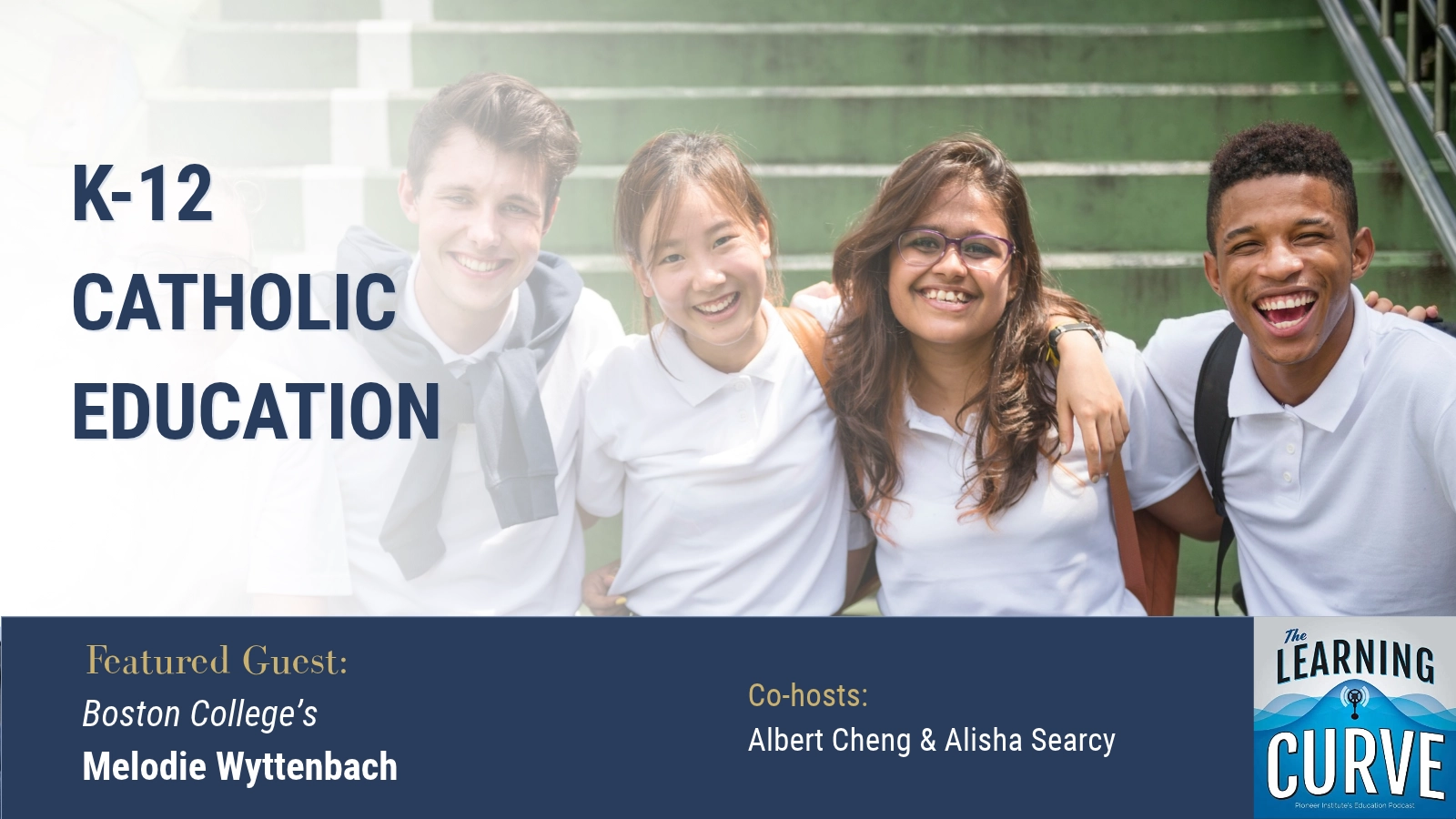
In this episode of The Learning Curve, co-hosts Alisha Searcy of the Center for Strong Public Schools and Prof. Albert Cheng of The Ohio State University speak with Dr. Melodie Wyttenbach, Executive Director of Boston College’s Roche Center for Catholic Education. Dr. Wyttenbach reflects on her career in Catholic schools leadership across the country and how Catholic education’s commitment to the true, the good, and the beautiful can foster a durable faith and sense of purpose in students. She examines the mission and operational realities confronting K–12 Catholic schools, including enrollment, governance, and labor costs, while highlighting promising models such as Cristo Rey’s work-study approach. Melodie considers how Pope St. John Paul II’s witness can help leaders connect faith with young people’s lives, and how a classical liberal arts foundation equips students to navigate modern challenges. Finally, Dr. Wyttenbach explores the expanding landscape of school choice, tax-credit programs, and ESAs, as well as what Pope Leo XIV’s papacy may mean for the future of Catholic education in America and worldwide for families and communities.
Stories of the Week: Albert shares an article from Chalkbeat on how Gov. Kathy Hochul of New York has opted into the Federal Tax Scholarship program. Alisha discussed an article from Washington Monthly on how it is time to teach high schoolers civics.
Dr. Melodie Wyttenbach is the Executive Director of the Roche Center for Catholic Education and faculty member for the Lynch School of Education and Human Development at Boston College. Prior to coming to Boston College, she served as an assistant professor and academic director of the Mary Ann Remick Leadership Program for the Alliance for Catholic Education at the University of Notre Dame. Melodie also has served as president of Nativity Jesuit Academy in Milwaukee, WI and director of mission effectiveness for the NativityMiguel Network of Schools in Washington, DC. Her published work includes Cultivating Talent: Examining Pathways to Increase the Presence of Hispanic Teachers and Leaders in Catholic Schools (2022), Seven Steps to Strategic Planning for Catholic School Leaders (2020), and Responding to the Call for Educational Justice: Transformative Catholic-Led Initiatives in Urban Education (2018). Melodie has a doctorate in educational leadership and policy analysis from the University of Wisconsin-Madison, and master’s degrees in educational administration from Marquette University and education from Mount Mary College.