

American Federation for Children's Patrick Graff on School Choice
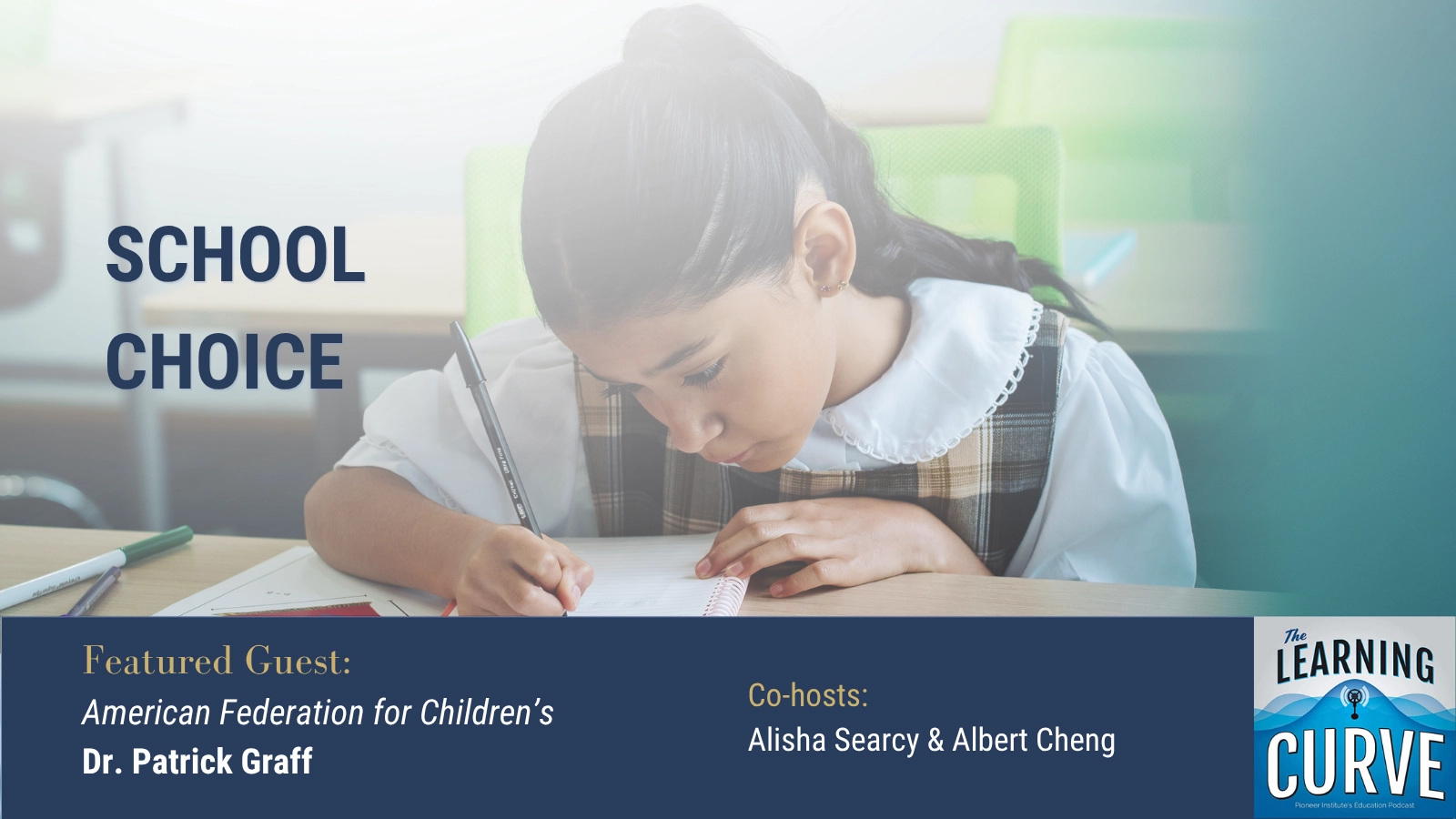
The Learning Curve Patrick Graff
Alisha Searcy: [00:00:00] Welcome back to the Learning Curve podcast. I’m your co-host, Alisha Thomas Searcy with Center for Strong Public Schools, joined by my other co-host, Dr. Albert Cheng from The Ohio State University. Did I get that right?
Albert Cheng: Yeah. You know, I’ve been learning the definite article, the Ohio S- … The is important, but then think I’m gonna get flack from all the audience who thinks it’s self-indulgent or something.
The Ohio State. Anyway, whatever. Eh, that’s fine. It’s a perennial topic for another discussion.
Alisha Searcy: Yes. Well, if it makes you feel any better, I feel like I’m starting to say I went to the Spelman College, so. We all think it’s our, you know, the ultimate institution, so it’s okay.
Albert Cheng: All right.
Alisha Searcy: But it’s good to be back.
And by the way, it is [00:01:00] September, and we have to acknowledge that as September 5th birthday buddies-
Albert Cheng: Oh, that’s right. Yeah …
Alisha Searcy: September’s a very important month for very important people. Virgos are amazing. So just special shout-out to any other September birthdays out there. And that’s something that Albert and I have in common, that we share the same birthday, and it’s just a special day and a special time, so happy birthday.
Albert Cheng: Well, happy birthday to you, too. Happy belated birthday to you.
Alisha Searcy: Happy belated birthday. Although, we must celebrate all month, but that’s a different conversation, too. So we’ve got a interesting show today. Looking forward to having on our guest, Dr. Patrick Graff. But before we get to him, we’ve gotta talk about the articles of the week.
What do you have, Albert?
Albert Cheng: Well, Alisha, you know, speaking of September, and just maybe a, on a more somber note, another thing about September is we just commemorated September 11th, the 25th anniversary of that. You know, so I caught an article from Chalkbeat [00:02:00] that featured how teachers teach about it. I thought it was just kind of fascinating to hear how s- teachers are doing it.
But, you know, I think what struck me most about the article is that while, one, wow, it’s been a while now. I still remember it, the day. And the thing that struck me about it was, wow, we have cohorts and cohorts and almost a generation of students that grew up after it. And I guess it just really struck me reading the article, uh, the question of how do we teach this- Mm
to students these days who were born after it is now an important question. And so anyway, I think I was just struck by the reality of that, and I think of course it raises the usual questions of how do we teach our shared history together. So anyway, I just maybe wanna flag that article, one, to acknowledge that day, but also to then get us to think about as we move forward this important task of conveying our, our nation’s history.
You know, not just 9/11, but everything else. You know, that’s part of our story, so.
Alisha Searcy: Yeah. You know, it’s so important, Albert. I’m glad you brought that up, first of all because we just need to [00:03:00] acknowledge 9/11. To your point, right, we cannot ever forget. And I think obviously there’s the importance of teaching our history, you know, part of American history, not forgetting those moments, the people who lost their lives and the families who have been grappling with that since.
But also just to remind us of a time that we came together as a country.
Albert Cheng: Mm. Do
Alisha Searcy: you remember that?
Albert Cheng: Yeah, yeah. I remember that.
Alisha Searcy: What a special time. So anyway, I appreciate that, and I couldn’t agree with you more. My article, speaking of teaching, is What They Teach Teachers in Grad School, an article in Real Clear Education.
So I have to tell you, this one was a bit challenging to my own thinking, and this article is about essentially a study that Daniel Buck conducted of the American Enterprise Institute, AEI, we all know that organization, who examined syllabi for programs at eight public [00:04:00] graduate schools of education across five states.
And he looked at master’s or certification programs that, quote, “Aligned most closely with an elementary teaching degree.” He writes, “Not programs that are overtly political.” One of the things that he is asserting in this particular article is that, as an example Of the 95 readings that Mr. Buck looked at, 45%, and we’re talking at the University of Wisconsin-Madison, which is ranked number one by US News and World Report in 2025, that 45% fell into his, quote, “critical category.”
That includes a report claiming that attacks on CRT, critical race theory, are part of a larger ideological effort to delegitimize historically accurate presentations of race and racism. And so I’m just gonna pause there at that particular point and tell you why this is a little bit challenging for me.
Number one, I actually do agree that [00:05:00] when folks are saying that you’re attacking CRT, that, yes, I do believe it’s a part of an ideological effort to delegitimize historically accurate information. We’re seeing it across the country. We’re seeing where even in the Smithsonian, President Trump has ordered certain exhibits to be taken down, and those are historical documents and facts.
And, you know, people need to know the history, even some of the ugly parts. And we just talked about that even with 9/11. And so what is shocking to me, according to this piece and according to this research that I’m looking forward to reading, is that even if it’s 45%, that a lot of the readings fall into what he calls critical or progressive or therapeutic.
And while I think educators who are in master’s and certification programs absolutely should be exposed to diverse thinking and perspectives, you would hope that most of their readings are around how to [00:06:00] be more effective teachers, right? Mm-hmm. And how to be more effective leaders. If I can separate my own opinions about, you know, what is happening in terms of the stripping away of teaching history and teaching civics, and just focus on the fact that we do need to have a conversation, and we do need to study, and I do think we need to…
I would even argue we need to have an overhaul of what education programs are teaching, whether it’s in the undergraduate level or the graduate level, because we want teachers and educators to be prepared, right? To go into classrooms, to go into schools, and be effective at what they do. The final thing that I will say, I finished my master’s program in, I think, 2015, ’16, somewhere around there, and I didn’t get any of this critical race theory, any…
There was no material, frankly, about race or any of that. And I went to a public institution for my master’s program. So that’s one school. My point is, I wanna make sure that we’re not misleading people [00:07:00] into thinking that across the country there is this over-representation, if you will, of racially focused progressive, you know, theology being pushed in our schools of education.
I don’t think that’s the case. I look forward to seeing this report. I haven’t done the research, but just on my personal experience and being in this space, it feels like that may not be accurate. So I’m very much looking forward to reading this report and seeing for myself.
Albert Cheng: Yeah. Well, Alisha, thanks for sharing your thoughts on it and wrestling with this, and this is a hot topic obviously, folks know, and I also saw the op-ed that came out of this.
And, you know, my position is that it’s an issue. The scope of the issue, I think we can all debate that. But, you know, I think my main takeaway with this is I wanna go back to one of the points you made, which is should we be reading things to bolster teachers’ content knowledge and prepare them to be a more effective teacher?
I mean, we, we talk about science of reading, for instance, quite a lot on this [00:08:00] show. Yeah, how much time in these teacher training programs are we spending on equipping our teachers to do that well? And so, you know, what’s the right percentage? Yeah, I think we can debate that, and, you know, I’m with you.
Higher ed needs to be the place where you can wrestle with different ideas and-
Alisha Searcy: Yes …
Albert Cheng: lean into viewpoint diversity and, and all of that for the sake of making us better thinkers, more rounded folks. I keep coming back to the point you made. To what extent are we focusing on preparing teachers to be the most effective with delivering the necessary content?
So anyway- Yeah … yeah, lots of questions, and I think- Yes … lots more discussion to be had on this report.
Alisha Searcy: Yes. And as always, love having these conversations and talking about these articles, so thank you. When we come back, we’ll be on with Dr. Patrick Graff, who is a senior fellow at the American Federation for Children.
Dr. Patrick [00:09:00] Graff is a senior fellow at the American Federation for Children, the nation’s largest school choice advocacy organization. At AFC, he advises the government affairs team on school choice policy design, legislative strategy, and education research. Dr. Graff has previously worked in the education field as a teacher, administrator, policy advisor, and researcher since his first year as a third grade teacher in 2011.
He received his PhD in sociology from the University of Notre Dame. Patrick, welcome to the show. We’re happy to have you.
Patrick Graff: Thanks for having me.
Alisha Searcy: So I wanna start, if you would just tell us about your background. Talk to us about your formative educational experiences, how you became interested in K-12 education policy.
Patrick Graff: So I grew up in California, just outside Sacramento, and had a great K12 experience and felt called to the Midwest. A lot of people thought I was crazy for leaving California, and I understand where that’s coming from. Uh, but I, I, I love the Midwest, and I’ve been here ever since. [00:10:00] So I live in South Bend, Indiana now.
And for a couple years in between following college, I taught in a K8 school down in Tampa, Florida, and it was a K8 Catholic school, which was the kinds of schools that I went to growing up in California, and was able to kind of experience firsthand something that we’ve never had in California, which is a tax credit scholarship program.
So Florida has now the largest set of school choice programs across the country. It has… They have over 500,000 kids enrolled across their several ESA programs, these education savings accounts programs. But at the time, it was a scholarship program just for very low-income students, students attending failing schools that would have the possibility of transferring into a private K8 if their parents so chose, if they were able to snag one of the limited scholarships available.
And so I kind of got to see that as a young teacher firsthand. The third-graders in my class, about a third of them received tax credit scholarships to be able to attend our school, and that really kind of lit a fire under me to [00:11:00] pursue education policy. So I got really interested in research and policy as a result of talking with their parents and seeing the ways in which those students thrived in our small Catholic school community there.
And eventually came back to Notre Dame here in Indiana and studied with a researcher who has done some large-scale evaluations of voucher programs, in particular the Indiana Choice Scholarship Program here in Indiana. So worked on a couple of those projects, got really involved in education research, and now work in school choice policy full-time with the American Federation for Children.
We’re the largest school choice advocacy organization across the country and really seek to expand opportunities for students across every school type for them to receive the education that best fits them. So that’s how you find me today.
Alisha Searcy: Thank you for that. I wanna talk about your teaching experiences for a second.
You mentioned teaching in Florida. Can you talk about how your teaching experience really influenced… And you talked a [00:12:00] little bit about that in terms of the students that you taught and the ones that you went to school with, but talk to us more about the teaching part of that and some of the broader issues that you’ve worked on within education policy.
Patrick Graff: You know, I really developed a passion for teachers and teaching research, research on teachers following my time in the classroom. Because as anyone who has taught knows, your first couple years of teaching are very tough. A lot of sleepless nights. If you care about the job, and I certainly did, you feel a deep responsibility to your students.
I had a, a room of 28 third graders running around, and their educational world was largely me, and a pretty formative year when we’re learning to read, we’re starting to discover new texts. So I love teaching reading. I also had the gift in our school, I taught a religion class. That was really interesting as a young college graduate, being able to just dive into answering questions about the students’ faith and what they’re bringing from home, their home culture and values, and bringing that to school, and be able to talk about [00:13:00] those things in the classroom.
I actually found that really inspirational and deeply moving, and that really inspired a lot of my future work as well. I, both on the teaching side, when I was in grad school, I actually did a lot of research on teachers in Indiana, particularly new teachers, and forms of support for new teachers. So I’ve written a little bit on that.
But on the other side, on the school choice side, and there’s this beautiful quote from a principal that we interviewed with the Indiana Choice Scholarship Program that actually really resonated with me and my experience at my school in Florida, where he was talking about when their school joined the Choice Scholarship in Indiana for the first time, they had all of these students who were only able to attend because of this Choice Scholarship.
And this happened to be a school that was previously about 85, 90% white, despite the fact that about half of their parish population was Hispanic and Spanish-speaking. And so they had this full Spanish mass coming on Sunday afternoons, but many of those families weren’t able to afford the tuition to attend the school until [00:14:00] the Choice Scholarship became a reality in Indiana.
And, you know, his statement to me was, “For the first time, our school looks like our parish.” And that was not something that was a possibility before then, but it really felt to him as a school leader that he was serving the whole community for the first time, and that everyone could be a part of that community institution.
And I felt that really powerfully in Florida as well. We had, in my class, students from families all across the Caribbean and South America, Cuban, Haitian, Dominican Republic, Colombian descent, second and third generation. And those cultures were just such a huge part of that school community, and obviously the Catholic faith of many of those families was also super present.
So all of those pieces were really formative to me, both on the, you know, teacher education side, but also on the school choice side.
Alisha Searcy: Yeah. It’s so interesting, Patrick. I grew up in Florida and, and a product of public school choice in Florida, and so I feel like they’ve been at it for a long time and have figured this out.
Now [00:15:00] I’m in Georgia, and as I look at our current ESA program, it’s got a lot of problems. And one of the challenges that I’m noticing, and I would love for you to talk about this, help me to understand, it looks like the only schools that are accepting students are very, very small. Their tuition, you know, is around the $6,500 amount that the parents get, and the quality isn’t there, and they’re not able to really serve kids who are really high needs, because the kids who are in our state, the kids who are eligible, are coming from the lowest performing schools in the state.
Yeah. And so as you’ve done this work around the country and you talk about this beautiful story in Florida, and I know, you know, how well some of their choice programs work, in places where it’s not working as well, what do you see as the challenges? Is it policy? Is it practice? What’s happening that is causing those programs not to work as [00:16:00] effectively?
Patrick Graff: Yeah, Alicia, that’s a really insightful question because one of the amazing things about being in the role that I am in now, where I get to advise our team on school choice policy design, I love questions like this because when you look across the history of some of these older programs, Florida included, even my state of Indiana, we had a very similar setup to the Georgia Promise Scholarship in the early years of the Choice Scholarship Program here, where it was very limited, very income-targeted.
But I think most importantly, and I think mostly to the detriment of the program, it restricted most of the transfers from so-called failing schools, right from the, the public school districts. And I actually think that that label and that stigma is very detrimental to program success. So for the Promise Scholarship there in Georgia that you’re speaking to, that is one of our main priorities for the state of Georgia, is to get out of that, you know, what has been called a failing school model bill for private school choice.
From the… And you would know this as, from, from the perspective of a legislator, it’s [00:17:00] very attractive at a rhetorical level to say, “Hey, we’re gonna, we’re gonna save these kids from failing schools. We’re gonna give them opportunity for a chance to get out.” But I think on the flip side, it really doesn’t speak to the realities that these families are often seeking out or where they’re coming from.
That failing schools label is only as good as your school rating system, which are wildly inconsistent across states, and as Albert would know, as a researcher as well, that, that often does not really capture school quality in an important way. And then even within schools, you have kids that, that are seeking out choice for all kinds of different reasons.
It’s not just that maybe their test scores are a little bit lower than they would be in a different school, although we believe that’s really important. But on the flip side, they might be getting bullied. They might be having severe mental health issues. Their family might be going through a traumatic time, and they need a different school option than the one that they’re zoned for.
There’s, you know, there’s a whole multitude of things outside of just the pure academic piece, which is what the program is designed around. And then on the participating school side, it [00:18:00] creates a lot of challenges for principals, school leaders, system leaders to jump into a program when all of the kids are labeled, I think incorrectly, as coming from a failed school.
I don’t think any private school is really jumping, or parents of those private schools are jumping to say, “Hey, let’s bring in as many kids from failing public schools as possible into our private school.” When in fact, a lot of those kids would be amazing assets to those schools, but the labels really get in the way of it.
So I totally agree. I think that that is something that we should continue to update, and I hope Georgia learns of the lesson that we’ve learned in many other states, I think Louisiana and Indiana included, who have gotten rid of that model and has actually opened up a ton more private school supply, and especially high-quality private school supply
Alisha Searcy: Thank you.
I appreciate that perspective. One more question before I turn it over to Albert. You recently wrote a report about comparing the impacts of increasing school spending and increasing school competition through school choice. So can you talk more about that? And one thing that I’ve [00:19:00] noticed that you said is that this is not a zero-sum game.
Help us understand what you mean by that
Patrick Graff: Yeah, I think this report really came out of my experience talking to parents, both in the private school and the public school world, sitting through legislative committee hearings, and just hearing the same old battle happening again and again, which is folks that are for school choice would get up and say, “This is such an important opportunity.
Parents need this option, especially the lowest income families who otherwise wouldn’t have an option except for these school choice programs.” And then on the other side, you’d have public school advocates who would understandably wanna do the best by the children in their schools and say, “We need this additional funding.
You should not be funding school choice programs. If you fund these school choice programs, you’re gonna hurt public school kids.” And that plays out in so many state houses across the country. And knowing a little bit about the research in both of these areas on both, you know, what happens when you scale up school choice programs to public schools in a state, and also what [00:20:00] happens on average when you decide to make these big increases to public school spending in states, and what are the effects of that?
And, you know, I thought we should really put these research literatures head-to-head, which is what I did in this report. And I think it kind of reveals, interestingly, some counterintuitive findings that, you know, in fact, these approaches are not necessarily opposed to one another, and I actually think it calls for a little bit more nuance in when and where we attend to one versus the other.
But, you know, the headline finding basically looks at the most recent large meta-analysis on school spending. So this is one of the most rigorous combination of 31 of the highest quality studies on school spending across the country done by Grabow Jackson and a co-author, published in a top economics journal, basically looking at, yes, when you spend more money, $1,000 more per year per public school student, you’re gonna see a little academic gain out of that.
But I think the challenge for the school spending [00:21:00] research writ large is that when you try to bring that to any kind of scale, the effect sizes, the impact of that additional funding is very small for how much you have to spend. And so my question is always, there’s gonna be trade-offs, what are some of the most cost-effective ways to spend more for education?
And if you’re talking about maybe some of your lowest income districts that have been chronically underfunded, a very targeted increase in spending for those districts or for particular schools within those districts might have a lot bigger impact than just kind of spreading funding across the state where a lot of well-funded schools, perhaps in wealthier property areas, are just getting additional dollars from the state education budget.
So there’s a lot of variation within that. But on the flip side, I looked at one of the most rigorous studies of private school competition from the state of Florida Well-renowned economics professor David Figlio looked at the tax credit scholarship. I think it’s funny ’cause my kids were actually a part of this study during this period.
But from the beginning of the program in 2003 up till [00:22:00] 2017, he looked at what happened to the public schools in areas of higher competition, where this tax credit scholarship program grew from 15,000 kids to over 100,000 enrolled on these tax credit scholarships. You know, a lot of folks that were a part of the debate at the state capitol in Tallahassee back in 2003 would tell you, “Well, these public schools are gonna get devastated.”
You’re taking this funding, you’re now allowing these students to take, you know, three to four or $5,000 scholarships at the time and go take that to a private school instead of that public school receiving that funding. And to the contrary, he actually found that over this longer span of time, over 15 years, that the public school students in those higher-competition areas grew by more than 120 days’ worth of learning, and it was actually even a higher effect for low-income students.
So they gained 140 additional days as compared to public school students in lower areas of competition. And so I really just kind of put those effect sizes head-to-head and just said, “Hey, let’s run an experiment, a [00:23:00] hypothetical.” What’s the counterfactual? If you go back in time and you talk to those legislators in 2003 and say, “Hey, we shouldn’t spend, over the course of the coming 15 years, we shouldn’t spend that cumulative $2.8 billion on the tax credit scholarship.
We should spend it on public school spending increases instead.” How much good would that do according to the best school spending research were those public, same public school students? So apples to apples, you’ve got the same amount of funding, the same public school students in those high competition areas in that same time period.
And basically what I found is that in order for the school spending approach in Florida to have had the same effect as just boosting competition through the tax credit scholarship, the state of Florida would have had to have spent nearly $32 billion over that same 15-year period, as opposed to the 2.8 that they spent on the s- tax credit scholarship program.
So far more cost-effective to create some systemic change by changing the incentives of how schools were responding [00:24:00] when parents felt like they weren’t doing a good job educating their kids, and there was an, an outlet for some of those kids to switch schools. And this wasn’t a mass exodus from public schools, but, you know, there would be a handful of kids leaving to take advantage of this tax credit scholarship.
So my basic takeaway is I don’t think that funding school choice, especially in a well-designed and responsible way, is a zero-sum game. I think that this can benefit public and private schools. You’re gonna give opportunity to these families who need it, while at the same time creating an environment where public schools have to work hard to maintain their students and work hard for them and demonstrate to parents that they’re providing value for them.
Particularly in five, 10, 15% of cases, there are public schools that, you know, there are teachers who are kind of content with, you know, the status quo is the status quo, we’re never gonna change anything. I think that that attitude just needs to be ripped out of education, and part of the way to do that is to light a fire under both teachers and system leaders, and I think this competitive landscape is a piece of it.
So [00:25:00] I found that this was a really cost-effective way to improve educational outcomes at scale, and I think it’s actually part of the explanation of why Florida is among one of the lower spending states per pupil across the country. They spend around, now it’s around $15,000 per pupil per year in the public school system when the national average is closer to 20, and yet they’ve consistently been in the top 10 in terms of academic outcomes.
I think that contrast really shows you that school spending can help, especially if it’s used well, but it has to be deployed into a system that is working well. If you’re pouring more funding into an inefficient, broken system, you’re not gonna get those same results. And there have been other states that have tried that and, and, you know, unfortunately, some of those have ended up with even worse outcomes despite spending more.
The connection is not as neat as a lot of people might automatically assume.
Alisha Searcy: Thank you.
Albert Cheng: Well, thanks, Patrick, for walking us through that analysis. It’s pretty clarifying. I really felt like I understood something a bit better here. But I want to pivot to another report that you recently wrote on the Education Freedom [00:26:00] tax credit.
So this is the federal tax credit program. In the report, you provide your own estimates of how many students are eligible for it. So wh- why don’t you start by giving us the top line findings, just how many students are eligible?
Patrick Graff: Yeah, so this is the new federal education tax credit that I know that you all have talked about on the program before here.
And, you know, we knew this was gonna be open to a lot of K12 children across the country. This is a school choice scholarship that is open to public, private, charter, and in some states, homeschool students, which was also kind of a big part of my report. And we, up to this point, really didn’t know precisely state by state kind of where the eligibility line fell.
So I kind of went through and applied parts of the law that talk about the income limit, which is at 300% of the area median income, which is a very high income limit. You know, it’s about 90% on average in a given state that will qualify, and actually, [00:27:00] across the whole country, on average, 91.7%, about 92% of kids are eligible to receive a scholarship under the Education Freedom Tax Credit.
And that comes out to about 51.7 million K12 students. So this is a broadly available, accessible scholarship program, and on the flip side, it’s now gonna be up to donors to donate to scholarship organizations and receive that dollar for dollar federal tax credit of up to $1,700 to help provide some of that opportunity for kids.
And, you know, part of what I wanted to estimate here as well is I know you’ve talked about on the program that there are 31 states that have opted into this program, so it requires a governor or a state to opt in. The 31 that have signaled their intent to opt in or have signed the paperwork, and, you know, that’s home to 31 million eligible students, but there’s still about 21 million eligible students that are waiting on the sidelines.
So these remaining 18 states and DC that have not yet decided whether they’re gonna join or not, that’s, you know, 21 million eligible [00:28:00] students that are waiting there. So trying to qualify both the scale of the opportunity for families as well as the need for action on these states where, you know, there’s really a lot that could be done by allowing students and scholarship organizations in their state to participate.
Albert Cheng: Well, thanks for that. So just to maybe clarify, right, so y- you’re assuming about 50, 51 million students eligible, but once you factor in how many states have actually opted in, that number goes down to about 30, and another 20 are kind of on the sidelines until the state- That’s right. Okay. Now, you mentioned in your report another gate, I guess that’s the word you used, and that gate is how each state defines what a school is.
So talk to us about that. How does that affect eligibility?
Patrick Graff: Yeah, this is a really interesting wrinkle of the federal tax law. So this is a tax credit that’s run through the Department of Treasury and IRS, so this is not a Department of Education program. This is a tax credit. And, you [00:29:00] know, the Treasury right now is working on rules for this program, and we’re hoping to see those rules by the end of the month, so we actually should get some news on this in a couple weeks if all goes well.
But we received some preliminary guidance from Treasury officials that said, in the law it talks about you can only provide scholarships for expenses in connection with enrollment at a primary or secondary school. So this needs to be a public, private, or religious K-12 school in the United States. And interestingly, there are quite a number of states that define homeschool students as attending a school under state law, and Treasury has deferred to state law for the definition of what a school is.
And so there are 22 states, according to the HSLDA, which is a large national homeschool association, that they believe that homeschool students have a path to participate and would be eligible students under state law. But that remains… You know, there’s another 28 states where homeschool students are not categorized that way, and there isn’t a clear path for them to [00:30:00] receive scholarships.
So, you know, I thought this was a very interesting, in some ways, inconsistency in the law, at least at the federal level, because they’re really deferring down to how states categorize students, but obviously never had this tax credit in mind when they were thinking about those definitions. You know, I’ve already been hearing from different homeschooling groups in different states trying to think about, you know, what are ways that we might be able to get engaged or become eligible.
You know, we’re still waiting on regulations, so this could change, but as it stands right now, this is kind of where the homeschool families are at.
Albert Cheng: Great. Thanks for clarifying that as well. So for my next question, I just want to step back and get a sense of what the scale of the opportunity is here.
You’ve given us some numbers and some wrinkles with how we actually estimate the size of the, the eligible population. What’s your read on how big of an opportunity this is?
Patrick Graff: I think it’s a lot larger than we originally believed. So when the law was first passed, there were some really helpful early estimates put out by Education Reform Now, which is affiliated [00:31:00] with Democrats for Education Reform.
And they went through state by state and put out estimates basically calculating how much money could be raised within your state if, let’s say, 10, 20, or 30% of taxpayers participate. It’s been a couple years since those numbers have been updated, and then there was also a, a recent wave of IRS tax data that was released.
Very exciting for us researchers. Uh, so I dove into the tax data over about the past, uh, month and a half, and last week had a new report following up on the student eligibility report on who can fund these scholarships, how much money could potentially be raised by independent donors deciding to give to their local scholarship organization to help fund scholarships for things like tutoring, special education services, tuition, and even transportation, and that can be a huge need in a lot of areas And basically what I found is that there’s a much l- larger universe than we originally thought of tax filers who have federal tax liability and could give.
So it’s 120 million [00:32:00] taxpayers owe some federal tax liability. Over 100 million of them owe the full $1,700. That’s about three in four tax filers who would be able to give. That’s quite a n- number of folks who would be able to support education instead of sending that money to Washington. And updating all of these estimates for tax year 2027, kind of bringing forward the tax brackets, everything else, there is potentially, even at pretty modest levels of participation, so let’s say 5% of tax filers participate, uh, which I think is definitely achievable given the track record at the state level for these types of scholarship programs.
That’s $9.4 billion for education across the states. And to put that in perspective, I mean, that’s more than 10% of what the federal government spends on education already every year. If you were to reach 10% participation, I estimate that would be about $18.8 billion. That is more than every single charitable deduction [00:33:00] and credit that is already given for education across the country.
I actually think that this is a lot more significant than maybe people originally realized, and I actually hope that a lot of average, everyday working Americans will give to this. I think there’s actually methods to do that in a way where you don’t have to give a big lump sum all upfront, and I know a lot of scholarship-granting organizations are working really hard to make that possible.
So it’s not just going after rich guys like your traditional education philanthropy. Anybody who has tax liability could give to this.
Albert Cheng: Yeah, let’s see how it pans out. You know, early on, folks were pretty bearish when they were thinking about, you know, the size of the credits that had, you know, gotten lower during the legislative process.
But you seem to be much more optimistic despite some of those setbacks. Patrick, I want to close with one more question, and I want to ask you to look into the future here. What should we be watching for next with this tax credit program? What ought we to be paying attention to?
Patrick Graff: I think a big one is [00:34:00] those remaining 19 states that haven’t opted in yet.
It’s three months until we get to 2027 when this new tax credit begins, and I know that there’s a number of other Democratic governors in particular who are really weighing the pros and the cons and really seeing just how many pros there are and how few cons for opting their state into this new federal tax credit for education.
I don’t know. We’ll see if you can call me back and hold me to this, but I think we’re gonna get close to 40 states by the end of the year. I’m hopeful for that. I don’t wanna be too rosy, but I like being an optimist. I actually believe that a lot of them are starting to realize that this will be a huge benefit to public school students, as well as students across other sectors who could really use these scholarship dollars.
Albert Cheng: Well, you know, 2027 is not that far away, like you said, and I guess we’re gonna see how this all unfolds and how accurate your predictions were. So anyway, Patrick, thanks for being with us on the show to talk shop.
Patrick Graff: Yeah, absolutely. Yeah, thank you for having me.[00:35:00]
Alisha Searcy: Well, Albert, that was a great conversation with Dr. Graff. He’s really good, really interesting perspective, particularly, of course, on his earlier career in education and studies, but also, of course, talking about the tax credit scholarship, so good interview.
Albert Cheng: Yeah, yeah, yeah. No, I’ve known Patrick. I’ve seen him on the conference circuit, seen him present his research.
But, uh, it was cool to hear the more personal side of his story.
Alisha Searcy: Indeed. Well, before we go, of course, we’ve got to do the tweet of the week. This week it comes from Chalkbeat, “The Rise, Fall, and Possible Future of High-Dosage Tutoring.” We all know what a big policy recommendation requirement that came out right after COVID to try to catch kids up.
A lot of states put a lot of funding, federal [00:36:00] government put a lot of funding in high-dosage tutoring, and it looks like based on this article that some of it worked, some of it didn’t, and of course we know why, right? The things that you fund effectively and hire effectively will work, and the things that you don’t won’t.
Make sure you check out that article in Chalkbeat. Really interesting information and just a reminder of what you measure matters. Make sure you join us next week. We’ll have on with us Paul Gillingham. He is Professor of History and Director of Graduate Studies at Northwestern University and the prize-winning author of Mexico: A 500 Year History.
Albert, always great to be with you.
Albert Cheng: Likewise. Yeah, we’ll see you next week.
Alisha Searcy: See everybody next [00:37:00] week
In this week’s episode of The Learning Curve, co-hosts Alisha Searcy of the Center for Strong Public Schools and Prof. Albert Cheng of Ohio State University speak with Dr. Patrick Graff, senior fellow at the American Federation for Children. Dr. Graff discusses his journey from teaching third grade in Florida to working as an education researcher and policy advocate, and how seeing students benefit from tax credit scholarships shaped his interest in school choice. He explores the design of school choice programs, including how restrictive eligibility requirements and “failing school” labels can limit access and private school participation. Graff also discusses his research comparing increased public school spending with greater school competition, sharing that school choice can benefit both public and private schools while improving educational outcomes cost-effectively. Finally, he examines the new federal Education Freedom Tax Credit, its broad student eligibility, potential to generate billions in scholarship funding, state participation, and what to watch as the program takes effect in 2027.
Stories of the Week: Alisha discusses an article from The Wall Street Journal; on what teachers learn in graduate schools of education. Albert shares a piece from Chalkbeat on how New York educators are navigating teaching the 25th anniversary of 9/11.
Patrick Graff is a senior fellow at the American Federation for Children (AFC), the nation’s largest school choice advocacy organization. At AFC, he advises the Government Affairs team on school choice policy design, legislative strategy, and education research. Dr. Graff has previously worked in the education field as a teacher, administrator, policy advisor, and researcher since his first year as a third grade teacher in 2011. He received his Ph.D. in Sociology from the University of Notre Dame.