




November 11, 2026
Comparing Florida’s Elementary Academic Performance To National Trends

Florida has made substantial progress in improving education access over the years. In the last two decades, the state has rapidly expanded school choice programs, launched the nation-leading Florida Virtual School, and opted to strengthen its curriculum standards through the Benchmarks for Excellent Student Thinking (B.E.S.T.).
But greater options and access to education must also provide improvement in student outcomes to be successful. While the state has made some progress over the last couple of decades, data show there is still room for growth. To better understand the current state of education in Florida, Pioneer analyzed data provided by Step Up For Students along with data from the state Department of Education and National Assessment of Educational Progress (NAEP) data over the last few decades.
Florida District School Enrollment Is Falling
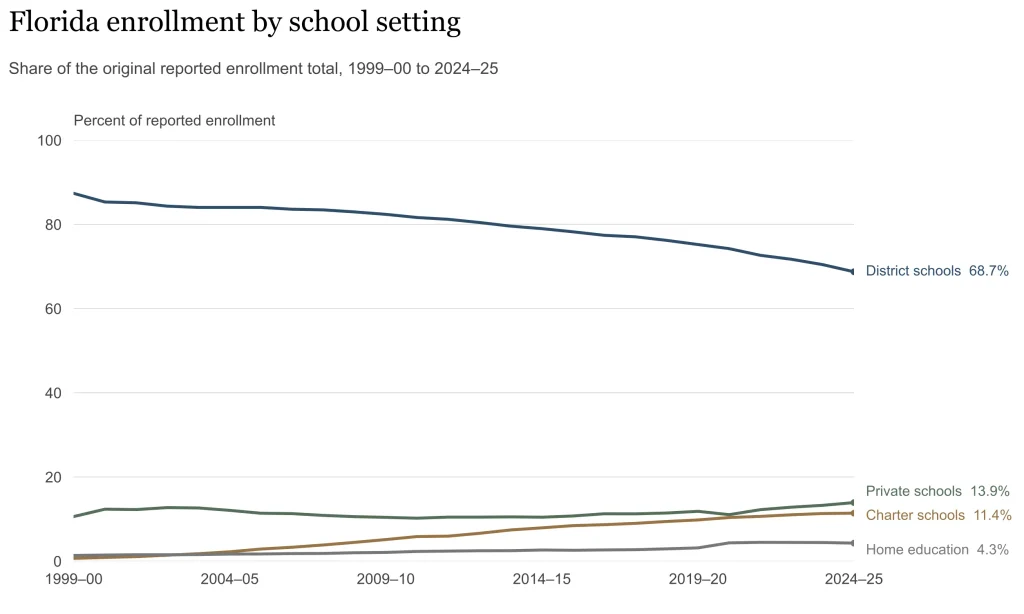
The latest state Department of Education data on Florida student enrollment shows families are choosing different types of schools than they were two decades ago. Back in the 2004-2005 school year, roughly 84.0% of Florida’s students attended district schools. In the 2024-2025 school year, that share is down to roughly 68.7%.
At the same time, the share of students enrolling in non-district schools is on the rise. Roughly 13.9% of Florida students attend private schools, up from 12.1% twenty years ago. Charter school enrollment has increased five-fold, from 2.2% in 2004-2005 up to 11.4% in 2024-2025. Those opting for home school also nearly tripled during this period, from 1.7% up to 4.3% in 2024-2025.
Fourth and Eighth Grade Results Are Mixed
While Florida has made curriculum reforms over the last two decades, student academic outcomes are still a mixed bag.
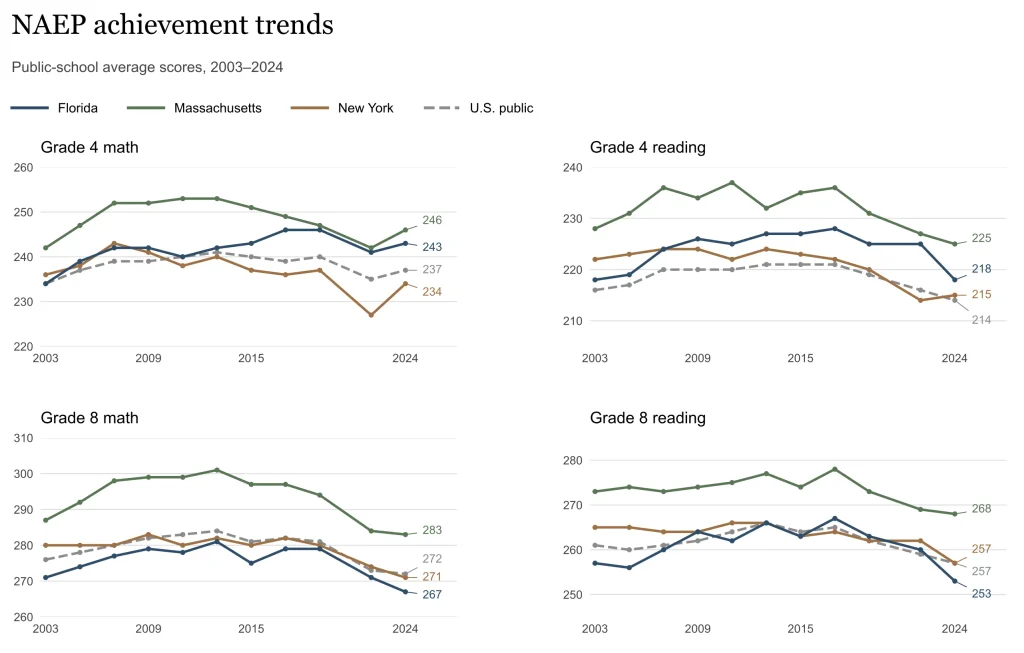
According to National Assessment of Educational Progress (NAEP) data, fourth-grade math scores were on the decline for the last several years, following a roughly similar trend to national average scores for math and reading. But the latest round of average Florida fourth-grade math scores in 2024 ticked up from the previous assessment, from 241 in 2022 up to 243 in 2024. Fourth grade reading scores, however, continued in a downward trend, dropping from 225 in 2022 to 218 in 2024. Both Florida’s average fourth grade reading and math scores remained above the national average in 2024.
For eighth grade scores, Florida’s performance is more concerning. The state falls below the national average in both subjects, which saw declines again in the 2024 assessment, continuing an existing downward trend. Eighth grade math scores dropped from 271 in 2022 to 267 in 2024, and reading scores dropped to 253 in 2024 from 260 in 2022.
Comparing Florida’s Performance Nationwide
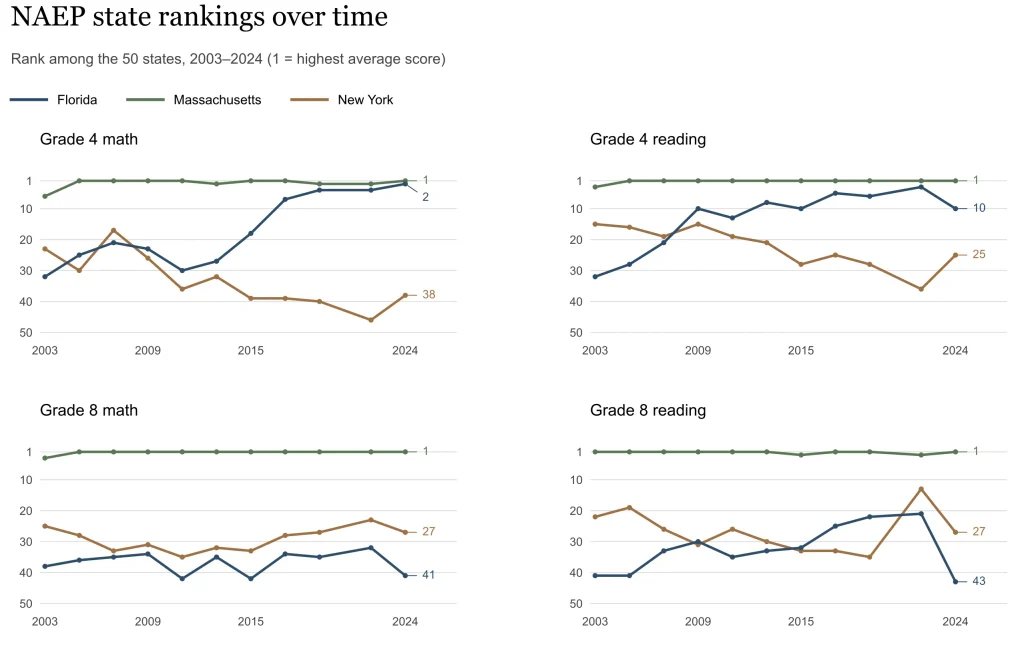
Although average scores have fluctuated over the years, the state remains ranked above the national average for both fourth grade math and reading.
In fact, in the latest NAEP assessment, Florida ranked second best in the nation for fourth grade average math scores, only behind Massachusetts. Two decades ago, fourth grade math scores ranked in the bottom half of states (#32 in 2003). For fourth grade reading, Florida has also improved to being tenth in the nation as of 2024, up from 32nd back in 2003.
Once again, these significant gains in elementary student achievement seem to be erased by the time students hit eighth grade. Florida eighth grade math rankings worsened over the last two decades, going from 38th in the nation in 2003 down to 41st as of 2024. Eighth grade reading score rankings fell to a historic low, down to 43rd in 2024, compared to a previous low of 41st in 2003.
Florida Schools Are Supporting Students of Different Socioeconomic Backgrounds
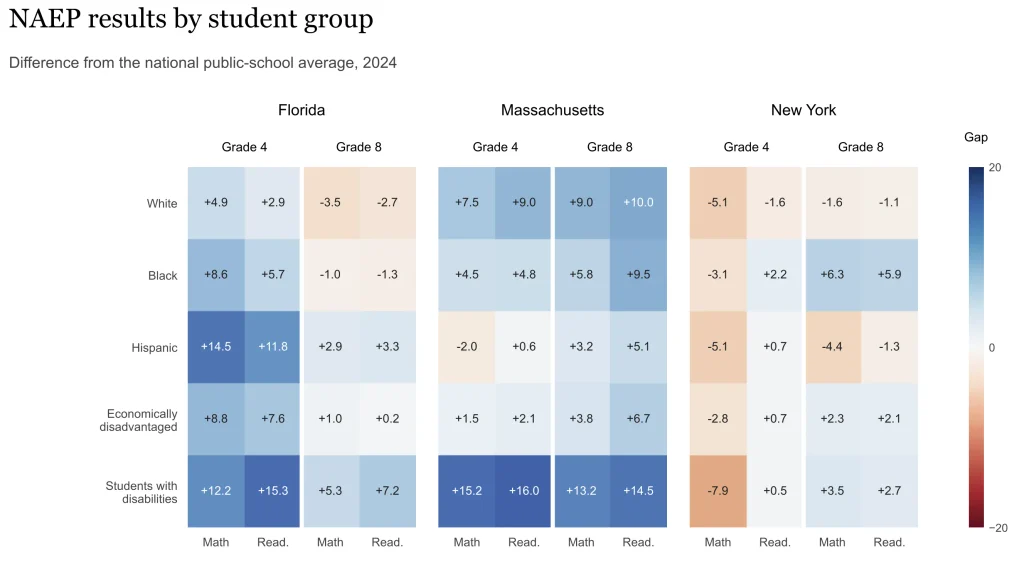
While overall scores and rankings may be showing some cracks in Florida’s education performance, the current district school system is making strides in serving various student groups with different socioeconomic backgrounds.
Even despite falling behind Massachusetts in terms of overall student achievement scores, Florida is outperforming Massachusetts, New York, and the national average when it comes to Black, Hispanic, and economically disadvantaged students’ scores at the fourth-grade level. However, when many of these students get to eighth grade, many see higher achievement levels in Massachusetts or New York.
Florida’s Hispanic students, economically disadvantaged students, and students with disabilities are performing marginally better than similar students nationally at the eighth-grade level, but outcomes for Florida’s Black and White eighth grade students are falling below the national average.
Conclusion
Florida has made significant gains in creating schools with better academic outcomes for its students over the past few decades, particularly for elementary students. But there is still work to be done.
Fourth graders are performing historically well in core subjects like math and reading and have some of the best average scores in the nation. But those top scores are lost by the time students get to eighth grade, leaving room for the state to continue to improve its school standards.
Related Publications


October 1, 2026
Federal Scholarship Program FAQ

August 31, 2026