
Uncategorized

October 22, 2026

Massachusetts’ Declining Unemployment Rate is the Result of a Shrinking Labor Force

At first glance, the latest unemployment numbers for Massachusetts look like good news. The state’s unemployment rate fell to 4.3 percent in August, its lowest level since March 2025 and down from a recent high of 4.8 percent in February, according to data released September 18 by the U.S. Bureau of Labor Statistics. But a falling unemployment rate doesn’t always signal a stronger labor market. A closer look shows that Massachusetts employers are still cutting jobs, and that unemployment is falling mainly because fewer residents are working or looking for work at all.

October 21, 2026

Question 5: Let Government Grow, but Not Faster Than Your Paycheck

Question 5 restores a taxpayer protection Massachusetts voters approved in 1986: State tax collections can grow, but not faster than the wages and salaries of the people who fund government. When collections exceed that limit, the excess must be returned to taxpayers.
October 20, 2026

Question 1: Public Records You Can Access in Florida and Colorado—but Not Massachusetts

Let’s dig into Q1 and, as always, be sure to read the official 2026 Massachusetts Voter Guide. Let’s start with the basics: The background on this issue does all the talking: States across the U.S. subject their elected officials to public records...
October 1, 2026

Federal Scholarship Program FAQ

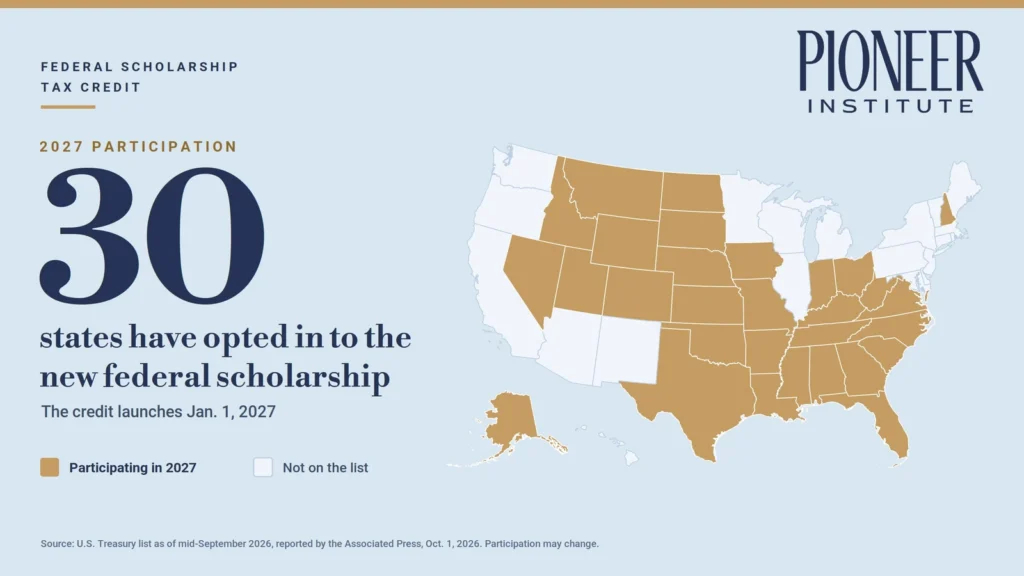
Beginning in 2027, the new federal Education Freedom Tax Credit will allow taxpayers to receive a federal income-tax credit for contributions to Scholarship Granting Organizations, or SGOs. Those organizations will use the contributions to provide scholarships for eligible K–12 students. The program...
September 14, 2026

Through July 2026, Massachusetts Home Construction Pace was Roughly in Line With 10-Year State Goal

This edition of The House Call compares Massachusetts home construction data to the state's 10-year housing production goal and the construction pace in other states. It also tracks the accelerating pace of accessory dwelling unit permitting in Massachusetts since the beginning of 2025.
September 10, 2026

Solving the Permit Puzzle

Despite recent statewide reform efforts, residential permitting in Massachusetts remains slow and unpredictable. As housing costs push families and employers toward lower-cost states like New Hampshire and Rhode Island, cities and towns don't have to wait for Beacon Hill to act. Much of the delay and added cost happens out of public view, in the back-office interactions between applicants, staff, and volunteer board members that occur long before any public hearing.
September 2, 2026

Reforming Massachusetts' Ballot Initiative Process

Massachusetts has one of the most restrictive ballot initiative systems in the country. So why are lawmakers considering new barriers instead of fixing what's broken?
September 1, 2026

Big Hospitals, Small Charity: The 340B Accountability Gap

The federal 340B program was introduced to aid safety-net hospitals – institutions that serve a disproportionate share of low-income patients – through access to heavily discounted drugs at the manufacturers’ expense. The program has grown into a $100 billion enterprise, surpassing Medicaid...
August 31, 2026

When Education Philanthropy Loses Focus

What is it about education that causes otherwise disciplined people from business and philanthropy to forget the very lessons that made them successful? Focus on the core business, measure results, and change course when something isn't working. Yet in education there is a recurring temptation to broaden the mission, multiply the objectives, and assume that addressing more of the problems surrounding children will eventually produce better academic results.
August 26, 2026

Massachusetts Should Stop Taxing the Trucks That Deliver Its Goods

A conference committee is deciding whether Massachusetts remains the only New England state that taxes rolling stock at its full sales tax rate, with no exemption and no limit. The House version of the Mass Ready Act would exempt rolling stock (the trucks, tractors, and trailers common carriers use to move goods in interstate commerce) from the 6.25 percent sales and use tax (H.5518, Sections 22A through 22D).1 The Senate version contains no such language.2 The House passed its bill 151 to 0.3 The conferees should keep the House provision and take an easy step toward making Massachusetts more competitive.